Saturday, 5 July 2008

Prayer of Abandonment


Lord, I abandon myself into your hands, do with me what you will. Whatever you may do, I thank you. I am ready for all, I accept all. Let only your will be done in me and in all your creatures. I ask no more than this, O Lord. Into your hands I commend my soul; I offer it to you with all the love of my heart. For I love you Lord, and so need to give myself, to surrender myself into your hands without reserve, and with boundless confidence, for you are my Creator. Amen. (From Charles de Foucault)

Friday, 4 July 2008

Baptism and Emptiness

Baptism is the sacrament of hypostatic union, or the hope of it. That is,

· We are brought face to face with our inability to save ourselves (we receive in baptism what by nature we cannot receive)

· But remain manifestly human afterwards

· Living now in direct relationship with Christ,

· And receive the Spirit of Jesus to be his disciples


Whatever else we might want to say about baptism, it is the rite where we are brought face to face with our own need and God’s desire to fill that need through Jesus Christ: God responds to our failure and emptiness with the grace of Jesus Christ by filling our emptiness with the Holy Spirit. Baptism is the rite that celebrates the iconic identity between Christ and us whereby we become icons of Christ himself, yet in this iconic likeness we are nothing more than who we were uniquely always meant to be. Baptism is the sacrament of our becoming fully human and proleptically announces the crowning of our humanity through union with God in Christ and his Spirit. This is why we were created, and why God became Incarnate in Jesus and gave the Spirit into our hearts: we are an emptiness filled by God, but in being filled by God's Spirit we become who we are meant to be in utter freedom.


Thursday, 3 July 2008

An Emptiness Made to be Filled in Christ

If Adam and Eve had not sinned, would Christ still have needed to come?

Most people reply ‘No’: Adam and Eve in Eden were plan A, and sin messed it up. Christ was the rescue plan to undo the sin. But most people also sense that this leads them where they do not want to go. Christ as plan B? They wriggle out of the impending theological problem by saying it is a theoretical question because God always knew that Adam and Eve would sin, and therefore Christ was not really plan B.

It doesn’t quite work. Hypothetical or not, Christ remains plan B. And that is not the Christian faith, as I understand it. It is just not Christocentric enough, and restricts Christ’s efficacy to sin alone. But for me Christ is much more than the antidote to sin. He is that antidote, but he is much more. Christ would have come even if we had not sinned. The fact that we have sinned just means that Christ’s coming deals with the sin as well. (That is, the salvation of Christ is conditioned by the needs of sinners in addition to the original purpose of creation and its crowning in Christ.) Christ was always going to come because we are made needing the Incarnation and the giving of the Spirit. We are made that way irrespective of sin. That is to say, we are created hollow, an emptiness made to be filled by God. That filling by God is achieved in the Incarnation of Christ and the giving of the Spirit. It is a pure act of grace – unmerited love. That is to say, unmerited in the sense that moral categories don’t apply.

Now, our sin is also dealt with in the Incarnation. The Scriptures focus on sin as the cause of the Incarnation because the Incarnation becomes the point where our natural emptiness is displayed, and where we can see the need for grace. But the grace we are given is the original grace always intended for us.

The majority tradition has perhaps missed this, and made creation and the coming of Christ more ‘plan A mucked up, now for plan B.’ But running from the scriptures through the Church Fathers and the theology of theosis on to modern exponents like Karl Rahner, is the understanding of the original need for the coming of Christ, despite sin.

And this need (because of our original emptiness) is a sign of the great dignity of being human. Humanity is made to be filled by God. Not filled in such a way that we are overwhelmed and dissolved into the great chain of being, but rather, filled by the God who is love, and in this love utterly united with God, yet in this union becoming who we were always meant to be, secure in our own identity as human persons. Our hollowness, our weakness, our emptiness, is our great dignity; it is in this weakness that we find the great dignity as creatures who can 'become God'. Because we are made lacking, God can fill us. And this is shown perfectly in the Incarnation. God can become human – fully human – and remain God. One person, two natures. Theologically, the hypostatic union.

This is paradoxical. Our very weakness is our strength, the point of our greatest dignity. If it were not so, Christ could not have come, and we would not be saved. We would either be divine already, or we would be damned. This is typically Christian and paradoxical. Strength and dignity in weakness and emptiness; just like life in death, power made perfect in weakness. This is the point of all the controversy of the first centuries around the nature of Jesus, and the point of the hypostatic union.

Sin remains sin, but it is the distorted result of our natural weakness and hollowness: unhappy in the dignity of being an openness to God, we try to be God by filling up the hollowness with things, people, ideas etc. and so we maniacally desire these and squabble, compete and kill to acquire and retain them. (Think here of Genesis 3 and the murder of Abel in Genesis 4.)

We think of our weakness and emptiness as a problem. When manifested in sin our weakness and emptiness is a problem, but it is also the pinnacle of creation. Indeed, the ultimate point of the hypostatic union in Jesus Christ is not only our personal union with God, but also the union of all creation with God. What we see in Jesus is not only our destiny, but also the destiny, through Christ and the Spirit, of all creation. We normally think of the dignity of humankind in terms of fullness and perfection, competence and completeness. This is not the original dignity of the human condition: the original dignity of the human condition is emptiness and weakness, an emptiness to be filled by God.

For Reflection:

1. Can you touch your weakness and emptiness? Can you also sense the great dignity of your humanity at that point of weakness?

2. Name one of your sins. Can you also see how this might be, or become, a point of sensing the great dignity of your humanity?

3. How might this change your attitude to yourself and others?

4. When and where do you feel God filling your emptiness?

Wednesday, 2 July 2008

The Weakness and Emptiness at the Heart of Human Being


Perhaps the most obvious feature of the human condition, but one often masked, is our weakness and imperfection. For example:

· Physically, we get tired, we get sick, we age, we die

· We cannot regulate human society in an equitable manner, control violence, racism, sexism, etc.

· Human history is a cul de sac of violence; particularly the 20th, so far reproduced in the 21st century

· The growth of our ignorance; the more we learn the more we know we don’t know.

· The triumph of technology, but a triumphant march ending in environmental damage or possible extinction.

· And in our personal lives, the difficulty we have in changing when we know we must.

· Gullibility, anger, obsessions, groupthink, etc., all these personal, psychological and sociological characteristics of humankind.

And if personal experience and observation isn’t enough, we have the great iconoclasts of the last 150 years, including Marx, Freud, Derrida, Girard. All these have unmasked the ways in which our weakness and failure are hidden from us.

And as the weakness and failure of human being is displayed to us in our experience, observation and in the great intellectual streams of our culture, so we realise that what we have based our lives on might be nothing more than an evanescence of limited lasting value. Our own existence, the reality of the world, truth, God, everything seems to disappear.

It can be hard to feel this at times and not mask it with our strengths and activities, or hide from it with the push of a button. But there are times in our lives when we get a sense of this lack at the heart of human being; disaster, relationship breakdown, death, failure; the encounter with beauty or nature, falling and failing in love; study; the encounter with God. I often have a sense of the chimera that is human being. We aren’t what we like to think we are; and when we strip away what we aren’t, we find an emptiness, a lack.

We fear this emptiness. Sometimes we try to define it away as abnormal, morbid, or perhaps a result of sin. We are not an emptiness, surely, so we fill our lives and our minds with great intellectual systems, busy ourselves with the practicalities of life, become owned by our possessions, and stuff our lives with relationships or the lack of them. And all to hide the hole at the centre of our existence.

But what if it was natural to be empty and hollow? What if, theologically speaking, we are made to be empty? What if our failure and sin as human beings was an indication that we are made hollow, empty, weak, beings that lack? What if sin is essentially the denial of our hollowness, and the result of our own efforts to fill the emptiness? What if our hollowness and emptiness is not to be feared, but the source of becoming who we truly are?

If any of this were true, it would change things. We would still have our weakness and emptiness, our failure and hollowness. These would remain experiences with the power to devastate our comfortable lives. But not only to devastate what is false, but also invite us to what is most real. Imagine if it were true that you and I, and the whole cosmos, were lacking something at the heart of our existence, and this lack was not just the result of sin, but also our original blessing?

Questions for reflection:

1. Where do you find your weakness/hollowness most visible?

2. What do you do with it? Fill it? Fear it? Run, mask it? Live out of it? (If this latter, how do you sustain this sense of weakness and hollowness without it overwhelming you?)

3. How do you sit with your own sin and failure? The sin and failure of other people?

4. If Adam and Eve had not sinned, would Christ still have needed to come?

Monday, 30 June 2008

Like God Loves God

The whole story of creation, incarnation and our incorporation into Christ's body tells us that God desires us, as if we were God, as if we were that unconditional response to God's giving that God's self makes in the life of the Trinity. We are created so that we may be caught up in this, so that we may grow into the whole-hearted love of God by learning that God loves us as God loves God. (Rowan Williams)

Sunday, 29 June 2008

Losing the Self

Through the awful emptiness of absence, God is encountered. Slowly it dawns that losing the image is the prerequisite of finding the original. Losing your way is the very way of seeking God. This truth about the vision of God reveals another law we may not even be aware we are obeying: that to find our true Self we must lose our ego selves. To deepen a relationship we must let go of the other. Absence then imperceptibly transforms into the mystery of presence. (Laurence Freeman)

Saturday, 28 June 2008

More Than a Feeling

Christianity disappears the moment it allows itself to be dissolved into a transcendental precondition of human self-understanding (Hans Urs von Balthasar)

Friday, 27 June 2008

Either/Or - Both/And

A task for Christian theology is to chart a course between the extrinsicism of blind faith and the immanentism of Gnosticism. We have to be able to perceive the revelation of God in Christ as a genuine revelation without reducing it to some kind of inner experience alone. The left and right of the church seem unable to hold this outer and inner together. In fact, I find that both the liberal extreme and the conservative extreme like to be either/or and find it very difficult to hold to a both/and. (This might seem surprising given how liberals like to think of themselves as open and comprehensive.) Another example of this either/or would be divine transcendence. Liberal theology dismisses transcendence as the God who is cold and distant, and the conservatives, in their well intentioned efforts to maintain the gap between God and creation, compromise the intimacy of the God-world relationship. Transcendence, correctly understood, holds both difference and intimacy together. This is not a call to create a theology that has no discernment of what should be included in it. More for a new effort to discover the traditional faith of the church which both liberal theology and the conservatives misuse.

Thursday, 26 June 2008

The Superabundance of Salvation

This is why Paul (Rom 5:15-21) can say that the balance between sin and grace, fear and hope, damnation and redemption, and Adam and Christ has been tilted in the favor of grace, and indeed so much so that (in relation to redemption) the mountain of sin stands before an inconceivable superabundance of redemption: not only have all been doomed to (the first and second) death in Adam, while all have been freed from death in Christ, but the sins of all, which assault the innocent one and culminate in God’s murder, have brought an inexhaustible wealth of absolution down upon all. Thus: ‘God has consigned all men to disobedience, that he may have mercy upon all.’ (Rom 11:32) Hans Urs von Balthasar

Wednesday, 25 June 2008

Sydney (and Others') Subordinationism

Anglicans in South Australia have an email list for news, events and some theological discussion. I recently put a link to my post on Sydney subordinationism
on sa-anglican and we had some good discussion. Here is my final reply:

Here is the theo-logic of the point I am making. [I understand you to be saying:]

· The relations are the being of God

· The Son is relationally subordinate to the Father

· And this is an asymmetrical subordination which you see as the consequence of the Father as source of Godhead

How then to prevent the subordinate relationship being predicated of the being (of God)? I know you don’t believe the Son is subordinate in being, but only subordinate relationally. But that is the point. Once the relations of Father and Son are separated from the being (your claim that relational subordination is functional not ontological) a fourth behind the persons is posited (the being of God, because being has been separated from the relations). Which is exactly why the Fathers said the relations are the being. It is not enough to say that subordination is divine. Of course, mutual subordination/ self-effacement/ and service are divine; that is not at issue. Within the Trinity if the relations of Father and Son are subordinate this has implications for the being of God. If what you are talking about is a mutual self-effacement within the Godhead, well, I wonder what all this has been about.

And finally, if the Son is eternally (and asymmetrically) subordinate to the Father, what are the implications for anthropology? Sydney is making the connections between doctrine of God and relations between men and women by claiming that, on the basis of the eternal functional subordination of the Son, women are functionally subordinate but ontologically equal. But my suspicion is that they have done it the other way. They have begun with their ideological oppression of women and played it back onto the doctrine of God. And that’s why it doesn’t work.

All those who believe the Sydney line should do this little exercise: make a list of the things that the subordination of women amounts to. Then apply this to the relationship between Father and Son eternally. And if the relations are the being, then how to stop these relations being predicated of the very being of God?

Tuesday, 24 June 2008

Depravity

A piece of traditional Christianity: Christianity believes that Jesus came to seek that which is lost, not that which has been destroyed.

The authentic Christian tradition has always condemned the doctrine that man (sic) is totally depraved as a heresy and a blasphemy. (E. L. Mascall)

Monday, 23 June 2008

Ironies of the Contemporary Church Part 4

Another irony of the contemporary church is the way in which a traditional faith is rejected by both right and left wings of the church. My theologically liberal friends know that I am anything but liberal. We have different theological methods, very different in fact, but end up in the same place on some of the big issues. I believe in the doctrine of the Trinity and Incarnation, as well as in the efficacy of Christ’s death and bodily resurrection, and that the Bible contains all that is necessary for salvation. I also support the full participation of women in the life of society and the church, and support the full integration of non-celibate homosexuals in the life of the church, which includes the office of bishop. My theological reliance on the traditional faith makes it harder to connect to the liberals, but because of my support of women and homosexuals I am suspect in the eyes of the right wing of the church too.


The problem for the reactionaries is that they think that all those who come up with different answers to the ‘great’ moral questions like homosexuality and sex outside of formal marriage are liberals. In comparison to some of them I suppose even someone as traditional as I am would seem liberal! This reminds me of an article in a Sydney evangelical newsletter about one of the bishop election synods we had here in Adelaide a few years back. The author, a Sydney evangelical here in Adelaide, was explaining to the folks back ‘home’ why the evangelicals in Adelaide vote with the Catholic conservatives at Synod. He said the reason was because the conservative catholics believe in the traditional doctrines of God and Christ, the bodily resurrection, the efficacy of Christ’s death on the cross and the authority of Scripture. But hang on, I believe in all those things, but I’m not one of the catholic conservatives. Ignoring the strange and pragmatic understanding of truth here (the reason he was justifying that temporary alliance was because good evangelicals of the Sydney brand know that Catholicism is popery), it is important to realize that similar traditional theological methods can (and often do) come up with different answers. I suspect the reactionary wing of the church likes to class everyone who disagrees with them as ‘liberals’ because it is so much easier to dismiss your interlocutor if you believe their methodology is flawed. Reactionaries say things like “Liberals (read those who don’t agree with them) don’t believe in the Bible/bodily resurrection/etc.” But the real world of the church is unlike the picture promulgated by either left or right wings of the church.

The problem for the liberals is that thy do theology in reaction to the reactionaries, allowing them to set the agenda. The reactionary misuse of the tradition is no reason to reject it. It is in fact, a better reason to use it properly.

Most people are suspicious of the extremes, and rightly so. The problem is that those of us somewhere more in the middle don’t seem to be able to present an attractive alternative to the extremes. Perhaps being in the middle somewhere is like that, or perhaps we live in a society tending toward extremes. But I also suspect that those of us in the middle have to start to work harder at presenting the believable middle in a dynamic way and make plain the craziness of the extremes. The natural home for most people is that kind of dynamic middle.

Sunday, 22 June 2008

Reciprocal Conversation

Please forgive the dated masculine language, but a quote from the great man:

“Man is God’s partner, and their reciprocal conversation ends with God himself becoming man.” (Hans Urs von Balthasar)

Saturday, 21 June 2008

Ironies of the Contemporary Church Part 3


Another irony of the contemporary church is the way in which the liberal wing of the church is so utterly saturated with the core outcomes of the traditional faith, yet rejects the traditional superstructure of belief and doctrine that produced these core outcomes. The liberals want to say that justice is key to the Bible, that God, Jesus, life, the church and ministry is all about love, the church must be involved in the world, that judgement is more than meeting a fork in the road with two equally weighted alternatives, and that the God-world relationship is dynamic and relational, and that God is not distant and uninvolved (they call this distant and uninvolved God transcendent!). But all of these beliefs are the result of the traditional faith of the church. The problem with liberal theology is that it is never writing its own theology, just reacting to the right wing reactionaries. Liberalism loves to put up straw figures that are easy to blow down, claiming that the straw figure is traditional Christianity. (Bishop Spong is the great exponent of this methodology.) And then, having dispensed with the traditional superstructure, thinks that its innovations are the true interpretation of the faith. The funny thing is that so much of the innovation is cultural residue from the triumph of Christianity. The doctrine of the Trinity won the battle of the religions and philosophies in making love the very being of God. This is why today almost everyone in the West thinks love is the most important thing in life. The doctrine of the Trinity ensured that the West would take personal rights seriously. The doctrine of the Trinity made God’s relationship of the world dynamic and relational, fully involved, and did this by saying that love is possible because God is transcendent. The doctrine of the Trinity and the God-world relationship behind it allowed the rise of western science because it gave creation its own integrity and being. And you don’t need process theology to have a doctrine of God that allows for divine involvement, personal integrity and freedom of human beings, and a salvation that honours that freedom. The Incarnation and the Trinity do all of this and more, and do it better.

Friday, 20 June 2008

Ironies of the Contemporary Church Part 2

For whatever reasons, the West (not just the church) has for at least a couple of millennia seen sex as either the great point of salvation or the great threat. Obsessively so. Most of us would agree that sex is a powerful force in human society and the individual. Of course. But the West has obsessed over sex’s potential to destroy or bring fulfillment to the extent where sex becomes the panacea for all ills or invariably the point of destruction (eternal or otherwise). For example, the alleged bourgeois repression of sex in nineteenth century Europe was nothing of the sort. People, or should I say men, obsessed over sex. Whether it was the sexuality of women or children masturbating, sexuality was seen as the great source of corruption of the family and society as a whole.

This leads me to the second great irony of the contemporary church. Many Christians, and most churches, have capitulated to this cultural norm. The church is obsessed with sex. On one end of the spectrum we have those who think sex is the panacea of all ills. This takes many forms: a spiritual director whose standard approach is to enquire about the directee’s sex life; or the priest who ignores his own self-indulgent sexual habits because they are irrelevant (allegedly) to ministerial integrity. On the other end of the spectrum the self-appointed guardians of sexual propriety within church and society, consigning gays, fornicators, etc., to hell, and while that destiny is cooking, at least kicking them out of the church after a satisfying witch hunt.

The irony deepens for those on the witch hunt end of the spectrum. Those on this end of the spectrum lambast those of loose sexual morals in the church as capitulating to the culture. That might be true, but what is certainly true is that they themselves, in obsessing over sex, have capitulated to one of the great cultural norms of Western society. Now that’s a bit funny.

Thursday, 19 June 2008

Ironies of the Contemporary Church Part 1


It is one of the ironies of the contemporary church that churches suspicious of, or that flatly reject, the traditional structures of the church have a tendency toward their own particular version of the straitjacket they believe they have rejected. The irony lies in the claim that they eschew the traditional structures to give voice to the freedom of the gospel or Spirit, yet can end up a good deal more narrow and exclusive. Traditional structures, for all their problems, often have embedded in them ways of including those who might otherwise be forced out, and provide sensible ways for participatory decision making and conflict resolution. For example, take many of the self-designated ‘Spirit-filled’ churches. These churches are often characterized by features antithetical to the Spirit. I include here the tendency toward uniformity and exclusion. And having leadership that is 'charismatic' seems to have just as much chance (if not more) of attracting and embedding craziness in leadership as traditional structures. Nepotism is virtually non-existent in traditional structures, but not so amongst Pentecostal churches. Recent church surveys suggest that pentecostal and charismatic churches that eschew traditional structures lack the means for sensible conflict resolution. It is more the case that if you disagree with the pastor you are out! The Spirit, contrary to this impulse of uniformity and exclusion, forced unanimity and erratic leadership, is the Spirit that gives diversity for the unity of the body and provides for the life of the church through structures that facilitate good decision making and inclusion. Well, sometimes anyway!

Tuesday, 17 June 2008

A Joy Deeper Than Misery


Victory, however, it is, and a real victory. The joy of Easter after all is founded on Christ's dereliction on the Cross and his abandonment in hell. For his abandonment was like the final testing of the unity of the Trinity, which as such is the fullness of joy. Not that the joy of the Divine Persons is an idle, self-indulgent kind of joy that they share in while the creature suffers; their joy penetrates deep into all the world's suffering; they share the expereince of its misery, but their joy proves deeper than all sense of abandonment. For God's action on behalf of lost humanity is so final that every reproach levelled against the providential ordering of the world is put to silence. (Hans Urs von Balthasar)

Monday, 16 June 2008

From Hospitality of Abraham and Sarah to Hospitality of God

Sermon for Pentecost 5, Year A, August 15, 2008, preached at Belair.

One of the Sunday readings yesterday was Genesis 18:1ff relating the visit of three figures to Abraham and Sarah to announce that God's promise to them that they would become a great nation would begin with the birth of a child in the near future. The visitation by these three figures was quickly seen in the Christian tradition as a biblical prefigurement of the Trinity. But many people find this a long bow to draw. But maybe not.

The birth of Isaac is the beginning of the fulfilment of the promise that through Abraham and Sarah all the families of the world would be blessed. Abraham and Sarah offer hospitality to the three figures, and hear the announcement. Jesus is the ultimate fulfilment of this promise. In Jesus' life, death and resurrection we become children of God, brothers and sisters of Jesus, able to cry out "Abba, Father", enjoying an intimacy of union with the Father through Christ and the Spirit. God makes us part of the household of God, to enjoy the love of Father and Son in the Spirit. Through the ultimate fulfillment of the promise to Abraham and Sarah, God makes real an eternal and unimaginably intimate hospitality.This is why thinking of the three figures as trinitarian is not far from the mark.

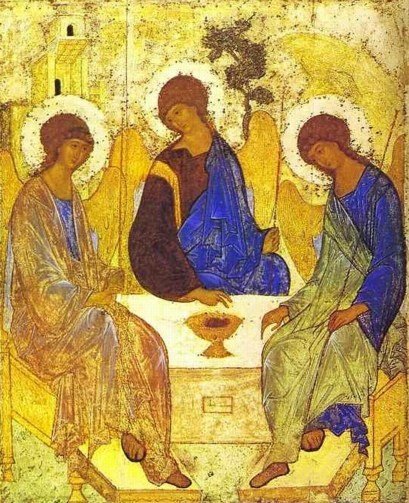
Perhaps this is part of the reason why some icons of the hospitality of Abraham and Sarah have shrunk to picturing just the three visitors.(Compare the icon above to Rublev's Trinity.) The hospitality of Abraham and Sarah has become the hospitality of God because the promise to them is ultimately fulfilled through our incorporation into Christ through the Spirit.

Wednesday, 11 June 2008

The Essence of the Trinity is Nothing Else Than the Trinity Itself


… the essence (of the Trinity) is nothing else than the Trinity itself. (St Augustine)


It is common for the Western tradition to be accused of a kind of modalism because of discussions about the substance of God, and these discussions preceding discussion of the Trinity. It doesn't seem that way to me, although it is true that the idea that there is a being of God behind Father, Son and Spirit is very much alive and well in the western church. (A sort of fourth behind the three.) I suspect that this is how many people understand the Trinity, and reject or accept it on this basis. St Augustine is often cited as an example of this error. But not so. Augustine thinks that the substance of the Trinity is the Trinity itself. The divinity of Father, Son and Spirit is held in common and is not a sort of fourth person or 'stuff' behind the three. This is perhaps one reason why St Augustine is loathe to answer the question, 'What are these three?" He wishes us to avoid thinking of some kind of 'stuff' of which Father, Son and Spirit are three examples.

The Father, the Son and the Holy Spirit are the Trinity, but they are only one God; not that the divinity, which they have in common, is a sort of fourth person, but that the Godhead is ineffably and inseparably a Trinity. (St Augustine)
There is no divine substance apart from the relations of the three. The Father, the Son and the Spirit are the Trinity, and there is nothing missing from their co-equal divinity and nothing 'ontologically' behind them. Without the personal identities in the relations of the three there is no God, no divinity, nothing, literally. This means that, if we include some characteristic within the eternal relations of Father, Son and Spirit, we cannot avoid this characteristic's inclusion into the very being of God. If we do posit a characteristic of the eternal relationship between say, Father and Son, like subordination, and we wish to avoid subordinating the Father and Son in their being (that is, ontologically), then we must separate the being of God from the relations of the three. And that is heresy.


Tuesday, 10 June 2008

What Would Be Left?


If the Word were removed from Jesus, what would be left? If your answer is 'his flesh/body', please read on. The right answer is 'nothing would be left'. This is because it is the Word who becomes flesh. (John 1:14) The Word doesn't just take on an outer suit of flesh, or is the soul bit in Jesus. God became human.

Say it to yourself: God became human. Is it plausible? How can God become flesh and still be God? The trendy answer is that God can't be human and God. (But that is really only the case if humanity and divinity are in competition.) And this trendy answer ends up in one of two places: a kenoticism whereby God is divested of divinity in becoming human; or making God's true identity dependent on us (E.g. Moltmann). But God can be utterly human and utterly God. This speaks to us of a "compatibility" (I think I read this from Rowan Williams, but he means this without in any way denying the complete otherness of God) between God and humanity. But it also tells us something of the true transcendence of God: God is utterly transcendent, which is to say not that God is utterly remote (that is the false interpretation given to transcendence by those wanting a straw figure to blow down), but that in God the usual rules of intimacy and identity (a tension between them) don't apply to God. God can so unite Godself with flesh and still remain fully God, and in this union bring this flesh into existence. And this without in any way compromising the integrity of the flesh. Or, to put it crassly, God can 'make' that which is not God precisely by uniting Godself with it. (Only God is so surpassingly free to be able to do this, and this is what true transcendence is about, and the significance of God being somehow else.) This flesh is then God's own flesh. And so, to return to the original question, if the Word were removed from Jesus, nothing would be left.

This is all about unity in distinction, which God is very good at. Think of the Trinity: Father, Son and Spirit, each with their own identity precisely in their complete unity, and in complete unity precisely because of their distinct identity. This is the point of the eternal Fatherhood of God: 'Father' is a distinct identity, but implies a relationship to be 'Father' in the first place

Or should I just say that God is love, and we know this because of Jesus Christ? Love is about union and distinction at once, and both to their fullest degree. This is the point of the doctrine of the Incarnation, and tells us our ultimate end in God (Christian hope does not dissolve our identity into some more basic lava of 'being' called God, but hopes in a union of personal love), the God who is Love.