Thursday, 3 July 2008

An Emptiness Made to be Filled in Christ

If Adam and Eve had not sinned, would Christ still have needed to come?

Most people reply ‘No’: Adam and Eve in Eden were plan A, and sin messed it up. Christ was the rescue plan to undo the sin. But most people also sense that this leads them where they do not want to go. Christ as plan B? They wriggle out of the impending theological problem by saying it is a theoretical question because God always knew that Adam and Eve would sin, and therefore Christ was not really plan B.

It doesn’t quite work. Hypothetical or not, Christ remains plan B. And that is not the Christian faith, as I understand it. It is just not Christocentric enough, and restricts Christ’s efficacy to sin alone. But for me Christ is much more than the antidote to sin. He is that antidote, but he is much more. Christ would have come even if we had not sinned. The fact that we have sinned just means that Christ’s coming deals with the sin as well. (That is, the salvation of Christ is conditioned by the needs of sinners in addition to the original purpose of creation and its crowning in Christ.) Christ was always going to come because we are made needing the Incarnation and the giving of the Spirit. We are made that way irrespective of sin. That is to say, we are created hollow, an emptiness made to be filled by God. That filling by God is achieved in the Incarnation of Christ and the giving of the Spirit. It is a pure act of grace – unmerited love. That is to say, unmerited in the sense that moral categories don’t apply.

Now, our sin is also dealt with in the Incarnation. The Scriptures focus on sin as the cause of the Incarnation because the Incarnation becomes the point where our natural emptiness is displayed, and where we can see the need for grace. But the grace we are given is the original grace always intended for us.

The majority tradition has perhaps missed this, and made creation and the coming of Christ more ‘plan A mucked up, now for plan B.’ But running from the scriptures through the Church Fathers and the theology of theosis on to modern exponents like Karl Rahner, is the understanding of the original need for the coming of Christ, despite sin.

And this need (because of our original emptiness) is a sign of the great dignity of being human. Humanity is made to be filled by God. Not filled in such a way that we are overwhelmed and dissolved into the great chain of being, but rather, filled by the God who is love, and in this love utterly united with God, yet in this union becoming who we were always meant to be, secure in our own identity as human persons. Our hollowness, our weakness, our emptiness, is our great dignity; it is in this weakness that we find the great dignity as creatures who can 'become God'. Because we are made lacking, God can fill us. And this is shown perfectly in the Incarnation. God can become human – fully human – and remain God. One person, two natures. Theologically, the hypostatic union.

This is paradoxical. Our very weakness is our strength, the point of our greatest dignity. If it were not so, Christ could not have come, and we would not be saved. We would either be divine already, or we would be damned. This is typically Christian and paradoxical. Strength and dignity in weakness and emptiness; just like life in death, power made perfect in weakness. This is the point of all the controversy of the first centuries around the nature of Jesus, and the point of the hypostatic union.

Sin remains sin, but it is the distorted result of our natural weakness and hollowness: unhappy in the dignity of being an openness to God, we try to be God by filling up the hollowness with things, people, ideas etc. and so we maniacally desire these and squabble, compete and kill to acquire and retain them. (Think here of Genesis 3 and the murder of Abel in Genesis 4.)

We think of our weakness and emptiness as a problem. When manifested in sin our weakness and emptiness is a problem, but it is also the pinnacle of creation. Indeed, the ultimate point of the hypostatic union in Jesus Christ is not only our personal union with God, but also the union of all creation with God. What we see in Jesus is not only our destiny, but also the destiny, through Christ and the Spirit, of all creation. We normally think of the dignity of humankind in terms of fullness and perfection, competence and completeness. This is not the original dignity of the human condition: the original dignity of the human condition is emptiness and weakness, an emptiness to be filled by God.

For Reflection:

1. Can you touch your weakness and emptiness? Can you also sense the great dignity of your humanity at that point of weakness?

2. Name one of your sins. Can you also see how this might be, or become, a point of sensing the great dignity of your humanity?

3. How might this change your attitude to yourself and others?

4. When and where do you feel God filling your emptiness?

Wednesday, 2 July 2008

The Weakness and Emptiness at the Heart of Human Being


Perhaps the most obvious feature of the human condition, but one often masked, is our weakness and imperfection. For example:

· Physically, we get tired, we get sick, we age, we die

· We cannot regulate human society in an equitable manner, control violence, racism, sexism, etc.

· Human history is a cul de sac of violence; particularly the 20th, so far reproduced in the 21st century

· The growth of our ignorance; the more we learn the more we know we don’t know.

· The triumph of technology, but a triumphant march ending in environmental damage or possible extinction.

· And in our personal lives, the difficulty we have in changing when we know we must.

· Gullibility, anger, obsessions, groupthink, etc., all these personal, psychological and sociological characteristics of humankind.

And if personal experience and observation isn’t enough, we have the great iconoclasts of the last 150 years, including Marx, Freud, Derrida, Girard. All these have unmasked the ways in which our weakness and failure are hidden from us.

And as the weakness and failure of human being is displayed to us in our experience, observation and in the great intellectual streams of our culture, so we realise that what we have based our lives on might be nothing more than an evanescence of limited lasting value. Our own existence, the reality of the world, truth, God, everything seems to disappear.

It can be hard to feel this at times and not mask it with our strengths and activities, or hide from it with the push of a button. But there are times in our lives when we get a sense of this lack at the heart of human being; disaster, relationship breakdown, death, failure; the encounter with beauty or nature, falling and failing in love; study; the encounter with God. I often have a sense of the chimera that is human being. We aren’t what we like to think we are; and when we strip away what we aren’t, we find an emptiness, a lack.

We fear this emptiness. Sometimes we try to define it away as abnormal, morbid, or perhaps a result of sin. We are not an emptiness, surely, so we fill our lives and our minds with great intellectual systems, busy ourselves with the practicalities of life, become owned by our possessions, and stuff our lives with relationships or the lack of them. And all to hide the hole at the centre of our existence.

But what if it was natural to be empty and hollow? What if, theologically speaking, we are made to be empty? What if our failure and sin as human beings was an indication that we are made hollow, empty, weak, beings that lack? What if sin is essentially the denial of our hollowness, and the result of our own efforts to fill the emptiness? What if our hollowness and emptiness is not to be feared, but the source of becoming who we truly are?

If any of this were true, it would change things. We would still have our weakness and emptiness, our failure and hollowness. These would remain experiences with the power to devastate our comfortable lives. But not only to devastate what is false, but also invite us to what is most real. Imagine if it were true that you and I, and the whole cosmos, were lacking something at the heart of our existence, and this lack was not just the result of sin, but also our original blessing?

Questions for reflection:

1. Where do you find your weakness/hollowness most visible?

2. What do you do with it? Fill it? Fear it? Run, mask it? Live out of it? (If this latter, how do you sustain this sense of weakness and hollowness without it overwhelming you?)

3. How do you sit with your own sin and failure? The sin and failure of other people?

4. If Adam and Eve had not sinned, would Christ still have needed to come?

Monday, 30 June 2008

Like God Loves God

The whole story of creation, incarnation and our incorporation into Christ's body tells us that God desires us, as if we were God, as if we were that unconditional response to God's giving that God's self makes in the life of the Trinity. We are created so that we may be caught up in this, so that we may grow into the whole-hearted love of God by learning that God loves us as God loves God. (Rowan Williams)

Sunday, 29 June 2008

Losing the Self

Through the awful emptiness of absence, God is encountered. Slowly it dawns that losing the image is the prerequisite of finding the original. Losing your way is the very way of seeking God. This truth about the vision of God reveals another law we may not even be aware we are obeying: that to find our true Self we must lose our ego selves. To deepen a relationship we must let go of the other. Absence then imperceptibly transforms into the mystery of presence. (Laurence Freeman)

Saturday, 28 June 2008

More Than a Feeling

Christianity disappears the moment it allows itself to be dissolved into a transcendental precondition of human self-understanding (Hans Urs von Balthasar)

Friday, 27 June 2008

Either/Or - Both/And

A task for Christian theology is to chart a course between the extrinsicism of blind faith and the immanentism of Gnosticism. We have to be able to perceive the revelation of God in Christ as a genuine revelation without reducing it to some kind of inner experience alone. The left and right of the church seem unable to hold this outer and inner together. In fact, I find that both the liberal extreme and the conservative extreme like to be either/or and find it very difficult to hold to a both/and. (This might seem surprising given how liberals like to think of themselves as open and comprehensive.) Another example of this either/or would be divine transcendence. Liberal theology dismisses transcendence as the God who is cold and distant, and the conservatives, in their well intentioned efforts to maintain the gap between God and creation, compromise the intimacy of the God-world relationship. Transcendence, correctly understood, holds both difference and intimacy together. This is not a call to create a theology that has no discernment of what should be included in it. More for a new effort to discover the traditional faith of the church which both liberal theology and the conservatives misuse.

Thursday, 26 June 2008

The Superabundance of Salvation

This is why Paul (Rom 5:15-21) can say that the balance between sin and grace, fear and hope, damnation and redemption, and Adam and Christ has been tilted in the favor of grace, and indeed so much so that (in relation to redemption) the mountain of sin stands before an inconceivable superabundance of redemption: not only have all been doomed to (the first and second) death in Adam, while all have been freed from death in Christ, but the sins of all, which assault the innocent one and culminate in God’s murder, have brought an inexhaustible wealth of absolution down upon all. Thus: ‘God has consigned all men to disobedience, that he may have mercy upon all.’ (Rom 11:32) Hans Urs von Balthasar

Wednesday, 25 June 2008

Sydney (and Others') Subordinationism

Anglicans in South Australia have an email list for news, events and some theological discussion. I recently put a link to my post on Sydney subordinationism
on sa-anglican and we had some good discussion. Here is my final reply:

Here is the theo-logic of the point I am making. [I understand you to be saying:]

· The relations are the being of God

· The Son is relationally subordinate to the Father

· And this is an asymmetrical subordination which you see as the consequence of the Father as source of Godhead

How then to prevent the subordinate relationship being predicated of the being (of God)? I know you don’t believe the Son is subordinate in being, but only subordinate relationally. But that is the point. Once the relations of Father and Son are separated from the being (your claim that relational subordination is functional not ontological) a fourth behind the persons is posited (the being of God, because being has been separated from the relations). Which is exactly why the Fathers said the relations are the being. It is not enough to say that subordination is divine. Of course, mutual subordination/ self-effacement/ and service are divine; that is not at issue. Within the Trinity if the relations of Father and Son are subordinate this has implications for the being of God. If what you are talking about is a mutual self-effacement within the Godhead, well, I wonder what all this has been about.

And finally, if the Son is eternally (and asymmetrically) subordinate to the Father, what are the implications for anthropology? Sydney is making the connections between doctrine of God and relations between men and women by claiming that, on the basis of the eternal functional subordination of the Son, women are functionally subordinate but ontologically equal. But my suspicion is that they have done it the other way. They have begun with their ideological oppression of women and played it back onto the doctrine of God. And that’s why it doesn’t work.

All those who believe the Sydney line should do this little exercise: make a list of the things that the subordination of women amounts to. Then apply this to the relationship between Father and Son eternally. And if the relations are the being, then how to stop these relations being predicated of the very being of God?

Tuesday, 24 June 2008

Depravity

A piece of traditional Christianity: Christianity believes that Jesus came to seek that which is lost, not that which has been destroyed.

The authentic Christian tradition has always condemned the doctrine that man (sic) is totally depraved as a heresy and a blasphemy. (E. L. Mascall)

Monday, 23 June 2008

Ironies of the Contemporary Church Part 4

Another irony of the contemporary church is the way in which a traditional faith is rejected by both right and left wings of the church. My theologically liberal friends know that I am anything but liberal. We have different theological methods, very different in fact, but end up in the same place on some of the big issues. I believe in the doctrine of the Trinity and Incarnation, as well as in the efficacy of Christ’s death and bodily resurrection, and that the Bible contains all that is necessary for salvation. I also support the full participation of women in the life of society and the church, and support the full integration of non-celibate homosexuals in the life of the church, which includes the office of bishop. My theological reliance on the traditional faith makes it harder to connect to the liberals, but because of my support of women and homosexuals I am suspect in the eyes of the right wing of the church too.


The problem for the reactionaries is that they think that all those who come up with different answers to the ‘great’ moral questions like homosexuality and sex outside of formal marriage are liberals. In comparison to some of them I suppose even someone as traditional as I am would seem liberal! This reminds me of an article in a Sydney evangelical newsletter about one of the bishop election synods we had here in Adelaide a few years back. The author, a Sydney evangelical here in Adelaide, was explaining to the folks back ‘home’ why the evangelicals in Adelaide vote with the Catholic conservatives at Synod. He said the reason was because the conservative catholics believe in the traditional doctrines of God and Christ, the bodily resurrection, the efficacy of Christ’s death on the cross and the authority of Scripture. But hang on, I believe in all those things, but I’m not one of the catholic conservatives. Ignoring the strange and pragmatic understanding of truth here (the reason he was justifying that temporary alliance was because good evangelicals of the Sydney brand know that Catholicism is popery), it is important to realize that similar traditional theological methods can (and often do) come up with different answers. I suspect the reactionary wing of the church likes to class everyone who disagrees with them as ‘liberals’ because it is so much easier to dismiss your interlocutor if you believe their methodology is flawed. Reactionaries say things like “Liberals (read those who don’t agree with them) don’t believe in the Bible/bodily resurrection/etc.” But the real world of the church is unlike the picture promulgated by either left or right wings of the church.

The problem for the liberals is that thy do theology in reaction to the reactionaries, allowing them to set the agenda. The reactionary misuse of the tradition is no reason to reject it. It is in fact, a better reason to use it properly.

Most people are suspicious of the extremes, and rightly so. The problem is that those of us somewhere more in the middle don’t seem to be able to present an attractive alternative to the extremes. Perhaps being in the middle somewhere is like that, or perhaps we live in a society tending toward extremes. But I also suspect that those of us in the middle have to start to work harder at presenting the believable middle in a dynamic way and make plain the craziness of the extremes. The natural home for most people is that kind of dynamic middle.

Sunday, 22 June 2008

Reciprocal Conversation

Please forgive the dated masculine language, but a quote from the great man:

“Man is God’s partner, and their reciprocal conversation ends with God himself becoming man.” (Hans Urs von Balthasar)

Saturday, 21 June 2008

Ironies of the Contemporary Church Part 3


Another irony of the contemporary church is the way in which the liberal wing of the church is so utterly saturated with the core outcomes of the traditional faith, yet rejects the traditional superstructure of belief and doctrine that produced these core outcomes. The liberals want to say that justice is key to the Bible, that God, Jesus, life, the church and ministry is all about love, the church must be involved in the world, that judgement is more than meeting a fork in the road with two equally weighted alternatives, and that the God-world relationship is dynamic and relational, and that God is not distant and uninvolved (they call this distant and uninvolved God transcendent!). But all of these beliefs are the result of the traditional faith of the church. The problem with liberal theology is that it is never writing its own theology, just reacting to the right wing reactionaries. Liberalism loves to put up straw figures that are easy to blow down, claiming that the straw figure is traditional Christianity. (Bishop Spong is the great exponent of this methodology.) And then, having dispensed with the traditional superstructure, thinks that its innovations are the true interpretation of the faith. The funny thing is that so much of the innovation is cultural residue from the triumph of Christianity. The doctrine of the Trinity won the battle of the religions and philosophies in making love the very being of God. This is why today almost everyone in the West thinks love is the most important thing in life. The doctrine of the Trinity ensured that the West would take personal rights seriously. The doctrine of the Trinity made God’s relationship of the world dynamic and relational, fully involved, and did this by saying that love is possible because God is transcendent. The doctrine of the Trinity and the God-world relationship behind it allowed the rise of western science because it gave creation its own integrity and being. And you don’t need process theology to have a doctrine of God that allows for divine involvement, personal integrity and freedom of human beings, and a salvation that honours that freedom. The Incarnation and the Trinity do all of this and more, and do it better.

Friday, 20 June 2008

Ironies of the Contemporary Church Part 2

For whatever reasons, the West (not just the church) has for at least a couple of millennia seen sex as either the great point of salvation or the great threat. Obsessively so. Most of us would agree that sex is a powerful force in human society and the individual. Of course. But the West has obsessed over sex’s potential to destroy or bring fulfillment to the extent where sex becomes the panacea for all ills or invariably the point of destruction (eternal or otherwise). For example, the alleged bourgeois repression of sex in nineteenth century Europe was nothing of the sort. People, or should I say men, obsessed over sex. Whether it was the sexuality of women or children masturbating, sexuality was seen as the great source of corruption of the family and society as a whole.

This leads me to the second great irony of the contemporary church. Many Christians, and most churches, have capitulated to this cultural norm. The church is obsessed with sex. On one end of the spectrum we have those who think sex is the panacea of all ills. This takes many forms: a spiritual director whose standard approach is to enquire about the directee’s sex life; or the priest who ignores his own self-indulgent sexual habits because they are irrelevant (allegedly) to ministerial integrity. On the other end of the spectrum the self-appointed guardians of sexual propriety within church and society, consigning gays, fornicators, etc., to hell, and while that destiny is cooking, at least kicking them out of the church after a satisfying witch hunt.

The irony deepens for those on the witch hunt end of the spectrum. Those on this end of the spectrum lambast those of loose sexual morals in the church as capitulating to the culture. That might be true, but what is certainly true is that they themselves, in obsessing over sex, have capitulated to one of the great cultural norms of Western society. Now that’s a bit funny.

Thursday, 19 June 2008

Ironies of the Contemporary Church Part 1


It is one of the ironies of the contemporary church that churches suspicious of, or that flatly reject, the traditional structures of the church have a tendency toward their own particular version of the straitjacket they believe they have rejected. The irony lies in the claim that they eschew the traditional structures to give voice to the freedom of the gospel or Spirit, yet can end up a good deal more narrow and exclusive. Traditional structures, for all their problems, often have embedded in them ways of including those who might otherwise be forced out, and provide sensible ways for participatory decision making and conflict resolution. For example, take many of the self-designated ‘Spirit-filled’ churches. These churches are often characterized by features antithetical to the Spirit. I include here the tendency toward uniformity and exclusion. And having leadership that is 'charismatic' seems to have just as much chance (if not more) of attracting and embedding craziness in leadership as traditional structures. Nepotism is virtually non-existent in traditional structures, but not so amongst Pentecostal churches. Recent church surveys suggest that pentecostal and charismatic churches that eschew traditional structures lack the means for sensible conflict resolution. It is more the case that if you disagree with the pastor you are out! The Spirit, contrary to this impulse of uniformity and exclusion, forced unanimity and erratic leadership, is the Spirit that gives diversity for the unity of the body and provides for the life of the church through structures that facilitate good decision making and inclusion. Well, sometimes anyway!

Tuesday, 17 June 2008

A Joy Deeper Than Misery


Victory, however, it is, and a real victory. The joy of Easter after all is founded on Christ's dereliction on the Cross and his abandonment in hell. For his abandonment was like the final testing of the unity of the Trinity, which as such is the fullness of joy. Not that the joy of the Divine Persons is an idle, self-indulgent kind of joy that they share in while the creature suffers; their joy penetrates deep into all the world's suffering; they share the expereince of its misery, but their joy proves deeper than all sense of abandonment. For God's action on behalf of lost humanity is so final that every reproach levelled against the providential ordering of the world is put to silence. (Hans Urs von Balthasar)

Monday, 16 June 2008

From Hospitality of Abraham and Sarah to Hospitality of God

Sermon for Pentecost 5, Year A, August 15, 2008, preached at Belair.

One of the Sunday readings yesterday was Genesis 18:1ff relating the visit of three figures to Abraham and Sarah to announce that God's promise to them that they would become a great nation would begin with the birth of a child in the near future. The visitation by these three figures was quickly seen in the Christian tradition as a biblical prefigurement of the Trinity. But many people find this a long bow to draw. But maybe not.

The birth of Isaac is the beginning of the fulfilment of the promise that through Abraham and Sarah all the families of the world would be blessed. Abraham and Sarah offer hospitality to the three figures, and hear the announcement. Jesus is the ultimate fulfilment of this promise. In Jesus' life, death and resurrection we become children of God, brothers and sisters of Jesus, able to cry out "Abba, Father", enjoying an intimacy of union with the Father through Christ and the Spirit. God makes us part of the household of God, to enjoy the love of Father and Son in the Spirit. Through the ultimate fulfillment of the promise to Abraham and Sarah, God makes real an eternal and unimaginably intimate hospitality.This is why thinking of the three figures as trinitarian is not far from the mark.

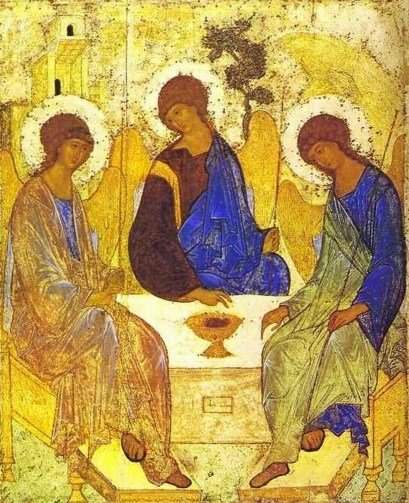
Perhaps this is part of the reason why some icons of the hospitality of Abraham and Sarah have shrunk to picturing just the three visitors.(Compare the icon above to Rublev's Trinity.) The hospitality of Abraham and Sarah has become the hospitality of God because the promise to them is ultimately fulfilled through our incorporation into Christ through the Spirit.

Wednesday, 11 June 2008

The Essence of the Trinity is Nothing Else Than the Trinity Itself


… the essence (of the Trinity) is nothing else than the Trinity itself. (St Augustine)


It is common for the Western tradition to be accused of a kind of modalism because of discussions about the substance of God, and these discussions preceding discussion of the Trinity. It doesn't seem that way to me, although it is true that the idea that there is a being of God behind Father, Son and Spirit is very much alive and well in the western church. (A sort of fourth behind the three.) I suspect that this is how many people understand the Trinity, and reject or accept it on this basis. St Augustine is often cited as an example of this error. But not so. Augustine thinks that the substance of the Trinity is the Trinity itself. The divinity of Father, Son and Spirit is held in common and is not a sort of fourth person or 'stuff' behind the three. This is perhaps one reason why St Augustine is loathe to answer the question, 'What are these three?" He wishes us to avoid thinking of some kind of 'stuff' of which Father, Son and Spirit are three examples.

The Father, the Son and the Holy Spirit are the Trinity, but they are only one God; not that the divinity, which they have in common, is a sort of fourth person, but that the Godhead is ineffably and inseparably a Trinity. (St Augustine)
There is no divine substance apart from the relations of the three. The Father, the Son and the Spirit are the Trinity, and there is nothing missing from their co-equal divinity and nothing 'ontologically' behind them. Without the personal identities in the relations of the three there is no God, no divinity, nothing, literally. This means that, if we include some characteristic within the eternal relations of Father, Son and Spirit, we cannot avoid this characteristic's inclusion into the very being of God. If we do posit a characteristic of the eternal relationship between say, Father and Son, like subordination, and we wish to avoid subordinating the Father and Son in their being (that is, ontologically), then we must separate the being of God from the relations of the three. And that is heresy.


Tuesday, 10 June 2008

What Would Be Left?


If the Word were removed from Jesus, what would be left? If your answer is 'his flesh/body', please read on. The right answer is 'nothing would be left'. This is because it is the Word who becomes flesh. (John 1:14) The Word doesn't just take on an outer suit of flesh, or is the soul bit in Jesus. God became human.

Say it to yourself: God became human. Is it plausible? How can God become flesh and still be God? The trendy answer is that God can't be human and God. (But that is really only the case if humanity and divinity are in competition.) And this trendy answer ends up in one of two places: a kenoticism whereby God is divested of divinity in becoming human; or making God's true identity dependent on us (E.g. Moltmann). But God can be utterly human and utterly God. This speaks to us of a "compatibility" (I think I read this from Rowan Williams, but he means this without in any way denying the complete otherness of God) between God and humanity. But it also tells us something of the true transcendence of God: God is utterly transcendent, which is to say not that God is utterly remote (that is the false interpretation given to transcendence by those wanting a straw figure to blow down), but that in God the usual rules of intimacy and identity (a tension between them) don't apply to God. God can so unite Godself with flesh and still remain fully God, and in this union bring this flesh into existence. And this without in any way compromising the integrity of the flesh. Or, to put it crassly, God can 'make' that which is not God precisely by uniting Godself with it. (Only God is so surpassingly free to be able to do this, and this is what true transcendence is about, and the significance of God being somehow else.) This flesh is then God's own flesh. And so, to return to the original question, if the Word were removed from Jesus, nothing would be left.

This is all about unity in distinction, which God is very good at. Think of the Trinity: Father, Son and Spirit, each with their own identity precisely in their complete unity, and in complete unity precisely because of their distinct identity. This is the point of the eternal Fatherhood of God: 'Father' is a distinct identity, but implies a relationship to be 'Father' in the first place

Or should I just say that God is love, and we know this because of Jesus Christ? Love is about union and distinction at once, and both to their fullest degree. This is the point of the doctrine of the Incarnation, and tells us our ultimate end in God (Christian hope does not dissolve our identity into some more basic lava of 'being' called God, but hopes in a union of personal love), the God who is Love.

Monday, 9 June 2008

On the Ordination of Women Part IV(ii): Headship

(Continuing some thoughts on how thin the headship thing is as an argument against the ordination of women.)

To my knowledge, the only other passage which refers to headship is to be found in the household code of Ephesians (5:21-33), where it is explicitly stated that the husband is head over his wife as Christ is head over the church. Notice it is husband and wife, which seems not irrelevant to the debate. And notice that no attempt is made to connect the headship of husband over wife with ministerial leadership in the Christian community. Indeed, when Ephesians speaks of the ascended Christ's gifts to the church, the ministries mentioned are ones we know women held.

It is not only the headship idea that is thin. There is only one text in the whole of the NT that actually forbids women to teach men (1Tim 2:2), although, again, this might refer only to husbands and wives. There is another which commands women to be silent in church (1Cor 14:34f, although remember in 1Cor 11 Paul acknowledges that women are praying and prophesying in church, and safeguards this ministry through what he writes), while none of the passages around the submission of wives (not women in general) in the household codes and in Titus (Col 3:18f; Ephes 5:21-33; 1Peter 3:1-7; Tit 2:5) make a connection between the subordination of wife to husband and ministerial leadership in the church. On the other hand the NT is full of women's ministry that gives them authority within the church. Junia is a good example, the woman apostle mentioned by Paul. (Rom 16:7) There is also a woman deacon named Phoebe (Rom 16:1), and women prophets (Ac 21:9; 1Cor 11:5), as well as various other female workers Paul mentions inhis letters. (Rom 16:3, 6, 12; Phil 4:2f cf 1Thess 5:12f)

And one final point: those who think that a woman cannot have spiritual authority over a man, what about the Queen's role in the CofE? Many of those against the ordination of women seem also to take seriously BCP's acknowledgement of the monarch's spiritual authority in the church. Seems a bit odd.

Saturday, 7 June 2008

Reading Genesis 12

Pentecost 3, Year A, June 1, 2008. Preached at Belair.

Tomorrow we read Genesis 12:1-9 at Holy Communion. It is a crucial passage in Scripture. Genesis 1-11 is what could be called myth. By this is meant a story that tells us something that is applicable to all. So we begin with the creation story, "and it was good". Then comes the Fall, and the spread of sin. This is narrated in the murder of Abel, the evil of the human heart unchanged after the flood, Babel, etc. This is the universal human predicament, the cul-de-sac that all people, of all times, in all cultures, face. And it is characterised in Genesis 1-11 by the human arrogance that seeks to be God and growing violence.(E.g. Genesis 4:23-25, a vengeance even greater than God's! Cf Genesis 4:15) This is the predicament from which we all need to be saved.

And what is God's response to this cul-de-sac of human history? Genesis 12 and the call of Abraham and Sarah. They are to leave this cul-de-sac and live rough because God promises that through them a great nation will arise, and that through them all the families of the world will be blessed. (See Hebrews 11:8-12) They believe God and are obedient to the call. And from there the rest of the Bible unfolds. And all people are blessed in Christ, son of Abraham and Sarah. (Matt 1:1)

A couple of points:
  • Those who try to maintain the historicity of the events of Genesis 1-11 are missing the point. It doesn't matter, truly, because Gen 1-11 is not to be thought of history as we usually think of it. That is Genesis 12 and following.

  • In fact, by trying to switch the focus to whether Adam and Eve existed etc, these funny Christians are blunting the Scriptural witness. I am Adam. I live in Babel. This is the point.

  • Genesis 12 begins what we might normally think of as history, and we can ask of it all of those sorts of questions. That this is not myth in the sense of Genesis 1-11 does not mean it is without universal importance. It is. Jesus, the offspring of Abraham and Sarah, is of universal import, but he is this precisely in his particularity. He is not 'me' in the mythic sense I just called myself Adam. He is the Word made flesh. He is not symbolic of something already true if only I could reach into myself (some kind of pagan salvation myth), he is God's interruption of the cul-de-sac in the flesh.

The Unity of Creation and Redemption


In Irenaeus, too, the larger theological context of the Christological problem is apparent: the unity of Godhead and humanity in Christ also involves the question of the unity of creation and redemption, of God and world. Jesus Christ is not understood simply as a great exception, but rather as the new beginning. (Walter Kasper)

Friday, 6 June 2008

In Search of a Human Jesus


The search for the historical Jesus makes interesting reading. It is a problem, though, when it is undertaken with a competitive notion of God in the background. Humanity and divinity will compete within Jesus and his ministry. The more human we make Jesus (the liberals), the less room there is for an incarnate God. The more we want Jesus to be God-directed (the conservatives), the less human Jesus becomes. Liberals say the conservatives are docetists, and the conservatives call the liberals adoptionists. Liberals evacuate his ministry of supernaturalism and the conservatives try to find bits of his ministry that prove his divinity. Both have a competitive understanding of God; a God whose essence is defined over-against the rest of us. We must remember that because God is transcendent there is not a competition between creation and divinity. Jesus can be fully human and fully divine. Jesus can be truly human and have God as his source, which is just to say what the ancients have said before us in affirming the Word's assumption of his humanity. And because of this assumption by the transcendent God, we are not to look for bits of Jesus' ministry that prove his divinity, or divide his ministry between those parts that are divine and those that are human. He acts always as the incarnation of the Word. The divinity of Christ is invisible, by which I mean that it is the human Jesus we see. But his divinity is discerned invisibly in his human acts, not alongside them or behind them. In other words, Jesus is indivisibly human and divine in such a way that he is God in the flesh, not God behind the flesh.

Feeling the need to choose between a fully human Jesus or a divine figure is an example of the problem affecting so much contemporary theology and the reaction against it, and partially explains the great divide between liberal and conservative theology. And surprisingly, the liberals and conservatives are closer than they think, at least in their common foundational theological error.

Thursday, 5 June 2008

The Dogma of the Monist

In their doubt of miracles there was a faith in a fixed and godless fate; a deep and sincere faith in the incurable routine of the cosmos. The doubts of the agnostic were only the dogmas of the monist. (G. K. Chesterton)

Wednesday, 4 June 2008

On the Ordination of Women Part IV(i): Headship


Headship is used as an argument against the ordination of women. The essence of the headship argument is that women are not to have authority over men, and should be submissive because that is what the Bible says. This is a pretty thin argument, especially given how much weight some attach to it.

There are only two passages that speak directly of headship, and neither of them use it to prevent the ministry of women. In 1Cor 11:2-16 Paul uses the idea that man (or husband) is the head of woman (or wife) to enforce the practice of women (wives) wearing veils when they pray or prophesy in church. This is not about ministerial authority in the church. Indeed, upon reading the passage again we can see that Paul's intention is to safeguard and affirm the right of women to pray and prophesy in the church, and highlights the interdependence of men and women in the Lord. (See also 1Cor 7:3-5) If this passage is seen to be important in the debate it seems to me it could only be used to require appropriate head wear on the part of women priests (seems like an argument for the consecration of women bishops!, or perhaps only those women priests who are married (and whose husbands are present).

As an aside, it is said by opponents of the ordination of women that the headship of men over women cannot be a cultural accretion because it is based by Paul on the order of creation. So, for example, in vv 8-9 Paul uses the second story of creation in Gen 2:21ff to explain the need for women/wives to wear hats in church. But most of us would think that the wearing of hats is a cultural accretion that can be shed. So the argument that headship is more than a cultural expression because it is grounded in other parts of Scripture needs to be approached with discernment.

Also notice that in 1Cor 11 headship is first about origin. God is the origin/head of Christ, man is the origin/head of woman. (Again, Gen 2:21ff is in the background.) If Paul's purpose were to enforce a rigid order of ministerial authority, or intended that this passage might be a bulwark of such a notion, he is making a strange argument. He mentions the descending order of origin, but then says that , 'in the Lord', men and women are not independent, and that men come from women, and that in any event, all come from God. (vv11-12) His purpose is to safeguard the right of women to prophesy and pray at church, and is ensuring that the origin-authority nexus is not overdone.

And what authority are we talking about? Whatever it is, it is not ministerial authority, and whatever the theology, the submission of women/wives is achieved with a hat.

Tuesday, 3 June 2008

Theological Imagination


Arius’ religious imagination simply could not accommodate a God who did what Jesus Christ has done. (Anne Hunt)

Monday, 2 June 2008

On the Ordination of Women Part III: The Fatherhood of God

The early trinitarian debates gave the Fatherhood of God a quite specific nuance that cannot be ignored in the ordination of women debates. In the debate over the last few decades it is worrying when people make God the heavenly image of the patriarchal father-figure. It is also worrying when people extend this to some inherent connection between human fatherhood, the fatherhood of God and male priests. Or worse, a crass linear course from the maleness of the language of 'Father' when applied to God to the need for a male priest. The first and determinative meaning of the 'Fatherhood of God' should be derived from its trinitarian meaning. In the Trinity, the Fatherhood of God is about finding identity in relationship. This is not a patriarchal idea. And it is a long bow to draw to get from this to an only male priesthood.

'Father' is a naturally relational term. It makes no sense apart from reference to a child. This is why the orthodox maintained the eternal fatherhood of God. God cannot be considered apart from the Son. (There was never a time when God was not Father, implying that intra-divine relationship lies at the very heart of divinity.) Furthermore, the Father's eternal identity comes from the relationship with the Son. Identity and relationship are not related in inverse proportion. The more we pronounce the identity of the Father the more the relationship with the Son is affirmed.

If priesthood is about safeguarding the Fatherhood of God, then priesthood cannot be about representing patriarchy. The eternal Fatherhood of God is non-patriarchal despite the exclusive male terms of Father-Son (although not Spirit, but it is a bit amorphous granted). If we are to take this trinitarian meaning of the Fatherhood of God seriously then priesthood is not about maleness, not about patriarchal power, but about relationship-in-identity. This makes a lot of sense to those who are ordained. We are not submerged into a congregation or the wider church. We retain our identity, but we retain this identity precisely because we are related to the body of the church. We are not priests to the world, but priests in the church. (As far as I am aware, in the New Testament the word for 'priest' is applied to Jesus and the church, not to the ministers of the church.) Lose our relationship to the wider body, and so our identity as priests gradually dissipates.

Fudge this first meaning of the eternal Fatherhood of God in the theology of ordination and the whole Christian paradigm unravels. It undermines the Trinity for one thing, which is not good. But also our vision of salvation is transformed into an alien understanding. Christianity believes in a salvation that is both relational and personal, without in anyway diminishing our identity or our relatedness. The eternal Fatherhood of God ensures this understanding is rooted in our theology of God. The same goes with the diverse gifts of the Spirit that are given for the unity of the body. (See 1Cor 12) The diversity of gifts is not a hindrance to unity, but the instrument through which the Spirit brings unity. Again, without the eternal Fatherhood of God the basis for believing this is slender.

From this vantage point the ordination of women, at a minimum, is not prohibited. But let us not be so churlish. The ordination of women makes the priesthood more diverse by including both sexes of the human race. And with this diversity encompassed in the unified office of priest, the eternal Fatherhood of God is proclaimed. And this is utterly congruent with the cross (as it should be) as revealing of the Father ('those who have seen me have seen the Father'), for it is on the cross that the unity of humankind is achieved. That unity is expressed in a priesthood open to women and men.

Saturday, 31 May 2008

God's Gift of Life is Christ


The way God gives us life and holiness is by giving us Christ, therefore causing us to share in the qualities that Christ possesses. Since Christ’s giving of himself to us constitutes God’s giving us participation in himself, Christ must be God by nature, not merely by a grace borrowed from another.
(DonaldFairbairn,
Grace and Christology in the Early Church, writing on Cyril of Alexandria's theology of grace (mapped to his Christology), in contrast to the theology of grace (and Christology) of Theodore of Mopsuestia. Book review to follow soon.)

Friday, 30 May 2008

The Hollowness Within


It is bordering on the banal to say that human beings have a tendency toward superficiality. Surface deep, with a great hollowness on the inside. The problem is that we try to hide our hollowness. And we do this in all kinds of ways. Education and learning is a great way to hide hollowness. Philosophically we can construct ontologies (theories about the nature of existence or being) that give us a solidity below the surface. Sartre was suspicious of these philosophical systems, which is why he coined the idea that existence precedes essence. (To prevent being defined before we live into ourselves.) Deconstructionists claim to have revealed the lie behind most of Western philosophy, showing the emptiness behind the great philosophies of being.

We can be tempted to mimic this 'fullness' with great theologies of substance in the attempt to fill up what is in fact the great hollowness at the heart of human existence. We need a theology that, instead of hiding our hollowness, allows us to live it.

We can begin this theology of hollowness with the Trinity. (Where else!) Trinitarian being (but remember God's 'being' when applied to God is not univocal; see the posts under 'transcendence') is not a fourth 'thing' next to the three persons of Father, Son and Spirit. Without the persons there is no divine substance left over. This provides a realness to personhood in the Trinity: the person is not a layer over some originate 'stuff'. Therefore when you encounter the persons you are encountering God, not a mask with God remaining a shadowy figure behind the mask. But this also leaves an emptiness or space at the very heart of God, because personhood is, in the Trinity, defined through relationship. God is eternally father, which means that God must always be defined through relationship with this other we name Son, and a relationship marked by utter self-giving and receiving, making space for the other to be the other, etc. We must think of the being of God in terms of this movement, and the identity of each person in terms of their relationship with the other. When we think of the Trinity like this we are taken away from a thick treacle-like understanding of being to a more dynamic understanding, an understanding that is a far cry from God being 'stuff'. This understanding of God is the justification for an anthropology that makes us less treacle-like beings, and more lithe with a hollowness waiting to be filled in a dynamic embrace of love. And that is the realm of Christology, specifically, the doctrine of the Incarnation.

Thursday, 29 May 2008

Living Within the Reality of Love

So to know the Holy Spirit is not to have some third object put before the eyes of our theological understanding but to live within the reality of an eternal divine witness to divine life as the gift of 'otherness'. As Father and Son show us that giving as perfect mutual 'investment' of life and love, so the generation of the Spirit constitutes the mutual gift as open to be given again: there is in God also a free, self-forgetting act of pointing to the free mutuality of Father and Son. The divine life is not taken up completely in a mutuality that is inaccessible to what is other than God. (Rowan Williams, discussing the trinitarian theology of Hans Urs von Balthasar.)

The Difference Going to church Makes in My Life Part II: To Be Engaged not Entertained

I don't go to church to be entertained as such. I go to church to be engaged. There is a difference, and it is important. In the entertainment industry there is a star up front, with an audience who do not actually participate, but watch. The purpose of the entertainment is fun through distraction, or even worse, manipulation and 'bread and circuses'. Entertainment usually provides less space for the imagination, and engages the senses of sight and sound, but usually in an overwhelming manner. And the entertainment industry is slick, without the still, small voice. (See 1Kings 19:13) Some churches attempt to match their worship to this cultural expectation. Funnily enough, their capitulation to culture on this grand scale seems to go unacknowledged, and they are often the churches that accuse other churches of capitulation to the world on sexual ethics!

Traditional liturgy is not entertainment. In comparison to the entertainment industry it might be boring; and maybe that is not a bad thing. It should be engaging though. And it should provide imaginative and emotional space, time to think and respond, and give a means to do so. It should engage all the senses, but in no way overwhelm them. Even the sixth sense should be attended to in the liturgy. And liturgy should have a structure, most certainly not be manipulative, but rather through the structure of the liturgy open up 'space' to encounter God and glimpse the self, and get an intuition that something deeper is going on in our lives and the life of the world.

Wednesday, 28 May 2008

The Bizarre Heresy of Sydney Anglican Evanglicalism

A few points on the bizarre heresy of Sydney Anglicanism regarding the alleged eternal subordination of the Son to the Father.


  • They argue that the Father, Son and Spirit are ontologically equal, but functionally subordinate in their personal relations. (Their aim is to justify the claim that men and women are ontologically equal but functionally subordinate.)
  • Which is why they are wrong. There is no ontological ‘stuff’ apart from the relations. The being of God is not a fourth in the Trinity next to the three of Father, Son and Spirit.(This is not making being and person identical, just that without the persons there is nothing ‘to be’.)
  • If there is a being of God apart from the relations this allows alien understandings to infect our theology. Orthodoxy ensures that the Son is the revelation of the Father, and cautions us against alien ideas incompatible with Jesus.
  • If the Father and Son are eternally subordinate in their personal relations then the ontological consequences cannot be avoided: the Son is no longer the revelation of the Father, and God remains a shadowy figure behind the Son.
  • They claim this on the basis of those passages that make Jesus subordinate in his earthly ministry.
  • And also those passages that make him subordinate eternally, if you want to read them that way. (They particularly love 1Cor 15)
  • It is true that the love of the Father and Son in the earthly life of Jesus is expressed in his obedience to the will of the Father. But to read this eternally, leads to the problems above, and others.
  • It is possible to understand the subordination of the Son in 1Cor 15 as voluntary, the voluntary love of the Son of the Father, congruent with orthodoxy.
  • This bizarre doctrine, I think, is a classic example of what happens when you separate yourself synchronically and diachronically from the rest of the church. And they have done it on the most fundamental issue of the church: the doctrine of God.
  • What is ironic is that, presumably, Sydney is teaching this internationally as the bankroll for Africa and Asia. The very churches that extol themselves as holding the true faith against the’ liberalism’ of gays and women. Their heresy is much more serious than anything they accuse their opponents of.
  • How bizarre. Apply caution before getting into bed with them.

Tuesday, 27 May 2008

On the Ordination of Women Part II: The Twelve

Some people think that because the Twelve were men only men can be priests and bishops. It must be remembered that the Twelve were the symbolic heads of the renewed twelve tribes of Israel. It is hard to jump from this to a necessary and absolute link between priesthood and maleness. The offices of priest and bishop are not the historical, linear heirs of the symbolic heads of the renewed tribes of Israel. Notice how relatively obscure the Twelve were in the early church. (Hardly mentioned in Acts, and the Gospels can't agree on a set of names.) Apostleship was important, and a link between apostleship and priesthood and episcopacy can be made. But the band of apostles was much broader than the Twelve, and included a woman named Junia. (Rom 16:7)

Monday, 26 May 2008

Do Not Be Anxious


There is a spot in the Adam Sandler movie Spanglish where the Mexican maid is worrying about her daughter, and instead of the Sandler character saying, 'Hey, don't worry, it will be alright,' he says children are a good thing to worry about. Which is all a bit counter-cultural. We are told not to worry, not to stress, etc. And it is easy to read this into Jesus in Matt 6:25ff. But I don't think this is what Jesus is saying. I don't subscribe to the idea that our task is to get to a point in life where we do not have to worry. I think there are good things to worry about.

In the Scripture reading just mentioned, the contrast Jesus is drawing is between being anxious about those things that tend toward superficiality and seeking God's kingdom. He is not saying seek a spot where there is nothing to be worried about. Or should I say 'concerned'. I think the cultural message about worry and stress (that is, aspire to a stress-free life) is just a mask for withdrawal from the world. Jesus says that we should seek the kingdom. That will involve worry and stress.

A few points:


  • I'm not suggesting worrying yourself sick about the kingdom. That would be to forget that it is God's kingdom, not your kingdom. Realising this allows us to take one step back from what we are striving for, to be what the tradition calls detached. It is God's kingdom, God's ultimate responsibility, and God will see it right. (We are now touching on faith and hope in the resurrection of Jesus.) This is why kingdom worries are not the anxieties of the world. (Not to mention that the kingdom anxieties are more than clothes, food etc.)

  • If you have to worry about things like clothes etc, then don't worry about the fact that you are worrying about them! Just get it over and done with, do what you have to do (whatever that is) to allow you to stop worrying about that kind of stuff. And then get on with seeking the kingdom.

Sunday, 25 May 2008

On the Ordination of Women Part I: In Persona Christi


In 1997 I moved the legislation to allow the ordination of women to the priesthood in the Diocese of Willochra.The first female bishop has been ordained in Australia now, but we are still hearing the same hackneyed arguments in oppositon. So here are some of the points (in an abbreviated form) I made in my speech, with some continuing relevance I think.

In Persona Christi: Can a Woman Represent Christ at the Altar?
The ordination of women is a necessary consequence of the theology of baptism where all who are baptised are made one with Christ. The baptised are capable and called to represent Christ in the world; that is, they are icons of Christ. To then deny the iconic nature of baptised women by arguing that they cannot represent Christ at the altar is to deny the baptism common to us all.

A good example of the iconic nature of the baptised, including women, is to be found in the Martyrs of Lyons and Vienne. In this account of martyrdoms in the late second century AD, a female disciple named Blandina is exposed to wild beasts, and when the other disciples see her they see Christ.

But Blandina was hung up fastened to a stake and exposed, as food to the wild beasts that were let loose against her. Because she appeared as if hanging on a cross and because of her earnest prayers, she inspired the combatants with great zeal. For they looked on this sister in her combat and saw, with their bodily eyes, Him who was crucified for them, that He might persuade those who trust in Him that every one who suffers for the glory of Christ has eternal communion with the living God.

In other words she was an icon of Christ. If women can represent Christ in the amphitheatre of martyrdom, then women can represent Christ at the altar. (Baptism is the foundation for both, and is why baptism is a prerequisite for ordination.) This is a basic consistency running from baptism through to ordination. Ordination cannot obliterate this iconic value of women, just as it is not ordination that gives men their iconic value as representatives of Christ in the first place. Therefore, to deny women ordination to the priesthood (and episcopate) on the grounds that they cannot stand in persona Christi is to undermine the integrity of baptism.

Saturday, 24 May 2008

Relationality and Bodiliness

Among the great achievements of those who have thought trinitarianly is the concept of the person as a living whole rather than as a mind encased in matter...To be is not to be an individual; it is not to be isolated from others, cut off from them by the body that is a tomb, but in some way to be bound up with one another in relationship. (Colin Gunton)

Friday, 23 May 2008

Despair

It is more serious to lose hope than to sin. (John of Karpathos)

Thursday, 22 May 2008

Book Review: Rowan Williams, 'The Dwelling of the Light. Praying with Icons of Christ.'


It is because the uttermost of death and humiliation cannot break the bond between Jesus and the Father that what Jesus touches is touched by the Father too... Because of his relation with the Father, a new relation is made possible between ourselves and this final wellspring of divine life. (p. 41)


This is a beautiful little book. First, it is tastefully set out and illustrated. Second, it provides an excellent guide to four key icons of Jesus. Third, it allows Rowan Williams to explicate a number of theological points, and especially allows him to talk about the point of the doctrines of the Trinity and Incarnation in terms not reliant on philosophy or esoteric theological knowledge. an example:
And what is true about Jesus is - if we really encounter it in its fullness - shocking, devastating: that his human life is sustained from the depths of God without interruption and without obstacle, that it translates into human terms who and what God the Son eternally is. The shock comes from realizing this means that God's life is compatible with every bit of human life, including the inner terrors of Gethsemane (fear and doubt) and the outer terrors of Calvary (torment and death). (p. 12)
In the introduction he provides a helpful summary of the theology behind the iconoclast controversy that raged in the Orthodox world over a thousand years ago. Indeed, Williams makes the point that the fruit of this debate provides us with the justification for any Christian art and imagery. Essentially, he says that the supporters of icons argued that icons "were actually a natural consequence of the way the God of the Bible worked." (p. xiii) He means here the Incarnation: the opponents thought that depicting Jesus was contrary to Chalcedon by depicting the human Jesus, and thus potentially splitting his divine and human natures; in reply, the proponents of iconography said that icons depicted the human Jesus without separating the natures because the human in Jesus is utterly "soaked through with divine life." (p. xvi)

The four icons he chooses to examine are: the Transfiguration, the Resurrection, the Hospitality of Abraham, and Pantocrator. His discussion of the Transfiguration and the Resurrection are particularly good, although that might just tell you my two favourite icons! It is worth reading his discussion of the first icon, the Transfiguration, for itself, but also because he introduces a number of features common to iconography. Especially important is the mandorla of darker colour representing the depths of God from which Jesus comes and brings with him the depths and power of the creator. The meaning of the icon hinges on this, but it doesn't follow that humanity (Jesus' and ours) and the rest of creation are excluded. This is the whole point of the Incarnation, and the icon of the Transfiguration.

The second icon he examines is the Resurrection:
  • This is not an icon of the resurrection - the resurrection was a 'private' event. This is an icon of the effects of the resurrection.
  • Jesus is in the centre of the icon, and framed by a mandorla

  • The icon is of the victorious Christ standing over the broken down gates of the underworld.

  • The defeated Satan is visible under his feet, and

  • The dead have been liberated, standing behind the main action we see various figures of biblical history

  • In the foreground with Jesus stand Adam and Eve, and Jesus is re-introducing them to one another.
The effect of the resurrection is the liberation of those who have been frozen in death without Christ, and through this a new and revitalised life of reconciliation. But more than this, Jesus has been to the very beginning of human sin and estrangement from each other and God.
'Adam and Eve' stand for wherever it is in the human story that fear and refusal of God began - not a moment we can date in ordinary history, any more than we can date in the history of each one of us where we began to forget God... The icon declares that wherever that lost moment is or was, Christ has been there, to implant the possibility, never destroyed, of another turning, another future; in his resurrection, he brings all those possibilities to reality.(p. 38)
Williams has a good discussion about the need to read all of Scripture through the lens of the resurrection (pp. 33-35) and our re-introduction to one another and all of creation (pp. 30-36)

I could keep going on the next two icons but you get the idea. This is a profound book, well worth reading, and if you have the opportunity, run a session on these icons in your local church.

A quote on the resurrection to finish:

The Christ of this icon, standing on the bridge over darkness and emptiness, moving into the heart of human longing and incompletion, brings into that place the mystery out of which his life streams, represented in the mandorla against which his figure is set. The locked gates of death, the frozen lives cut short, these are overcome in the act of new creation which we are witnessing. (p. 41)

Wednesday, 21 May 2008

Christ Our Saviour in Person

The salvation won for us in Christ on the cross and in the resurrection(and giving of the Spirit and ascension, etc.) is not external to the person of Christ. Some, in their desire to safeguard the sovereignty of God and God's grace, make the salvation won in the cross a transaction external to the person of Jesus. To summarise the external transaction idea: there is a law and those who break it must die; you have broken the law (so have I), so you deserve to die.(So do I.) But Christ takes this punishment for us, satisfying the obligation of the law through his sacrifice on the cross. The price is paid to (well, here the theory runs into real trouble, with the answers varying from Satan to God the Father) and we are saved.

There are better ways to safeguard theologically the grace of God in the cross and our utter reliance on Christ's sacrifice than this. And there are lots of reasons why this crudity should be abandoned. One reason is because Christ is no longer the saviour in person. Salvation (no matter what metaphor you are using or prefer, whether it be sacrifice, redemption etc) is won in the very being of Jesus. This is the whole point of the hypostatic union: the union of human and divine in the person of Christ, fully lived out in his life, death and resurrection, saves us. He is my saviour in his person. (Adding another layer of meaning to the phrase 'Jesus is my personal saviour'. He saves me, and he saves me in his person, not outside it.) No external transaction due to an outside force that God must obey, but the union of human and divine, and the beginning of the hypostatic union of all creation in Christ.

Tuesday, 20 May 2008

From Sin to More Than Everything

"In sin we have lost everything. In the Triune God we have been given infinitely more than everything." (Halden, Inhabitatio Dei)

The Continuum of Relevance and Identity

In an early article Jurgen Moltmann produces a helpful continuum between relevance and identity. The church moves between both relevance and identity; in the world but not of the world; incarnated in the world with a citizenship in heaven. If it moves too far to one side there is a reaction the other way. Mission and evangelism follows this continuum. Think of those churches that focus on ‘personal faith’ as a gathered community to the extent that their sectarian nature makes them irrelevant to the world around. Of course, they would say that is the whole point! Calling people out of the world that is passing away. Or consider those churches for whom their Christian faith seems little more than an overlay upon existing views on justice, relationships, God, etc. So relevant that they have merged back into the world around them! Mission and evangelism requires both identity and relevance. We are a people called out, yet God sent the Son to save the world. Remove the admonitions concerning justice from the Bible and it would almost be readable in one session!

It is good to ask ourselves where we are on the continuum. Where does your predilection lie? It is good to be aware of what might become excessive within our ministry, and what might be overlooked. (And as an aside, it is also important to recognise this as part of the dynamic involved in the threatened schism in the Anglican Communion at present.)

Monday, 19 May 2008

A Simple Theory of Traditional Church Decline

I have a simple theory to explain the decline of the traditional churches over the last 50 years in this diocese. We are the victims of our own success. Fifty years ago our churches were full. And as the culture changed and the gap widened between traditional churches and the lives and thinking of ordinary Australians, so decline at some point became likely. Our churches were still strong. Good numbers and lots of kids etc. But the writing was on the wall. Full churches didn't need to change. The formula had been working for so long! Some decorative change perhaps, but not the sort of change necessary. It has taken decades for us to get to the place where it is clear that more than decorative change is necessary. Our strength predisposed us away from asking and responding to the hard questions; we could, with some reasonableness, claim that the system wasn't broken.

Now we can see how long ago the system broke down. The question is how many of our churches have left it too late to respond. There is a critical level of resources below which it is very, very difficult to come back from. How many of our churches are below that critical level? How many still have the resource base to make a response? That's the question really. It is really not that hard to know the kinds of things we have to respond to, and the kinds of responses, at least in general terms, we need to make. But a church needs the resources to do so. The sad thing is that we had to let our resource base be whittled down before we reached the point of acknowledging the need for real change. But I suppose that goes with the ground of our former success.

Those churches that do respond, and have the resources adequate to sustain the response, have a good likelihood that they will be flourishing in 10 years time. Which, of course, will bring the problems of success further down the track. That's the cycle I suppose.

Sunday, 18 May 2008

All Are Sinners Implies the Need for Evangelism

One of the hard things about coming to faith (or a deeper faith) is to admit that we have to change our ideas and lives. The underlying principle is that we are wrong and the inherited faith is right (to put it crudely; yes I know it is not about being right and wrong, but the crudity has its point). We have to learn afresh how to be human, have our ideas and expectations turned over, and act differently. (If it were not so Christianity seems a little superfluous.) It applies to all of us, and does not matter how long we have been people of faith. This is partly why I have more sympathy for evangelism than many others in the progressive wing of the church. There is a tendency amongst progressives to eschew evangelism because it assumes that the 'targets' are missing something that they need and we (the evangelists) have. For many progressives this smacks of colonialism. And, of course, it can be the face of a crude colonialism. Despite that, the gospel does assume that there is a lack within us, and that only God can fill this lack, and God has done this in Jesus Christ. All people must hear and respond. This understanding need not be colonialist, and in fact, it could be argued that those who hold out for a 'universal religious experience expressed in multiple ways' approach might just be the ones pushing the colonialist wagon! But more on that later. Three points that might go someway toward a more positive appraisal of the evangelist's task.

  • All have sinned, and all need the saving grace of Jesus Christ. No exceptions, and self-righteousness is explicitly contrary to the inner logic of evangelism. Don't judge evanglism by the repellent aspects of smug/I'm saved Christianity.

  • All need what they do not have naturally, and this deficit is present in each of us and in every culture. There is no basis for pride (on the part of the evangelist) in this; quite the reverse. We should all be joined together by the bonds of humility and the knowledge of our continuing need. Whatever we have received through Christ is pure and unadulterated gift. Even faith is a gift. (One of the problems with smug Christianity: it becomes a work.)

  • God has chosen to bring salvation through a means that is not universally available naturally. The good news of salvation must be brought to each and every one of us. That is, the good news of God's salvation in Christ is spread by the simple, and profound, act of opening our doors and lives to our neighbours. How very humble and un-selfrighteous. Indeed, how very Christ-like.

Saturday, 17 May 2008

It's All About Union

There are many metaphors used to speak of our relationship with God, and what Jesus has done for us in his death and resurrection. But I am going to make a statement which is not fully thought out or researched, but intuitively seems right. All of these metaphors (e.g. beatific vision, messianic banquet, forgiveness of sins, etc) are summed up in the metaphor of union with God. I realise that this is using one of the metaphors as the metaphor, but it seems to me that this metaphor takes us directly to the underlying consistency of the Christian gospel. Our end is to be united with God, and we see this end in Jesus. All the other metaphors fall under the power and meaning of what this metaphor refers to: our deep and abiding union with God through Christ and the Spirit. The forgiveness of sins is a good example. An absolute ton has been written about the forgiveness of sins, and some Christians make it the determining metaphor for Christ's work of salvation. There is nothing wrong with this as long as we realise that 'forgiveness of sins' is about union: sin prevents our union with God; forgiveness of sins makes union possible.

The doctrines of the Incarnation and the Trinity teach us this. They are, if you like, the abbreviations of the whole Christian schema. They direct our theology as the spectacles through which we read the rest of our experience, and guide us in our interpretation of Scripture. Both doctrines are about union: the union of humanity and divinity in Jesus, and the union of love of Father and Son in the power of the Spirit within the Trinity. Some metaphors have a natural affinity with this abiding vision of God, others need its correction. Forensic metaphors (like judge) are useful, but need to be kept in contact with the union of love we call the Holy Trinity.

Friday, 16 May 2008

Trinity Sunday 2008


Anglicans in Australia are invited to celebrate Trinity Sunday this week. So a few thoughts:

  • When preaching on the Trinity it is generally useful to help people be less obsessive about how 3 = 1.

  • Although you could get them thinking a little about the threeness and oneness of God by saying that whereas the threeness may be numerical, the oneness of the Trinity has in it a sense of the oneness of union. It will still raise the question why one God not three, but it is a good start. (And the idea of union and unity will lay the ground work to the answer as to why we do not worship 3 gods.) Most people will get what you are driving at. Especially if you use some examples like community, marriage where two become one, etc.

  • I'll be talking about images of God and how our image of God affects how we see ourselves, our purpose and how we act. Bloodthirsty gods are worshiped by bloodthirsty people. Chac mool is a case in point. Three images of God appropriate for Trinity Sunday are:

  • A lava lamp! I'll be using this in my kids' talk. When it is heated up the wax inside is moving around, bits breaking off and floating around a bit and then reuniting with the mass. This is not an image for how 3=1, but points to thinking of God as dynamic, with this movement of Father, Son and Spirit.

  • The cross, of course. The crucifixion of Jesus is the Trinitarian event. There are three actors in the event of the cross, Father, Son and Spirit. (See 1Jn 4:7-16) In the cross the Son experiences a godforsakenness bridged by the Father's love in the person of the Spirit. (Or, if you follow von Balthasar, the ultimate image becomes the descent into hell, the 'place' of utter godforsakenness.) This requires more work to get across, but is worth mentioning so that people get the hang of the idea that the Trinity isn't disconnected from the history of Jesus and the Bible.

  • Rublev's Trinity (see picture above) with its deferential figures, picture of hospitality with eucharistic cup and open circle, and our eye not converging to a distant horizon, but drawn back to ourselves, inviting us to join the three in the picture.
Best wishes for those preaching this week-end!

Forgiveness of Sins

Christ's forgiveness of our sins is not the reprieve of a judge but the embrace of a lover. (John Main)

Thursday, 15 May 2008

Doing Theology is a Religious Experience

Empiricism can be defined as that philosophical movement that restricts reality to what can be proven to be in the world. ('Proof' residing within a narrow set of criteria.) Theory, from this angle, has no take on reality. The religious parallel is those who restrict the 'stuff' of faith to experience, exclusive of theologising. This tendency can be observed among those particularly struck by a spiritual experience, often restricted to an emotional experience or, at least, an emotional response to the experience concerned. I think here of some of the excesses of the charismatic and pentecostal movements. And, surprisingly, it is to be found among the liberal wing of the church whose theology too often appears as a thin veneer easily peeled away from the rock of experience (experience often couched in psychological terms or a broad, inchoate spiritualism). And then there are, of course, those utterly obsessed with a personal relationship with Jesus (again, narrowly defined).

Perhaps this goes back to the split between theology and spirituality that occurred in the West a thousand years ago or more, and is still so evident today in the progressive wing of the church. In earlier times spirituality and theology were not seen as separate but were united in true theologia. Why exclude theology (in the narrow sense) from our total religious experience? Let the barriers between spirituality and theology soften a bit, and let 'doing theology' be the religious experience (understood in a very broad sense) it so obviously is. It would seem to me that those who do theology well are those for whom theology is a religious experience, breaking down the narrow understanding of religious empiricism. If we were to do this, it would then be possible to reclaim our Christian heritage that understood the doctrine of the Trinity to be the ground for Christian mysticism (rather than some kind of general sense of the incomprehensibility of God being the foundation of mysticism). Theology could then take its place as a language of mysticism. (E.g. the doctrine of the Trinity)