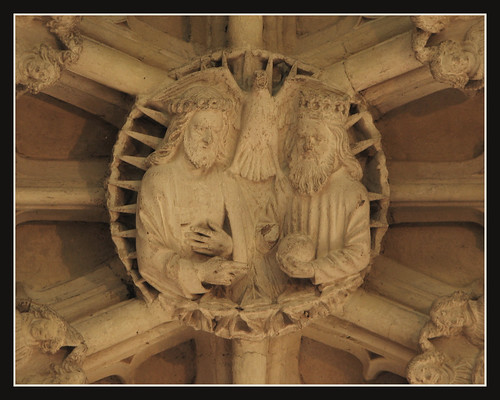
Friday, 26 September 2008

The Mother of All Biblical Metaphors!

The Exodus with its elements of slavery, passover and redemption, and following this, the narrative of desert, covenant, rebellion and promised land, is one of the dominant interpretive lenses of the Bible. An immense amount of Scripture is refracted through this narrative. Not only this, it is the pivot on which the whole of the biblical story moves. Prior to it we have Genesis 1-11, outlining to us the universal predicament of human kind. God's response to this predicament is to bring redemption, and this begins with the call of Abraham and Sarah, leading (eventually) to the slavery of the people of Israel in Egypt. And then, after the Exodus and entry into the promised land, we have the settlement leading to the Exile and the Return, with the latter seen as a new Exodus in Isaiah 40-55. And let's not forget the theme of rebellion and pedagogy in the desert (Hos 11:1-4), or the flight of Elijah to the mount of God. (1Kings 19). And then there is Jesus. Think of the links between their stories: the Holy Innocents (Matt 2:16-18), his call out of Egypt (Matt 2:15), his temptations in the desert (Matt 4:1-11), the transfiguration (Lk 9:28-36), the death of Jesus at Passover (Jn 19:14) and his identity as 'the lamb of God" (Jn 1:36). And then there is the beautiful litany over the water in A Prayer Book for Australia, including,

"We give you thanks that through the waters of the Red Sea you led your people out of slavery into freedom, and brought them through the river Jordan to new life in the land of promise."

And I could think of all this without trying - just shows how much there is. And consider the influence of the Exodus on Western culture generally, with our proclivity toward freedom from slavery, and all the liberation movements sprung from the basic metaphor of the movement from slavery to liberation and life in the promised land. Not to mention the Jewish/Christian insight that the voice of the victim is the voice of God, pre-eminently shown in the crucifixion, but also in the Exodus.

As the basic metaphor of the Christian life, the story of the Exodus should be taken seriously.
For example, everyone wants to go to the promised land, but rarely do we think that we should go there via the desert. And even when we do go via the desert, we seem to think we have left there before we really have. Life in Christ does not allow us to avoid the basic structure of the movement from liberation to the promised land. This is one of the basic insights from the desert tradition of the church with its discipline and asceticism. (Literally, for many of them, in the desert. See inset, St Catherine's Monastery at the foot of one possible site for Sinai.) The desert is where we learn to rely on God, and where our desires for the 'fleshpots of Egypt' can be purged. Here we will hear the voice of God, live into the convenant and hear the call of God wooing us and preparing us for entry into the promised land.

Isn't this so much our experience now? While we have whiffs of the promised land, our life now is to be thought more a preparation for the promised land, a land we have not yet reached. (Rowan Williams spends some time on this idea of the church as preparatory for heaven in Tokens of Trust, Chapter 6, focussing on the idea of becoming familiar with the truth so that, on the day of judgment, our experience is not quite so terrifying! On the theme of not yet reaching the promised land, see Heb 11:39-40) It is important to realise this, as it can prevent misunderstanding our experience, as though because we are not continually experiencing complete and unhindered intimacy with God we are somehow losing our faith, or worse, think that there isn't really a God! Or because we question and complain at times we are somehow alien to the Christian experience. None of this is true. The desert can be hard, we can hanker after Egypt, wonder where God is, yet in the midst of this have a deep sense of God's care for us and guidance toward the promised land. And even, at some point, realise the way in which God provided for us through the desert.

[Pentecost 20(A), September 28, 2008]

Thursday, 25 September 2008

Reading Scripture: Not Always as Easy As We Might Like it To Be

We all know that we are meant to "believe" everything in the Bible. And that we should eschew those complex readings that seem to make the Bible say exactly the opposite to what a simple reading suggests. But maybe reading the Bible isn't quite as simple as it sounds. Try this:

"So, therefore, none of you can become my disciple if you do not give up all your possessions." (Lk 14:33)

The plain meaning of the text is clear; discipleship of Jesus demands a practical renunciation of all one's possessions. Some have read this kind of passage that way, and I think here in particular of St Anthony and, in the twentieth century, Dorothy Day. But most of us would not take this verse as something to be believed and followed literally. We might try and categorise it as hyperbole, or we might look to its wider context in the Bible, including the Gospel of Luke, the rest of the New Testament and the whole Bible. We might discover that in Luke, although he has the first generation of disciples give up everything (e.g. compare Mk 1:20 & Lk 5:11), there are plenty of indications that this response is not necessarily required of every disciple since.

Let's try another one; the bizarre story of Jephthah and his nameless daughter. (Judges 11:34-40) He makes a vow to God to ensure victory against his foes, to sacrifice what/whoever first meets him when he arrives home. Unfortunately (particularly for her), it is his daughter, and so she is offered up as a burnt offering. (No alternative victim sent by God in this story. Cf Gen 22) What are we meant to make of that? Is his behaviour to be lauded (or at least vindicated because he did, at least, fulfill his vow, even if it was a stupid one) or condemned? The last few verses about the tradition of mourning might be a mild (although ambiguous at best) critique of his oath and actions. And in the wider context of Judges, he fits the flawed character of many of the judge protagonists. And in the wider context of the OT and its disapproval of human sacrifice, it is inconceivable that this story now functions in the Bible as a recommendation for faithfulness, no matter how it was understood when written. I suspect that is how most of us would see it.

But it gets more complicated. Hebrews 11:32 cites Jephthah as a model of faith. (Although exactly what is being remembered is not stated.) And didn't the father sacrifice the Son (Jesus)? Many take this to be literally true, which would then mean Jephthah's actions could at least be vindicated. A straight reading of the text is perhaps not as easy as some might claim.

Tuesday, 23 September 2008

Resurrection: Leaving Nothing Behind

"The belief in resurrection tells us that what God wants to hold in everlasting life isn't some shadowy fragment of ourselves but the person we have become, body and soul." (Rowan Williams)

Monday, 22 September 2008

Love (III) by George Herbert


Rowan Williams says of this poem, "What more is there to say in the wake of this, the greatest Christian poem in the English language?" (Tokens of Trust, pp. 149-150.)


Love bade me welcome, yet my soul drew back,
Guilty of dust and sin.
But quick-ey'd Love, observing me grow slack
From my first entrance in,
Drew nearer to me, sweetly questioning
If I lack'd anything.

"A guest," I answer'd, "worthy to be here";
Love said, "You shall be he."
"I, the unkind, the ungrateful? ah my dear,
I cannot look on thee."
Love took my hand and smiling did reply,
"Who made the eyes but I?"

"Truth, Lord, but I have marr'd them; let my shame
Go where it doth deserve."
"And know you not," says Love, "who bore the blame?"
"My dear, then I will serve."
"You must sit down," says Love, "and taste my meat."
So I did sit and eat.

Sunday, 21 September 2008

Study Notes For Rowan Williams, 'Tokens of Trust' Chapter 6

Again, this chapter is not difficult. It is about the church, about being Christian imperfectly, and about our final hope. And it is all grounded in his first three chapters really, where Williams has laid the trinitarian groundwork of understanding ourselves and the hope we have been given.

  1. On pg 136 Williams mentions in passing one of the great theological movements of the 60s that remains prevalent in one form or another in the diocese of Adelaide! This is the death of God movement, which poured out divinity onto the earth to the extent that God becomes the sum total of human aspiration. The death of Godites were deeply impressed by Jesus, and sought to free him from the accretions of doctrine and church verbiage. They loved what he stood for, but ignored Jesus' relationship with the Father, a relationship that defines him in the
    Scriptures. Williams says "it is just not possible to empty out of Jesus' story this constant, all-pervading, sometimes dark and agonizing, always decisive relation to the mystery out of which he comes." (136)

  2. Williams closely allies the church to the Trinity, this 'threefold rhythm of love." (136) The church is an image of the Trinity, where diversity and identity are not inversely related, but our 'individual' identity is bound up with others, to whom I am related. However, he cautions of thinking that the Trinity and the church are two inter-related examples of communion. We are drawn into the communion of love that is God, and do not possess this communion in our own right.

  3. I particularly like his emphasis on our participation in the church now as preparatory for the kingdom that is to come. It will be a bodily life of community that will not be less than this life, which is part of the reason why we believe in the resurrection of the body. (Here is one to remember: "God does not redeem us by making us stop being what we are..." (141)

  4. Our hope does not lie within our power to grant. Our hope is in the faithfulness, trustworthiness, of God. Immortality is correctly predicated of God, not us, and we gain our eternal life derivatively from God. There is no shard within us awaiting release to zoom back to God. (138-144)

  5. Perhaps surprisingly for many Anglicans, the Archbishop provides a positive account for the necessity fo some kind of purgatory. (144-150) We have distorted our humanity, and the redemption given to us in Christ will undo that twist and distortion. And this will hurt. We gain some practice in this in our discipleship now. Coming face to face with the truth brings challenge and pain at times. Purgatory should not be thought of as an intermediate state, but just a recognition that in our continuing journey with God, as we are formed more fully into the likeness of Christ through love, the transformation will not be painless.

  6. But what of hell? We must always hold open the possibility, for we know the depths of our unwillingness to face the truth, and its consequences. But this leads to why a focus on our failure is so important in the Christian schema, and full of hope. The church points to God as its hope, not its own holiness. And this applies to us all as individuals.

  7. And don't miss a beautiful account of the importance of contemplation in our lives and the life of the church. (155-159) Contemplation strips away all the false identities, and all the ideas and emotions and behaviours attached to these false identities. Indeed, to even let go of what makes us happy. (156) And all this to put distance between us and our usual comforts so that we might have a chance of seeing the truth, which will be strange and disorienting.

  8. And finally, what might a trinitarian experience 'feel' like? Don't be surprised if it is not like talking to someone on the other side of the room, despite the fact that we use the language of 'person' to describe God. Father, Son and Spirit are not literally persons. We should know this is immediately true, because the trinitarian persons are present to each other internally, simultaneously. "Something is is going on that is deeper than that, but no less personal, no less a real relationship, but something that doesn't depend entirely on how we feel and what we think: a pouring-in of God's love that will steadily transform us from the inside." (158; see Romans 5:5)

Saturday, 20 September 2008

Workers in the Vineyard (Kids' Talk)

Matthew 20:1-16.

Act out the parable with a clock to manipulate the hours, and a few gardening tools. Get the kids out there play acting it out. Bring in a few new workers as in the parable. Play it up a bit, "How does it feel out there in the heat', that kind of thing.

Then bring in the last group. What do the kids think? Quite simply, this is how God does it. Just becasue you are a disciple of Jesus your whole life doesn't mean you get a bigger reward! God wants to reward everyone, no matter how much they do!

[Pentecost 19(A), September 21, 2008]

Friday, 19 September 2008

Ordinary Religion (vs The Gospel)

[Matthew 20:1-16]

Ordinary religion says that we all meet a fork in the road; one way goes to hell, the other to heaven. Follow the rules (whatever they happen to be, whatever it is you are meant to believe) and you go to heaven, don't follow the rules and the way to hell opens up. Its religion as law, and there is plenty of it about. It is ultimately about remaining in control within our relationship with God. The recluse in the story below is a member of ordinary religion.

When God walked into heaven and found that everyone was there, he wasn't pleased at all. He owed it to his justice, did he not, to carry out his threats. So everyone was summoned to his throne and the Angel asked to read the ten commandments. The first commandment was announced. Said God, 'All who have broken this commandment will now betake themselves to hell'. And so it was done. The same was done with each of the other commandments. By the time the Angel came to read the Seventh, no one was left in heaven except a recluse - smug and self-complacent. God looked up and thought: 'Only one person left in heaven? That makes it very lonesome." So he shouted out, 'Come back, everyone!' When the recluse heard that everyone was forgive, he yelled in rage, 'This is unjust! Why didn't you tell me this before?' (Anthony de Mello, The Song of the Bird, pp138-139.)

The recluse did his part of the bargain, and when God 'changed' the rules, he lost control. Personal interest does not take us all that far down the road to God. (It can take us a little way, as it turns out, but becomes a dead end if we can't jump tracks. More on that in a future post on the four degrees of love.)

Contrast this to the gospel. The gospel is not about control, but about grace. The gospel still holds out the possibility of damantion, but does not conceive of two equally wieghted roads. The road to salvation in Christ is heavily weighted in our favour, with the possibility of damnation remaining. In God's kingdom the rules of ordinary religion do not apply so neatly.

The kingdom of heaven is like a landowner who went out early in the morning to hire labourers for his vineyard. 2After agreeing with the labourers for the usual daily wage, he sent them into his vineyard. 3When he went out about nine o’clock, he saw others standing idle in the market-place; 4and he said to them, “You also go into the vineyard, and I will pay you whatever is right.” So they went. 5When he went out again about noon and about three o’clock, he did the same. 6And about five o’clock he went out and found others standing around; and he said to them, “Why are you standing here idle all day?” 7They said to him, “Because no one has hired us.” He said to them, “You also go into the vineyard.” 8When evening came, the owner of the vineyard said to his manager, “Call the labourers and give them their pay, beginning with the last and then going to the first.” 9When those hired about five o’clock came, each of them received the usual daily wage. 10Now when the first came, they thought they would receive more; but each of them also received the usual daily wage. 11And when they received it, they grumbled against the landowner, 12saying, “These last worked only one hour, and you have made them equal to us who have borne the burden of the day and the scorching heat.” 13But he replied to one of them, “Friend, I am doing you no wrong; did you not agree with me for the usual daily wage? 14Take what belongs to you and go; I choose to give to this last the same as I give to you. 15Am I not allowed to do what I choose with what belongs to me? Or are you envious because I am generous?” 16So the last will be first, and the first will be last.’ (Matthew 20:1-16)

What is the antidote to ordinary religion? The gospel of Jesus, of course. But how do we enter the upside down world of the gospel? Here are a couple of clues:

  1. This is not popular at the moment, but start with your own failure, and your moral equivalence (in failure) with every other human being. Then remember grace.

  2. But more importantly, love God. The grace of God gives us the gift of responding to God, and the response we are given is love of God. The more we love God the less we begrudge God's grace shown to others, and, sometimes only eventually, we come to see the grace that is at the beginning and end of our response of love.
Another story to finish.

Jesus began to teach in parables. He said: the Kingdom of God is like two brotheres who were called by God to give up all they had and serve humanity.

The older responded to the call though he had to tear himself away from his fiancee and his family and go off to a distant land to spend himself in the service of the poor. Years later he was imprisoned for his work, tortured and pt to death.

And the Lord said, 'Well done my good and faithful servant! You gave me a thousand measures of service. I shall now give you a thousand million measures of beatitude. Enter into the joy of your Lord.

The younger boy ignored the call. He married the girl he loved and prospered in his business. He was kind to his wife and children and gave an occasional alms to the poor.

And when he came to die, the Lord said, 'Well done my good and faithful servant! You gave me twenty measures of service. I shall now give you a thousand million measures of beatitude. Enter into the joy of your Lord.'

When the older boy was told that his brother was to get the same reward as he, he was surprised. And he rejoiced. 'Lord,' he said, 'had I known this at the time you called me I know I would have done exactly what I did for love of you.' (
Anthony de Mello, The Song of the Bird, pp. 134-135.)

[Pentecost 19(A) September 21, 2008]

Wednesday, 17 September 2008

Creation's Dependence on God


Creation is an action of God that sets up a relationship between God and what is not God. Eternally, there is just God – outside time because he doesn’t get better or worse, or change in any way. And time begins when God speaks to call into being a world that is different and so establishes a reality that depends on him. It depends on him moment by moment, carried along on the current of his activity. Behind and beneath everything we encounter is this action. (Rowan Williams)

Tuesday, 16 September 2008

If Salvation is for Any...


If salvation is for any, it is for all…. The ‘return’ to the lost, the excluded, the failed or destroyed, is not an option for the saint, but the very heart of saintliness. And we might think not only of Jesus’s parable of the shepherd, but of the great theological myth of the Descent into Hell, in which God’s presence in the world in Jesus is seen as his journey into the furthest deserts of despair and alienation. It is the supreme image of his freedom, to go where he is denied and forgotten…. He comes to his new and risen life, his universal kingship, by searching out all the forgotten and failed members of the human family. (Rowan Williams)

Sunday, 14 September 2008

Study Notes For Rowan Williams, 'Tokens of Trust' Chapter 5


The book is getting easier. Three highlights to look out for are what he says about the meaning of peace, the nature of the church, the Eucharist, and the Bible.

  1. The meaning of peace not as an absence of conflict or tension, and this includes inner peace, but peace as a dynamic giving and receiving within relationships with others. And there is always some 'action' happening in relationship! 'Peace' as conceived by many is more like escape.

  2. The church echoes the Trinity as neither individualism nor communitarianism, but personal. (Think about the person of the Father: the more he is father, the more he relates, thus person brings 'individuality' and relationship into proportionate relationship.) In this regard Williams mentions the early church metaphor of 'Body of Christ', and points out that its Christian use goes beyond the functional interpretations of paganism. The church as the Body of Christ is about gift giving and receiving, with each unique member called to bring their unique contribution to the common life. This is not just a functional perspective, but recognises that the gift of God is personal, directed to us and shared via our uniquely personal presence and activity. Not just about functional giving, but the gift giving of ourselves, albeit through ministries.

  3. The Archbishop says a lot of good things about the Eucharist, particularly relating it to the work of the Spirit and baptism. The Eucharist is not magic, but the work of the Spirit in extending the presence of Jesus in this action of making eucharist. The sharing of the bread and wine through Christ (and addressed to the Father in thanksgiving), prefigures the end of all things, when all that is will glorify God through Christ in the power of the Spirit. The eucharist gives us a clue to the cosmoc nature of salvation (just in case the Incarnation isn't enough!).

  4. Jesus is the Word of God, not the Bible. The Bible is the primary witness to Christ and is not a text of magic answers to life's questions. It witnesses to a history and a life: God's history and life (Father and Son), and God's history and life with the cosmos in Christ.

Friday, 12 September 2008

Pure Forgiveness

Jesus comes across a bit on the excessive side at times. Hyperbolic, we might say. If someone takes your coat, give them your shirt also (Lk 6:29); turn the other cheek (Lk 6:29); how many times should I forgive my brother or sister? (Matt 18:21-22) And, in one of the parables Jesus uses to teach about forgiveness (Matt 18:23-35), notice the ridiculous amount of debt that is forgiven. (10,000 talents = 150,000 years of a labourer's wage!) It is easy to set our sights too low when it comes to forgiveness. (Or difficult to set our sights higher.)Most forgiveness is that which is 'earned' in some way. We find it easier to forgive someone who has shown remorse or repented their actions, than if they remain unrepentant. We are then able to respond with a suitable response of forgiveness, and a bridge over the trouble is built through this 'negotiation' of repentance and forgiveness. Note though, in this process the repentant person has already moved on from the sin and the kind of person they were. We are not forgiving the sinner per se, but an improvement on them! This is our usual modus operandi in respect to forgiveness. There is nothing wrong with this, and it is very practical in all areas of human life, ranging from the interpersonal to the public and political. Saying 'sorry' has become part of the political landscape, and we find it easier to move on with the apology than without. But there is a purer forgiveness: the utterly gratuitous forgiveness of the sinner and the sin without prior repentance. This is forgiveness worthy of the title of forgiveness. How difficult it is to forgive the sinner who has not repented and continues to be the person capable of recommitting the sin. Purer forgiveness, but much harder. We rarely see it, even more rarely (if ever) live it ourselves. The purest forgiveness is implied in this less perfect form of forgiveness but is displayed to us in the death and resurrection of Jesus. Jesus is God forgiving us before we repent, before we make ourselves worthy of forgiveness. (Rom 5:6-11) In Jesus Christ, the pure forgiveness of God is made manifest and efficacious for all. (Rom 5:18-21) When we repent it may feel as though the forgiveness we receive from God comes in response to that repentance. However, the possibility of repentance is a gift we received within the gratuity of pure forgiveness. That is, God's forgiveness is pure, and it leads to repentance, to that very practical kind of forgiveness we are all so familiar with. No matter how hard we try, and no matter how successful in changing, all of it comes to us through the gratuity of pure forgiveness. (Lk 7:36-50) [Pentecost 18(A), Matt 18:21-35] See J. Derrida, 'On Forgiveness'.

It's About Ideas and Information

The key to ministry is not coordination and administration, but the sharing of information and ideas. (Easum and Bandy)

Thursday, 11 September 2008

Its about Continuity and Change

The only way to preserve values over time is to be involved continuously in renewal and change, thus finding ever fresh expressions for those values. When any organization decides it will seek to save its life by building walls against change, that organization is destined to lose its life and vitality. It is through such concepts as ‘continuity and change’ and ‘stability in motion’ that we find the path that leads to ever new organizational life. (Lovett H. Weems Jr)

Wednesday, 10 September 2008

It's About a Dream

There is no freeway to the future. No paved highway from here to tomorrow. There is only wilderness. Only uncertain terrain. There are no road maps. No signposts. So pioneering leaders only rely upon a compass and a dream. (James M. Kouzes & Barry Z. Posner)

Tuesday, 9 September 2008

It's About Vision

Vision is a gift from God. It is the reward of disciplined, faithful, and patient listening to God. Vision allows us to see beyond the visible, beyond barriers and obstacles to our mission. Vision ‘catches us up’, captivates and compels us to act. Vision is the gift of eyes of faith to see the invisible, to know the unknowable, to think the unthinkable, to experience the not yet. Vision allows us to see signs of the kingdom now in our midst. Vision gives us focus, energy, the willingness to risk. It is our vision that draws us forward. (Bishop Rueben P. Job)


Without a compelling vision there will be a vacuum in which almost nothing is happening, but in which almost every problem becomes exaggerated. (Lovett H. Weems Jr)

Monday, 8 September 2008

Study Notes For R. Williams, 'Tokens of Trust' Chapter 4


“Fearlessness in giving has to find its place at the heart of things…” (83)

1. God’s desire for us and our world is an ‘economy of gift’ (82) whereby we live by a mutual generosity. But this is not the world we live in, and none of us seem to be able to break this cycle of ‘original sin’, which is merely the observation that we are all born into this imperfect world, and exhibit this imperfection in our lives. Thus we have weaved a tangle of selfishness “that goes back to the very roots of humanity.” (82)

2. Jesus is the break in the cycle that is needed.(83) The break must be genuinely human (or it won’t break the human cycle), but it must also be divine to effect the transformation required, for only God is so utterly free as to be able to give utterly selflessly. (This selfless giving is the very nature of God, Father, Son and Spirit.) This is why the doctrine of the two natures in Christ is so important; it verbalizes the experience of being saved by a human act, but one carried out by God in person.

3. Jesus, as Son in relationship with the Father, is this living out in history of the Trinitarian life of unrestricted and utterly consistent love. Utterly consistent remember because God is an utter fullness of love already and does not need us in this sense.) And in him this love is turned also toward us, so that the love we see and receive in Jesus is the total and unselfish giving of God. Through Christ, who is both God’s love turned to us and the Son in person in relationship to the Father, the very life of God is brought into history, personally. Think of Jesus as the intersection of God’s own life of love with the world.

4. But when love meets sin, the cross is the result. (84-85) Notice some of the New Testament metaphors for the death of Jesus (87-88) Williams picks up. None are literally true (which doesn’t mean they are meaningless), but all help us understand the depth and comprehensiveness of the salvation wrought in Christ. “The single central thing is the conviction that for us to be at peace Jesus’ life has to be given up. It isn’t that a vengeful and inflexible God demands satisfaction, more that the way the world is makes it unavoidable that the way to our freedom lies through the self-giving of Jesus, even to the point of death.” (88)

5. The descent into hell, pp. 88-89. Don’t get hung up on this, the point is that Christ’s salvation is universal and complete: nowhere is safe from it! The dereliction of the cross finds its nadir in the descent to the dead/hell, that place of utter godforsakenness. This follows the logic of the substitution of the cross to its (theo)logical conclusion.

6. Interesting argument for the reality of the bodily resurrection of Jesus, not just as a personal/psychological appearance (91-2). The resurrection is the triumph of God over evil and sin, but the theology of resurrection focuses on Jesus, not this triumph in abstract terms. This suggests that the disciples could not dispense with Jesus when talking of resurrection.

7. Through the giving of the Spirit to us (see John 20) we receive the new humanity that is possible through Jesus ‘the break’ in original sin. The cycle is broken in him, and transmitted to us. (92) This Spirit we receive is not just a Spirit of loving other people, but is the Spirit of the love of Father and Son, the love that is free and unrestricted self-giving. (The latter is possible because of the former.) This parallels Jesus’ relationship with the Father on the one hand, and on the other hand, his relationship to the world.

8. The victory of Christ and the giving of the Spirit now have led some to think that the end has already come. Wrong. And this includes all those who cease to act rightly because they believe the end is nigh. We are assured of the future victory, but as the future. (This is one reason why it is important to see the resurrection as the future come to meet us, rather than a past event like the cross. The victory is not locked in the past, ineffective against current evils.)

9. In speaking of the second coming, Williams remembers a saying of Luther who said that if he knew the world was ending tomorrow he would plant a tree today! This is because to do so is good in itself, and doing good is important no matter how short the time frame. (98) So caring for the environment, or doing justice, is the right thing to do and to do now, even though the resurrection will transform everything.

10. Notice the interesting interpretation of ‘Lead us not into temptation’ (99). The light of Christ’s love is not just all beer and skittles. There is the pain of transformation, transforming the persons we have made ourselves by following the channels of original sin. Williams says that ‘save us from the time of trial’ is asking to be spared this final transformation until we have had the time to do some more work now, so that the final judgment won’t be quite so painful. 11. Sharing in the communion of Holy Spirit doesn’t just mean receiving an external gift, but receiving the Spirit that transforms our very natures. (101) What we share – our human nature – is transformed into the likeness of Christ himself. (The Word of God, by becoming an obedient human person, perfects our nature, and this perfection is transferred to us.) This new nature echoes the Trinitarian life itself, a nature that is constituted by mutual giving and receiving. (102) Thus the cycle of original selfishness, broken in Christ, becomes universal

Its About Leadership

The time for leaders has come, the time for enablers has passed. (Kennion L. Callahan)

Sunday, 7 September 2008

Where Two or Three Are Gathered


Cathedral Service

I’m only here because I wandered in

Not knowing that a service would begin,

And had to slide into the nearest pew,

Pretending it was what I’d meant to do.


The tall candles cast their frail light

Upon the priest, the choir clad in white,

The carved and polished and embroidered scene.

The congregation numbers seventeen.


And awkwardly I follow as I’m led

To kneel or stand or sing or bow my head.

Though these specific rites are strange to me,

I know their larger meaning perfectly-


The heritage of twenty centuries

Is symbolised in rituals like these,

In special modes of beauty and of grace

Enacted in a certain kind of place.


This faith, although I lack it, is my own,

Inherent to the marrow of the bone.

To this even the unbelieving mind

Submits its unbelief to be defined.


Perhaps the meagre congregation shows

How all of that is drawing to a close,

And remnants only come here to entreat

These dying flickers of the obsolete.


Yet when did this religion ever rest

On weight of numbers as the final test?

Its founder said that it was all the same

When two or three were gathered in his name.


Peter Kocan

Saturday, 6 September 2008

Discipline and Forgiveness (The Structure of Matthew 18)


Matt 18:10-20.

Where two or three are gathered..." This is the verse we usually focus on in Matt 18; the presence of Jesus is not dependent on huge 'success'. True enough, and it gives a bit of a warm fuzzy, especially to dwindling congregations or persecuted churches. But let's not miss what else is also going on in this text. But to do this we need to look at all of Matt 18, which can be divided up into four basic parts. The first section talks of the need for humility(18:1-5) . Given the next section's focus on the need for leaders to care for those they lead, and the question about greatness at 18:1, it is probable that this section is a warning to the leaders of the church, offering a practical solution to the ever-present problem of arrogant leadership.

Section 2 is 18:8-14 warns these leaders about the judgment to follow if they disdain even the least of the Christian community. None should be lost. But alas, while this sounds like a recipe for harmonious communal relations, such is not the case. Section 3 (18:15-20) provides the church with a simple procedure by which recalcitrant members of the church can, to be anachronistic, be excommunicated. ("Let such a one be to you as a Gentile and a tax-collector"; although see 9:9-13). Try to work it out the text says, but if , then take witnesses to see if they can talk some sense into the person, and if the person persists, let them be judged in front of the entire church. God will uphold the decision (18:18 "... will be bound in heaven", a theological passive, that is, God will do it) of the disciples, "For where two or three are gathered in my name, I am there among them. (18:20)

But we can't stop there. Section 4 is that beautiful teaching of Jesus on forgiveness that is a direct response to the arrogant mega-vengeance of Lamech in Gen 4:15 & 22. (See Matt 18:21-22) , followed by the parable of the unforgiving servant. The teaching of Jesus is a response to the universal predicament of humankind, offering an abundance of forgiveness as an antidote to the hubris of disproportionate vengeance. (And this forgiveness that we practice toward others mimics God's forgiveness of us, Matt 18:23-35.)

A couple of things to notice about the structure of the chapter. First, the sections on potential relationship breakdown occupy half the chapter, while the need for forgiveness occupies the remaining half chapter. There is a suggestion here, I think, of the importance of forgiveness no matter what else is said about particular instances of church discipline.

Second, while forgiveness seems to be the primary and overriding imperative here, church discipline cannot be excluded. Arrogant leadership brings judgment (threatened eternal judgment, see 18:3, 8-9), and improper behaviour linked to an arrogant unwillingness to be corrected results in 'ex-communication' (with earthly consequences and heavenly implications, see 18:18-20)

By holding all these threads together without a simple resolution the passage reflects the complexity of real life. It just isn't enough, in the face of serious ecclesial failure, to speak only of forgiveness. Similarly, however, heavy-handed punishment is overriden by the dominical imperative to forgive.

Friday, 5 September 2008

Reading Scripture

How to interpret Scripture has always been the key to the Christian faith. Even before we had the writings that ended up in the New Testament it is clear that people were working the Scriptures.

So how do we read the Scriptures? The most important point is to read each part according to the whole. This is a tricky thing because we are reading Scripture and working it well before we understand the whole. This is one reason why dismissing Scriptural texts, especially ones representative of the important themes of Scripture can prevent the reader ever understanding the whole.

A few examples at this point. Take some of the well known stories of Genesis 1-11. They are not meant to be read literally; this is not the point of why they are where they are in the Bible. Genesis 1-11 is, if you like, setting the scene for what is to unfold in the remainder of the Bible. These stories represent the universal predicament of humankind and creation, the cul de sac from which we are to be liberated. Genesis 12, on the other hand, begins God's response to the universal predicament. The response is the calling of Abraham and Sarah, culminating (if I am permitted to telescope things a bit!) in Jesus. To become bogged down in the historicity of Adam and Eve or the ark is to miss the point of how these stories function in the Bible. (Reread Romans 5:18-21 with this in mind as it will make a huge amount of sense of what Paul is saying.) In this case we read these first chapters in the light of the total structure of Scripture.

John 14:28 is another example of the need to read from the perspective of the whole.
Jesus says "The Father is greater than I." The heretics love this because they use it to reinforce their alien understanding of the eternal relationship between the Father and Son. The Son is not eternally subordinate to the Father. If it were so that the Son was eternally subordinate, the whole gospel unravels, for God remains the shadowy figure behind Jesus and our salvation is not inclusion in the very life of God but a subordinate relationship. Read from the perspective of the whole (and in this case the whole as represented in the historic Creeds of the Church) this verse does not mean an eternal subordination. It refers to the manner in which the eternal self-effacement of the Son is translated in the life of the incarnate Christ.

But how do we work each portion from the perspective of the whole? It is essential to work each part of Scripture, no matter how small, on its own terms. But 'on its own terms' includes the wider context of the passage. So one must work a few verses in the context of the chapter, the book, the testament, the whole Bible, and the historic faith of the church derived from working these Scriptures before you and I were even around.

It is important for each of us, as we work Scripture, to bear in mind the whole that we are constructing. Does the Scripture we are working fit the whole? Before it is rejected, it is important to gain a sense of why it doesn't, and in rejecting it how much other Scripture we are leaving out. The less Scripture left out from our 'whole', the better. (And please, unless you are of the stature of Hans Urs von Balthasar or Karl Barth or the like, don't tell me you include all Scripture in your 'whole'. Indeed, even those two greats probably struggled with some of Scripture and how to fit it into the whole.) It is more likely that, instead of rejecting a piece of Scripture, it can be reworked in the light of the whole. A few examples of this latter procedure will follow in the near future.

God Almighty


"When we express trust in ‘God the Father almighty, maker of heaven and earth, and of all things visible and invisible’, we affirm that we have grounds for hoping that our lives, in all their fragmentedness, their conflict and their imperfection, can be held and drawn into cohesion – just as the diverse and alarming world itself is held in cohesion – so that God’s own self-consistent active love and beauty may be reflected within the universe." (Rowan Williams)

Thursday, 4 September 2008

Chalcedon, prosaically stated

Jesus turned towards the world is God's wisdom and power in action; but Jesus turned towards the Father is the embodiement of a sort of divine response to divine generosity, the Son turned towards the Father. The life of God is not only the outpouring gift, it's a life in which our own response of selfless gratitude and response is also foreshadowed for ever. Jesus is divine responding embodied in our nature and our world; he responds freely and totally to the gift of the Father, and that response is no less divine than the gift - a perfect response that is both human and more than human. (Rowan Williams)

Wednesday, 3 September 2008

God is Not the One Who Pushes the First Domino

St John's Chapel, Exodus 3:1-15, the great 'I AM.'

Here is how one of the arguments for the existence of God goes. Here I am, but there is a cause as to how I got here, and a cause behind that, behind that, behind that.... until we get to God. (I had a line of dominos to push over, starting from the first domino to elucidate the point.)

And the question that comes to mind immediately? Who caused God.

Exactly. And that's why the proof doesn't work.

Except it is not the argument that Christianity developed. We don't think God is one cause among many, who just happens to be the first cause next to the first domino.

I'll come back to this.

Turning to the story today. God has heard the cry of the people, the cry of the oppressed, and God intends to free them from their slavery and lead them into a prosperous land flowing with milk and honey. Moses is a bit non-plussed by it all, and asks for God's name. And God says, "I AM".

Strange; it is incomplete. "I am a man, I am Warren Huffa, I am human, I am not a chair, etc; all these are sensible and complete. They define who I am, and do this partly by defining that I am not you, not that chair, etc. But "I AM"?

God just is. God is already complete. God doesn't need to define God's self any further, no need to define God's self over against something else. God just is.God doesn't need us to be complete. This stretches our theological imagination. Christianity thinks of God as absolutely full, with no need to define Godself in relationship to you or I, no need to compete with you or I.

Go back to the example of the dominoes. God is not therefore the one who starts the dominoes off. God is more like the reason why there are any dominoes at all. What pushes them over is as natural as the dominoes themselves. [This means that belief in God is not an alternative to science in explaining the functioning of the universe.]

When you next come to chapel I am going to use this in a subtle piece of theology, but a life transforming one.

In the Stillness

Eternal God, show us how deeply important it is to care and not to care, to let go and allow you to be Lord.

Lord, teach us the silence of humility, the silence of wisdom, the silence of love, the silence that speaks without words, the silence of faith.

Lord, teach us to silence our own hearts and minds: that we may listen to the movement of the Holy Spirit within us and sense the depths which are God. Amen.

Tuesday, 2 September 2008

The Log in Your Own Eye

St John's Chapel, Luke 6:41-42.

Who likes being gossiped about? No one?
Now, who has gossiped about someone else? You get the point.

No one likes it being done to them, but we all do it. And if you haven't done it, you will. Don't feel bad though; welcome to the human race!

Jesus knew this about us. He likened it to missing the plank in your own eye while criticizing someone else for the matchstick in their eye. (I had a plank and a match held up at this point.) That is, we apply standards to others that we do not maintain ourselves, and are often oblivious to this blindness.

Why? Well, I suppose we feel better about ourselves when we do it. But it gives us a false sense of self and fractures community. There is a better way to strengthen our sense of self rather than criticizing others, and, at the same time, have the courage to face our own truth and do something about it. The key is finding our sense of self in God. This does not mean that we can't find our own sense of self, but just that we do not rely on ourselves alone, for then we will tend to reinforce our sense of self at the expense of others.To find our sense of self in God is to give ourselves a foundation that is solid in itself, not requiring us to pull others down to build ourselves up.

Monday, 1 September 2008

The Desires of the Flesh


St John's Assembly, Galatians 5:13-1, 22-23.

Some people say that we are the most sexually liberated and free generations of humans ever. And that we have successfully thrown off the chains of sexual oppression that held back former generations.

Well, historically, not exactly true in the way we think. Not true that former generations were necessarily sexually chained in all respects. And certainly not true that this generation is liberated in comparison. It seems to me there are new chains. Like peer pressure, to be cool means, for some, to be sexually active. It doesn't look anything like freedom from where I stand. Looks more like a new oppression to me. But I am just a priest... Resist the pressure, and you might find freedom. That will take courage, and character, and I am starting to learn that courage and character are here in abundance.

Christianity has been criticized for being one of those forces historically that said sex was bad, that anything that was enjoyable was bad. Some truth in that, I am sad to say. But not exactly true. I missed that bit in my Christian formation. I found what Christianity has always said, and it is this: whatever we do, however we exercise our freedom, if what we do is done selfishly, or if the result of our freedom is the pain of another, then it's wrong; if it is done out of love, consideration for the other, then it is right. True freedom does not lie in doing whatever we like. True freedom lies somewhere else.

St Paul in today's reading from the Bible says that true freedom is to be found in the Spirit of God. He contrasts the fruit of the Spirit with the consequences of selfishness. Selfishness brings with it enmity, jealousy, anger, envy and the like. Of course it does, because selfishness (no matter how free it seems) is about me, not us. The Spirit of God, in contrast, brings with it love, joy, peace, patience, kindness, generosity, faithfulness, gentleness and self-control. Nothing enslaves this Spirit and its fruit, and this Spirit, the Spirit of Jesus, leads to true freedom.

Let us pray.
Jesus, in your life and teaching you showed us the way to true freedom, a freedom that cannot be bound by selfishness, but instead leads to life in abundance for all. We pray for hearts that are free, free to love, free to be joyful, free to be generous, and free to be peaceful.
Give us the courage to choose to be truly free. Amen.

Sunday, 31 August 2008

A Prayer for the Heart

Let us pray for wisdom. Let us pause from thinking and empty our mind. Let us stop the noise. In the silence let us listen to our heart. The heart which is buried alive. Let us be still and wait and listen carefully. A sound from the deep, from below. A faint cry. A weak tapping. Distant muffled feelings from within. The cry for help.

We shall rescue the entombed heart. We shall bring it to the surface, to the light and the air. We shall nurse it and listen respectfully to its story. The heart’s story of pain and suffocation, of darkness and yearning. We shall help our feelings to live in the sun. Together again we shall find relief and joy. Amen. (Michael Leunig)

Saturday, 30 August 2008

Moses and the Burning Bush (Kids' Talk)


Pentecost 16(A)

What would God have to do to get your attention?...
How about making the lights go off, now! (Have this organised)
They'll see through it. If they don't go with the whole miraculous thing as getting their attention.

Then into the story. Last week we left Moses growing up in the palace of the king, called Pharaoh. Moses fought with the Pharaoh, and so he had to leave and go and live in the desert as a shepherd. For a long time. But God came to Moses becasue God has a special task for him. And to get his attention God made a bush burn without burning away.

Can anyone think of other ways in the Bible God gets people's attention?...

The most important way was the cross of Jesus. That gets our attention because it shows us how much God loved us.

The Great 'I AM' of Exodus 3


Sunday August 31, 2008; Pentecost 16(A) Exodus 3, the burning bush and the great 'I AM'.

Strange name: I AM. This is partly God's way of avoiding ancient paganism's method of controlling a god by knowing the god's name. But there is more than this at work here. We are being asked to stretch our theological imaginations.

'I AM' is incomplete. I might say of myself, 'I am a human,' or 'I am Warren Huffa'. 'I am' needs further explanation and definition. In this way I am who I am over-and-against that which I am not. I am human, not a rock. But not so God. God needs no further definition than 'I AM'. God is already complete, and in no need to be defined over-against anything else. God just is.

This is stretching the theological imagination. God is complete, and is so without reference to me or you. (Or anything at all, for that matter.) Nothing more can be added to God, or God's life. God is already full and complete. An absolute fullness.

Sounds remote, self-sufficient and transcendent. Nothing could be further from the truth! In fact exactly the opposite is the truth. For example, God is love, a complete fullness of love already; loving us does not add anything to God. And rather than this making God cold and distant it ensures that God's love is a free gift, with no ulterior motive (no matter how laudable) for God's benefit (not even a win-win for God and us). And because there is no ulterior benefit God's love is entirely trustworthy, because God won't arbitrarily change for the sake of God's changing needs. (This is the point Rowan Williams makes in chapter 1 of Tokens of Trust.)

Let's stretch our imaginations a little more. Jesus claims this great 'I AM' in the Gospels. Especially in John in those "I am ...": the bread of life, the good shepherd, the light of the world. And most especially John 8: "Before Abraham was, I am." But not only in John. In Matthew's version of the miracle of Jesus walking on water, Jesus calms the disciples with the "I am". So Jesus is claiming that God, who is complete and full, who is not defined over and against anthing else but just 'is', this Goid, has taken flesh in Jesus. Jesus, who is defined as himself by not being someone else, or not being a rock. How very un-Godlike. The Jesus who becomes tired, who thirsts, who weeps, and, most especially, who dies a failure on the cross. How very un-Godlike. That stretches the theological imagination.

Let's stretch it a little bit more. We hear in the Gospel today that the evidence of this claim is to be found in this most un-Godlike aspect of Jesus: his death on the cross. Not just a temporary aberration from which we should avert our eyes in embarrassment, but the evidence we need to know th claim is true. Now that stretches the imagination to breaking point - or the reformulation of who God is.

Indeed, and this is the point. The God who is absolute fullness is the fullness of love because of the cross of Jesus. There is no interruption between God and Jesus, and because of this what we say of Jesus can be predicated of God. The cross of Jesus becomes the cross of God, and God becomes the God who is for us. (Rom 8:31)

Where Are You?

St John's Chapel address, weeks 5 & 6 Term 3, 2008.

[Adam and Eve, the two figures representative of all human beings, have disobeyed God, eating the fruit that they were deceived into believing would make them into gods. They are scared and disoriented, and God comes to find them.]

A reading from the Book of Genesis.

"Adam and Eve heard the sound of the Lord God walking in the garden at the time of the evening breeze, and they hid themselves from the presence of the Lord God among the trees of the garden. But the Lord God called to the them, and said to them, ‘Where are you?’ Adam said, ‘I heard the sound of you in the garden, and I was afraid, because I was naked; and I hid myself.’ "

For the word of the Lord. Thanks be to God.


Think of ... (I used an example of a cruel and violent act perpetrated by one person on someone trying to help them)

And the person who did it? What would you say to them? Perhaps, 'Why did you do that?' or 'Who are you, this is so below our common humanity, you have transgressed some of the most basic behaviours that we take for granted to be human community.'

In the language of Genesis, God says, Where are you? The idea is that we have wandered far off (we’re lost). In Genesis the evidence that we have wandered far off is human arrogance, hubris is the word, the arrogance to think we can be like God, and this arrogance shows itself in murder and vengeance and increasing violence. As basic as that. Not far off really. Genesis might use strange stories (like today’s) to communicate it. But if you were to read the first 11 chapters of Genesis, that is the point. Humanity – remember I have said previously that Genesis thinks that we are Adam and Eve – has wandered far off.

Alexander Solzenhitsyn, who died recently, wrote The Gulag Archipelago, which was the book that help alert the world to the horror of the Soviet gulag. He had been there himself and experienced and seen the depravity and deprivation. He tells part of the story of the millions who were arrested, their interrogation and torture, and eventual deportation into the Siberian work camps. He says the reason the NKVD (KGB) agents could be so cruel and lethal, was because they no longer believed in God; they thought they were God. In the language of the Bible, hubris. In terms of Genesis 3: "Where are you?"

But that is not us. True. We are not the NKVD. But let’s think about that a little more. Maybe we are implicated somehow. Our society has structured the economy around utterly unsustainable practices, and become so dependent on those practices, that we are struggling to make the necessary changes to prevent ecological breakdown. In the language of Genesis, ‘Where are you?”

Or anyone who has used illicit drugs. Using drugs might seem cool but it kills someone else over in a third world country who gets caught up in the violence that surrounds the manfacture and distribution of drugs. And remember, the same gangs producing and selling the drugs operate the modern slave trade around the world. In the language of Genesis, 'Where are you?'

The signs are everywhere. We can all see it around us. Even here at the school; exclusion ridicule at times. Does this ever happen? Bullying? And do we stand up against it? Not the gulag I agree, far from it, but multiply these small acts millions of times around the world and …

Today, let us hear the question God asks of each of us: where are you? In the Bible Adam and eve need to find their way back to God. And we are Adam and Eve.

And the Biblical answer to the open ended question of our lostness is Jesus. A new Adam, and a new humanity.

Thursday, 28 August 2008

Study Notes For Rowan Williams, 'Tokens of Trust' Chapter 3

A MAN FOR ALL SEASONS

R. Williams, Tokens of Trust, Chapter 3 notes.

“What is seen in Jesus is what God is; what God is is the outpouring and returning of selfless love, which is the very essence of God’s definition, in so far as we can ever speak of a ‘definition’ of the mystery. The phrase in the Creed, ‘being of one substance with the Father’ or ‘of one being with the Father’ can sound a bit chilly and technical … Yet it ought to be one of the most exciting words in our vocabulary…” (71)

This chapter is a brilliant attempt to fill out the claim that Jesus is both human and divine by using all kinds of images, and by contrasting what the ancient Creeds say with what they are not saying. Extraordinary claims were made by his disciples very early on. These claims led inexorably to what we know as the doctrine of the Trinity and the Incarnation. In the totality of his life, we see in Jesus a movement within God, between Father and Jesus, which is expressing what is the case always in God. And this human life is God’s life without impediment, being God’s face directed to us, but also a human response to God, prefiguring our ultimate response to the Father as individuals, a human race and a cosmos. How is it that such extraordinary claims were made of Jesus, and from the earliest strata of the tradition? It is so un-Jewish!

Williams begins with Jesus’ preaching of the kingdom of God, which he understood to mean living under God’s presence and rule and no one else’s. But this kingdom was personalized in Jesus, for acceptance of this kingdom coincided with saying ‘yes’ to what Jesus was saying, trusting in Jesus and what he was saying to God and humankind. Jesus did not just make this kingdom visible (but he did do this) but made it possible. This citizenship through Jesus in God’s kingdom is about our freedom from all (natural and supernatural) powers that demand our allegiance, especially when this allegiance is contrary to God’s kingdom. Such a proclamation and person had (and still does) obvious political and social import, although it cannot be captured by social action alone.

This proclamation of the kingdom was, in fact, talking about being part of God’s people, and this was the central point of debate and conflict in the Jewish world of Jesus. The many Jewish sub-groups had their own particular ideas about who was in and who out. Jesus’ claims about himself found no easy home among these groups.

Remember that the Jews understood membership in the people of God to be dependent on God’s invitation. Jesus was making an implicit claim cutting across the assumption of the day. And he seemed to be suggesting that those everyone agreed were not included in God’s people, and were never likely to be able to meet the requirements of entry, were actually received into membership by believing in Jesus! (60) And this membership meant a new relationship with God and the grace of relating to God as Jesus did. (‘Our Father in heaven…’) without the complexities and intermediaries of the different Jewish systems.

There is remarkably little about Jesus as just a teacher in the NT, even in the early tradition when you would expect it. This is easily explained if we remember that Jesus is remembered not for what he taught alone, but for what he did. In and through him a new community was formed that claimed a new intimacy with God, and this led to questions about his authority to do this. The answer was not an angelic intermediary (hence the denial of this in Hebrews 1) but that there is simply no gap between Jesus and God. (62)

“Awkwardly and slowly and with much complication and even apparent contradiction, the New Testament moves towards the extraordinary notion that the Creator of the universe is at work without interruption in the life and work of Jesus – that it is God who is doing what Jesus is doing.” (62-63)

And given this extraordinary experience and claim, it is no wonder that his followers went out into the word around to preach him and his kingdom, no matter what ‘nationality’ or language the listeners were.

“They saw Jesus as a ‘man for all seasons’, a man for all climates and languages, capable of transforming any human situation by his presence. And when you put it like that, you can see how this echoes what is said about God’s all-powerful nature, capable of transforming any situation.” (65)

But notice how the Scriptures show a Jesus, he in whom God’s action is present without impediment, who is also humble and dependent on God, not just a powerful wonderworker. Jesus receives from God, and reflects back to God. Here is the beginning of the doctrine of the Trinity! God is more than a solitary individual, but a movement of love between Father and Son. (66) But in this movement back to the Father Jesus embodies a perfect human response to God, foreshadowing our own complete response forever. This Trinitarian formulation sets Christianity apart from every other philosophy and religion. (Except those religions and philosophies that, although thoroughly saturated with our language, have claimed it for themselves.)

Williams suggests that a concerto performance is a good way of thinking of the Incarnation. The composer brings to life this music, pouring all that they are into it, yet it is the musician who is playing entirely. As Williams says, it would not be good for the musician to suddenly stop and say “Let me tell you how I feel about this.” (75) The composer and the musician coincide in the performance of the concerto. Here is the link to Jacqueline du Pre’s performance Williams cites as an example of God and humanity at work in Jesus: http://www.youtube.com/watch?v=L5C99JyP2ns; “Two ‘sorts’ of life, but in practice lived in one flow of action.” (75)

And don’t miss the final section (pp. 76-77) on Mary.

Wednesday, 27 August 2008

Sacramental Worship Is Not Magic


Sacramental worship is not magic. Few would think it is, at least explicitly, although its more subtle presence needs to be avoided. Magic is about control: the person who has the knowledge and power, the elements, and the incantation, and what is desired occurs. God cannot be so corralled. Whatever we do in the sacraments, it is not control God. A sacramental theology that sees God self-bound to the sacraments must not become a subtle control mechanism on our part. How such a sacramental theology I leave to someone more able.

Sacramental theology that has become a subtle form of control is analogous to legalism. Legalism says, basically, I do my part then God must do God's part. This is ordinary religion and is believed by many on the edge of the church or outside it. But it also has its purveyors amongst the moralists well inside the circle of faith. It is a control mechanism antithetical to grace. Interestingly, part of the discomfort we feel about sacramental worship that has become legalistic (by which I mean pedantic to an extreme) is that it seems a bit 'magical' with its priest/magician, elements of bread and wine and efficacious incantations.

And it is not just sacramental worship that is open to the magical interpretations. Intercessory prayer is similarly fraught with the possibility. Who hasn't heard someone say, 'I prayed for ...., but it didn't make any difference, therefore i no longer believe." I understand it, indeed sympathise, but it's magic at root.

A theological foundation in all this to keep in mind is that God doesn't need us to worship God. This is exactly the same theological insight discussed in a Christian theology of transcendence. Remembering that in the Christian schema of things God is an absolute and complete fullness ensures that we can never manipulate God through our worship. It also means that whatever we receive from God through worship is without any benefit for God, that is, is for our benefit only and entirely.

Which leads me to a worthy spiritual exercise. For a period of time attend the Eucharist with no intention of receiving from God; go only to give thanks. It is the end of any possibility of magic, and deeply humbling. And, bereft of our own desires, full of thanksgiving for what God in Christ has and is doing, the sheer grace of the sacrament can be received in a new and refreshing manner.

Tuesday, 26 August 2008

Stretching Our Theological Imaginations

Christianity stretches our theological imagination. The fundamentalisms of the right and left are, at root, a failure of theological imagination. And, to my way of thinking, there are three key 'stretches' in the historic faith of the church, that once assimilated into our way of seeing everything (including Scripture) is utterly liberating. The three stretches are:

  • The doctrine of the Trinity
  • The doctrine of the Incarnation (in which I include life, death, resurrection of Jesus)
  • The doctrine of creation, including creatio ex nihilo and transcendence.
Here are three examples of the kind of stretching required. First, the insight that God is not just somewhere else ('up there, a long, long way away' which is the meaning liberals attach to transcendence, and on this basis reject it for some kind of pantheism or, that blunt instrument of a term, panentheism) but somehow else. But how? Exactly. And incidentally, the implications of this in terms of God's presence and intimacy to and with creation gives everything pantheism does without corrupting our integrity as distinct from God and therefore free. And it is a much more precise theological formula than 'panentheism. See for example Phillip's use of it in terms of a non-competitive God, and a God who can save without diminishing our humanity.

Second, a God who is not defined (like creaturely being) by only separation and difference, but can be fully distinct and fully united with what it is not. I am not a rock because I am human. God can be human and divine without compromise of that humanity or divinity. Now that is stretching things. How to conceive of this? Well, actually, think of the Jesus of the Gospels and you come close. And just to re-stretch your imagination if thinking of Jesus requires little imagination: remember, if the Word (divinity) were removed from Jesus, what would be left? The answer? Nothing would be left. But Jesus is, and always is, fully human.

Third, that in the particular life of this one person, mapped reasonably accurately to a particular time in earth history, with all the baggage attending this history, brings healing and completion to everything that is, including planets and stars hundreds of light years away. Now that is an extraordinary claim. In fact, for me, the jump in theological imagination required is the relatively small jump (or so it would seem in comparison to the claim that Jesus saves the whole cosmos) from Jesus saving humankind. how can one particular life be so universal? Once you have made the jump from the dot of his one life to the circle of the all humanity, then enlarging the circle doesn't take all that more theological imagination, or perhaps I should say, not a jump in kind, just magnitude. But think about it, what an extraordinary claim to make of particularity, especially given the experience of our inefficacious influence on a very small circle of influence. Now that is stretching the theological imagination. No wonder the extremes of right and left tempt, and the historic faith of the church claims the status of a revelation.

Monday, 25 August 2008

Moses in the Nile (Kids' Talk)


Pentecost 15, Exodus 1

(Have 'Moses' on some card in Hebrew.) What's this? It says 'Moses'. Who knows about Moses? (Get the answers, lead into his birth if possible.)

Essentially tell the story with props and willing volunteers.
Points:
  • Last week ended in Egypt
  • Now the people are slaves to a mean king called Pharaoh.
  • Moses' mum tries to hide Moses from the soldiers, but eventually can't anymore and puts him in a basket on the River Nile.
  • We had a basket with a doll, and a few volunteer reeds (hands in the air waving about)
  • Big sister looks on (we got a volunteer to do this)
  • Pharaoh's daughter gets the child (another volunteer, with princess headgear)
  • Big sister speaks to princess, gets Moses' mum (another volunteer) to nurse Moses
  • Princess names him Moses, because he is drawn out of the water.
  • Moses ends up living in the palace 9from slavery to palace)

Biting Satire

I've withdrawn my GAFCON satire because I think it is a bit too biting perhaps (yes, yes, I know, that is the point of satire), so I'll put the theological gloves back on instead. I want the blog to be a point of debate, not cheap shots. So to all those GAFCONs who engage in the debate without rancour and witch-hunting, genuine apologies. For the rest, well ...

Sunday, 24 August 2008

Our Humble Nature


"... Jesus, in whom the whole fullness of the Godhead is bodily present to us in the humility of our own nature." (Karl Rahner)

Prejudice Against Miracles

A prejudice against any sort of miracle may be a buried uncertainty about the unfolding presence and action of the Creator, about that burning intensity of divine action that is always around us. It may reflect a version of the watchmaker image, a world wound up by God long ago and ticking steadily on, uninterrupted. (Rowan Williams)

Wednesday, 20 August 2008

In the Beginning...


Chapel address, Terms 3 2008. [Genesis 1:1-4a; 9, 10b, 16, 18b, 25, 26a, 27, 31]

If I said to you that I had a splitting headache, you would know exactly what I meant. I could say that my head really, really hurts. Both are comprehensible. One is metaphor, one is something more literal.

There are some people who say that it is impossible to convey anything meaningful except in literal language. Not true. I just gave us a simplisic example, but it makes the point. Today's reading tells us a lot, but it is not meant to be read literally. In fact, the first few chapters of the Bible are meant to be read as myth, by which I mean a story that has universal application. When you read this story, and the others that follow it, we are meant to see ourselves and our world. Evey person is meant to be able to read it and understand that this is their world; we are Adam/Eve.

What we read today is one of the stories of creation, first page of the Bible in fact. When God creates, God looks at what God has made and says it is good. God creates in increasing levels of complexity culminating in the creation of humankind. And at each stage God looks at what God has made and says it is good (not perfect). Eventually, God looks at everything and says it is very good. That's us. That is the world around us. Before you encounter the world, before we decide if someone or something has value, God looked at it and say it was good.

And God gives to the humans a task to be keepers of the creation. Part of the purpose of humankind is to be God's stewards over what God has made. And it is good, remember. How very contemporary.

This was all written well over 2000 years ago. And to reiterate the point, we are not meant to be reading this part of the Bible literally. That is why there are two different stories of creation in the Bible. Genesis 1 and 2. They are basically the same. But, they were composed by different people and eventually put together into the one story, running on from each other. Let's think about that: if the person who put them together, and the people who put it into the Bible, thought we should read the Genesis story literally, why put in two? You wouldn't. You would put in one story. But there are two stories, and they are not the same when literally read.

Here the affirmation of God in your ears today: God made you, and you are God's. And God saw you and said, it is good, you are very good.

Building For the Kingdom, Not Building the Kingdom


We can address problems and bring change, but we don't change the world. Injustice just moves on, or so it seems.

From a World Vision pamphlet:

  • Human trafficking enslaves more than 27 million people worldwide

  • Human trafficking generates $7 billion a year and is the third biggest crime in the world behind drugs and arms.

  • It is estimated that more people are enslaved today than in the entire 400 years of the transatlantic slave trade. (My emphasis)

Which is depressing if we think we are building the kingdom. I have heard N. T. Wright make a helpful distinction between building the kingdom and building for the kingdom. What we do here does not bring in the kingdom, and we will not change the world. But the work we do will be used by God in the transformation to come, which will be historical and material. The way in whcih God uses it is not to just take it over and continue the work, but rather in a surprising and novel way. This is why the small acts of peace and justice, trust and love, are not worthless in comparison to the great problems of the world.

Monday, 18 August 2008

Creation is About Relationship


Faith doesn't try and give you an alternative theory about the mechanics of the world; it invites you to take a step further, beyond the nuts and bolts, even beyond the Big Bang, to imagine an activity so unrestricted, so supremely itself, that it depends on nothing and is constantly pouring itself out so that the reality we know depends on it. Creation isnt a theory about how things started; as St Thomas Aquinas said, it's a way of seeing everything in relation to God. Whatever you encounter is there because God chose that it should be there. (Rowan Williams)

Prayer, the Most Crucifying Thing

Prayer, in the sense of union with God, is the most crucifying thing there is. One must do it for God’s sake; but one will not get any satisfaction out of it, in the sense of feeling “I am good at prayer. I have an infallible method.” That would be disastrous, since what we want to learn is precisely our own weakness, powerlessness, unworthiness. Nor ought one to expect a sense of the reality of the supernatural of which I speak. And one should wish for no prayer except precisely the prayer that God gives us – probably very distracted and unsatisfactory in every way.

On the other hand the only way to pray is to pray. And the only way to pray well is to pray much.

If one has no time for this, then one must at least pray regularly. But the less one prays, the worse it goes. And if circumstances do not permit even regularity, then one must put up with the fact that when one does try to pray, one can’t pray – and our prayer will probably consist of telling this to God.

As to beginning afresh, or where you left off, I don’t think you have any choice. You simply have to begin wherever you find yourself. Make any acts you want to make and feel ought to make, but do not force yourself into feelings of any kind.

You say very naturally that you do not know what to do if you have a quarter of an hour alone. Yet I suspect the only thing to do is to shut out everything and just give yourself to God and beg for God’s mercy and offer God all your distractions. (Dom John Chapman)

Creation vs Its Opposite (Which is Not Necessarily Evolution)

Ultimately it comes down to the alternative: What came first? Creative Reason, the Creator Spirit who makes all things and gives them growth, or Unreason, which, lacking any meaning, strangely enough brings forth a mathematically ordered cosmos, as well as man and his reason. The latter, however, would then be nothing more than a chance result of evolution and thus, in the end, equally meaningless. As Christians, we say: I believe in God the Father, the Creator of heaven and earth. I believe in the Creator Spirit. We believe that at the beginning of everything is the eternal Word, with Reason and not Unreason." (Benedict XVI)