Tuesday, 11 August 2009
God's Call

Monday, 10 August 2009
Christianity Without The Baloney

A guest post from the Revd Ron Keynes.
I have become increasingly cynical about all the letters to editors from atheists and others who charge Christians with being superstitious. Whilst there may well be some who fit into that category, the ratio pf Christians must be similar or rather less than the ordinary population. Look at any popular magazine - even newspaper – to see how much information there is offered about horoscopes and suchlike silliness.
The real question comes down to the matter of what is the focus of Hebrew-Christian Faith? And the answer dissolves the antagonists’ challenge. The fascinating reality of the Faith is that it emerged over millennia from observations of life, experience and relationships. And the stories that are evident, especially in the Old Testament, are designed, not for people to believe in, but rather to understand what is being offered to see if it does not match their own experience. It is hardly even religion! It is certainly not superstition. It is contextual and experiential.
So what were the issues being questioned by those old Creation Stories. Stemming from the observation that life was meant to be creative and worthwhile, that there could only be one God, not mobs, was the reality that rather too often, the opposite is the case. Life can be brutal and hurtful. And the question is ‘from whence comes such hurt?’ The stunning answer that the old story-tellers/ prophets came up with is that humans are the ones responsible. Not for all the mess, but a pretty solid proportion of it. The Adam and Eve thing. Here is no history lesson, but a description of what tends to go on inside of me when I determine to be boss of the universe, or even a small part of it. ‘You shall be like gods’ is the challenge, and sin – if you can face that ‘religious’ word, - consists of my (and your!) capacity to determine to make you fit my pattern. That first generation of the story was followed up by the Cain and Abel saga – if I go far enough I will eliminate you from the scene and cover up my destruction of you.
So what does this ancient Hebrew-Christian Faith go on to develop? Do not get led astray by the old stories of mayhem and destruction said to have been ordered by God. Like scientific evolution, this understanding of life and its vicissitudes had – and still does have – numbers of ups and downs as the truth is searched for. (I have long wondered why so many Christians still seem to have difficulty with evolution, as each and every one of us has moved on from where they were as two little specks of nothing that met at the right time in the right place. Even physically and intellectually, I am not what I once was – and if, very sadly, - I happen to have remained at an undeveloped state, that is tragedy and not the way it should be.)
Search the Scriptures and see how much of the faith has nothing to do with ‘believing,’ – and certainly nothing to do with believing the incredible. It has everything to do with such ancient and invariable matters as justice and truth and integrity. Read those old prophets of the Jewish faith, and listen to their drum. In fact, both Old Testament and New Testament prophets – John’s Revelation in particular – have nothing to do with ‘end of the world’ scenarios, and everything to do with the challenge to live in service of others, fairness to others, compassion for others. And Guess Who was just as strong hot on the subject – and even more so. Not only did Jesus talk about such an approach to life, He lived it, at great cost to Himself. So when I put me before you, then I am denying the most significant faith in the world. And there is not a lot of religion in that! It has far more to do with being what we Aussies call ‘fair dinkum.’
The real irony for me is that in friendly debates with some strong atheists I have encountered over the years – and there have been quite a few – is that when we get down to the nitty-gritty and I point out the issues above, they have been rather surprised to find that we have been on somewhat the same side. The fact that there have been both past and recent incidents of Christian adherents failing in their loyalty and truth simply underlines the Biblical emphasis on the capacity of we humans to collapse under the strain of being faithful. On that, none of us are immune.
Friday, 7 August 2009
Thursday, 6 August 2009
Domesticating The Crucified III: Making the Cross Our Own

This is going to sound wrong, but it is dangerous to make the cross our own. There is a sense in which it is essential to be united with the crucified Christ: we can reflect on it, mystically enter into it, and physically follow the crucified Christ. But this also has the effect of making the cross less uncomfortable, even when our embrace of it leads us into suffering. We imitate and emulate and participate and the raw shock of the crucified God can dissolve. That God becomes human and is given over completely to powerlessness in the face of evil and is lifted into the finality of death is truly shocking. The desertion of Jesus is abhorrent to religion, our sense of justice and to the image of God that we use to protect us from the rawness of life. The resurrection to new life does not diminish the repugnance of the cross, but makes it even more frightening: life comes through abandonment and the giving over to death. (Not just seeming abandonment.)
Wednesday, 5 August 2009
Domesticating The Crucified II: Believing In The Crucified

It is ironic that those who love Jesus are so prone to domesticate his cross. The previous post indicated that one way we do this is to use the resurrection as a way of blunting the the raw offense of the cross. Funny little theories of atonement also have the same effect. One of the problems with the theories is that they legislate beforehand how we should understand the cross, and they do this to help us understand it. Legislating how to understand the cross restricts what God is allowed to do. The cross of Jesus does not fit our accepted understanding of God and God's action. Second, in helping us understand the cross the theories run the risk of domesticating it and the God of the cross. Understandability is not something we should easily be able to attach to the cross of Jesus.
Tuesday, 4 August 2009
Domesticating The Crucified I: Let Jesus Die

The gospel story is incredible. God dies, and we don't come round to this easily. We (Christians) have had all sorts of ways to shield us from the bare fact of the story, namely, God's union with a corpse. A favoured heretical device is to split the union of human and divine in Jesus to shield divinity from the ignominy of human death. Another device is to dim the divinity of Jesus ever so slightly so that it is not true divinity that is united with a corpse. As common as the above devices is the more common of using the resurrection of Jesus to save him from death. Of course, only a few extremists think that Jesus didn't die, and the whole point of the resurrection is that it is the resurrection of someone who died. But the resurrection can be used to blunt the raw shock, incredulity and offense of the cross. How dare God let Jesus die! Oh, it's OK, God resurrected Jesus later! The shock and impossibility of Jesus' actual death is blunted in this way by the resurrection. The resurrection is not meant to relieve us of the shock of the crucifixion and death of God. On the contrary it merely reinforces the importance of the identity of the crucified Jesus and challenges our pre-existing notions of God. In Christ God is given over to the finality of death for our sake. God did that? God does that? What kind of God is this? Atheism is an understandable response to the cross of Jesus. Faith in the crucified-risen Jesus is not a reinforcement of the God of ordinary religion, but is the product of conforming our understanding and expectations to the narrative of cross and resurrection, not the other way around.
Monday, 3 August 2009
Anglican Covenant

I am one of those unsure of the worth of the proposed Anglican Covenant. In practical terms I have thought it would not make much difference because those who don't want to be part of it won't be. So we would have those Anglicans who are part of it (who think certain things about sex), and those who don't. Big deal. But a recent letter from the Archbishop of Canterbury, Rowan Williams, has made a (as usual) sensible contribution toward seeing its theological basis and practical utility. The covenant, if it comes into existence, will not necessarily be a new structure of separating the impure from the pure (I have my doubts on this though), but separate the Communion into two ways of being Anglican. The first way will be the 'covenanters', those who think that certain local level initiatives must be authorised on a Communion-wide level (or even wider). And there will be those who believe that local practice and pastoral need, and perhaps prophetic insight, overrides the absolute need for Communion-wide agreement. So two ways of being Anglican. I would contend that the second way of being Anglican is absolutely critical for our life together, for without this kind of prophetic voice churches descend into ordinary religion. So I would prefer not to separate the two ways of being Anglican.
My first intuition regarding the covenant was that it would have no practical effect. But the Archbishop has suggested a direction it might lead. Those parts of the existing Communion that choose not to join the covenant would not/should not represent the wider Communion in ecumenical gatherings because they are not representative of the whole. I can see the argument, although I wonder if we are making it all up as we go along given the existing variety within Anglicanism around the globe now. Moreover, representativeness requires a certain sensitivity to the whole, a whole that transcends any single person's particular beliefs or stance. So it seems a bit arbitrary to exclude those who don't sign up to the covenant. After all, those who don't sign the covenant will not be rejecting everything Anglican or Christian, but will remain Anglican according to the Archbishop, and with a suitable sensitivity to the whole, could represent all of us.
Friday, 31 July 2009
Publicizing the Personal: Reversing the Sacramental
What are we to make of the publication of the personal in our culture? The latest is the 14 year old girl who took a lie detector test on air and was reduced to tears after a harrowing admission. But we can also think of (alleged) reality TV like 'Big Brother', or the media personalities who make confessions on national TV, or the truly bizarre website named 'sextube' where it appears that people post their own home-made sex footage. (I guess the pornographers are represented on the site also.) Why do ordinary people do this kind of thing? And why do ordinary people view it, listen to it, and follow it? Apart from the critique we could offer from a psychological, sociological and theological perspective regarding voyeurism, and that in our society this kind of thing can re/launch a media career, there is something sacramental about all this. Or should I say a godless sacramentality-in-reverse. Sacraments are an outward expression of an inward grace from God, and confession (and absolution) is a sacrament. (So is sex.) But the publication of the personal (like in a TV confession) often includes what should be sacramental, but is not a grace from God, and not intended to be so. What should be carried out in a sacramental context is turned around, so that those who should be the recipients of grace (e.g. the penitent) become the purveyors, directing something they think worthwhile to their audience, or perhaps trying to receive something from the audience (perhaps adulation or understanding). And what exactly is being communicated? Whatever it is it isn't God's gift. I suspect it is something much more perverse, and most definitely spiritually dangerous and reflective of the vacuity when God is removed from the centre of human life and action.Thursday, 30 July 2009
Envy (vs Gratitude)

It is easy to be jealous or envious of another. And we can be envious of just about anything: possessions, spouse, children, career, coiffure, "luck". Is there anything wrong with a little envy? It's natural, isn't it? Well, on that last point, it is to be expected given the way we experience human nature currently. On the former point, yes, there is something wrong with a little envy, and for two reasons (at least). First, it is the nature of sin to grow in us and, potentially, rule our lives. This is particularly so with a human reality like envy. We can end up filled by it and its cousins jealousy and covetousness. And the door is wide open then to malice and bitterness. The second reason why even a little envy is best avoided is what we miss out on while we are envious. Life! Instead of living one's own life, envy leads us to someone else's. The antidote? Gratitude. The grateful person is centred on their own life, and is able to look for the gifts in their life, exploring, affirming, living, even when they aspire to improve their life and become more fully human.
But grateful to whom? It is not enough to be just aware of the good things in your life. This is good, but not enough to keep envy at bay. One of the benefits of faith is that we can be grateful because we have someone to be grateful to, namely God.
Wednesday, 29 July 2009
And We Were On Top Of The Pile
I hoped it seemed so obvious before you read the last 2 posts here and here) that the doctrines of the Incarnation and the Trinity are Hellenistic expressions of political compromise and autocratic power. And just in case you are not quite at the point of wondering if you were a bit too hasty in your easy rejection of the doctrines on this basis, how to explain the doctrine of the Incarnation when Christianity was in the political and cultural ascendancy within the Roman Empire? The doctrine of the Incarnation is the major expression of the Christian God of lowliness and humility. If the doctrine of the Incarnation is merely an expression of political power and the church's capitulation to it, why continue with a doctrine that so clearly unites the way of God and the way of the cross? It makes no sense. What makes sense is that the doctrine of the Incarnation is the doctrinal expression of the story of the ministry, death and resurrection of Jesus of Nazareth, and perhaps despite, and sometimes through, the process of doctrinal formulation, with all its problems, the gospel was held against temptations to the contrary.
Tuesday, 28 July 2009
The Emperors' Doctrines?

Another jibe directed at the doctrines of the Incarnation and the Trinity is that they are the product of political maneuverings (and therefore not gospel) and the emperor's power designed to support his sole rule. The first is true to an extent, but the wrong conclusion is being drawn; the second is plain wrong.
First, why assume that political maneuverings mean that the gospel is lost? Certainly there was plenty of ego involved, but this is the real world in which Jesus was incarnated. There is no forum of 'spiritual purity' in which to hammer out anything Christian. To think so is a different religion.
Second, if the emperor wanted a doctrinal outcome that instantly supported his autocratic and sole rule, he/they seriously mucked up with the doctrines of the Incarnation and the Trinity. A messiah who dies on the cross? A messiah who as the incarnation of true divinity and preaches the sermon on the mount? Why not split the humanity and the divinity, and in a way that leads inexorably to the separation of divinity and humanity, so that God could be saved from the radical Jesus? Exactly, and that is not what happened. And why would an emperor want a Trinity of non-hierarchical love? Makes no sense. More like the emperor had to make do with the gospel, and like all of us ever since we try to mould the doctrine around our perspective, but the doctrines have the annoying talent of escaping complete domestication.
Monday, 27 July 2009
Trinity and Incarnation: Hellenization of Christianity?
The doctrines of the Incarnation and the Trinity are anything but the Hellenization of Christianity. Of course they couch the gospel in terms set within the Graeco-Roman world. The doctrine of the Incarnation demands it! If you are one of those who thinks that the two mentioned doctrines were a capitulation to paganism, here are a couple of thoughts.
First, and this is more readily recognised these days, the doctrine of the Trinity with its internal relations within true divinity is not Hellenic. Moreover, these relationships are not hierarchical. A non-hierarchical relational God is Christian, not Hellenism in thin disguise.
Second, the doctrine of the Incarnation, with the union of humanity and divinity in the person of Jesus of Nazareth, introduces change and new experience into God's own life. This has been cause of some reluctance amongst even the greatest theologians of the Incarnation over the ages, which just goes to show how un-Hellenic the doctrine itself actually is.
Third, the death of the Word-made-flesh is not Hellenism. It can't be, and is why the usual christological heresy in some way tries to split the human and the divine, or subordinate the divinity of Jesus to that of the Father. In so doing the heretics maintain the Hellenistic aversion to the real world of flesh, blood, sweat and death.
Thursday, 23 July 2009
In the Line of David?

The Old Testament sets its hope on the emergence of a messiah in the line of King David (See 2Sam 7:1-17; Mk 12:35-37). The New Testament picks this up and sees it fulfilled in Jesus. (E.g. Mk 10:47) Nothing surprising in that is there? David was, after all, designated by God who sees the heart (1Sam 16:7), and made Israel a great nation politically. Except that David was also an adulterer and a murderer. (2Sam 11:1-27) It is easy to forget this when we read in the New Testament of Jesus spoken of in terms of King David. And Matthew's Gospel emphasizes the fact that Jesus is the product of the liaison between David and Bathsheba. (Matthew mentions Bathsheba specifically, whereas virtually all the other entries in the genealogy of Jesus are solely the males. See Matt 1:6b) What are we to make of this? The importance of repentance? (That is, God can make something of a repentant sinner?) Yes, but there is something more profound going on here. God can use sin and sinners for God's own purposes. Think of the cross, a terrible sin, yet the point of salvation. And Jesus seems to prefer sinful humanity in calling disciples. We like to think of the great saints as above reproach, but they didn't think of themselves in such a way, and when we cut through the hagiography we find grace moulding itself around, and sometimes using, continuing failure. And Jesus, as God in the flesh, is incarnated in a real human nature, and is at one with sinners in his crucifixion and death.
Why would God do it this way? Pride and perfection leave less room for God, and perfection can lead us to give the credit to human beings rather than God. Not so the sinner. God uses the weak to shame the strong and their wisdom. God has more space to work a surprising result through the weakness of the human vessel. (1Cor 1:18-31)
Tuesday, 14 July 2009
Love The Questions
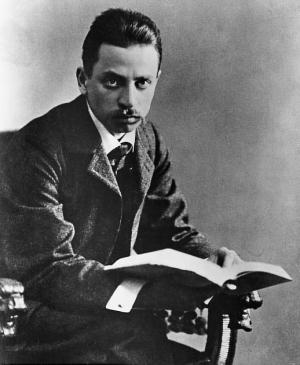
I want to beg you … to be patient toward all that is unsolved in your heart and to try to love the question themselves like locked rooms and like books that are written in a very foreigh tongue. Do not now seek the answers, which cannot be given you because you would not be able to live them. And the point is, to live everything. Live the questions now. Perhaps you will then gradually, without noticing it, live along some distant day into the answer.Rainer Maria Rilke
Monday, 13 July 2009
Now, I Know We Don't Like Black and White, But ...

We are rightly suspicious of black and white judgmentalism. This is one of the features of the Book of Revelation that is a bit hard to take. But let's not be too hasty. People who end up at the upper extreme of the black index don't begin there. They start way back somewhere else on the continuum. And they steadily head that way over time. Sin (or virtue) is, after all a habit, and we make ourselves into the people we are through our habits. The black and white of apocalyptic is, at the very least, warning us about the decisions we make today. (Again, part of the helpful urgency embedded in the apocalyptic form.) Do this (or not do it), and the same the next time, and so on, and who will you become? The extremes of human failure often depicted in apocalyptic might appear to be a long way from where we think we stand but, according to apocalyptic, perhaps not so improbable as we would like tothink.
Thursday, 9 July 2009
Blame It On Darwin?
A guest post from the Revd Ron Keynes.It has been an interesting time recently. The big anniversary mention of Charles Darwin and his ‘Origin of Species’ seems to have brought out the worst in some parts of the Church. I was passing a local Baptist Church recently to find a banner about coming sermons, presenting that congregations’s view that evolution is man’s attempt to avoid responsibility ... and God. Perhaps my views on the work of that naturalist of the past is somewhat jaundiced – he married into a somewhat distant line of the Keynes family, would you believe. He married a niece of John Maynard Keynes – (who also demands further attention in these fiscally challenging times)
Most sad of all is the way in which Darwin’s search for truth in his area of discipline had turned into a huge dispute between science and religion. I doubt if the man ever considered that possibility, for I understand that the one-time candidate for Orders continued his support for the (Anglican) South American Missionary Society till his death and did not expect the horrific response from many! Be that as it may, the real issue of his thoughts and theories has tended, in many circles, to become a matter of huge conflict.
One thing that has long struck me in the debate that has gone on far longer than my lifetime is that surely there is no conflict in the two disciplines of life, science and religion. Both, surely, are searches for truth, and what’s more, searches for bases for truth. Evidence, if you like. Both are essential elements to human development, although the latter tends to come in for considerable flak – mostly because (pardon me!) religionists tend to go in for untenable arguments and grounds, particularly if some sacred cows appear to be in danger. Truth is the issue, and always must be, whatever the outcome.
I recall every now and then the experience of a co-theological student of 50 years ago, who refused to attend lectures on the Creation Stories of Genesis because the lecturer refused to bow to that young man’s refusal to understand Scripture biblically. He vowed to remain literal and fundamental, which meant he must still be trying to defend an impossible chronology. In spite of Archbishop Ussher, the world was not finally created on 23rd October, 4004BC.
If you can cope with another story, I recall 35 years or so ago, having been asked by my Bishop to go to Coober Pedy to sort out a pastoral problem. The RFDS was happy to agree to me flying with them so that meant a series of days flying with a not too happy pilot, unsure of the value of having this ‘skypilot’ alongside of him. Suffice to say that the experience became a valuable one. After landing at Cook (SA) on the Transline, Jack, said pilot, told me he thought that we Christians were stupid. I agreed at the possibility of such a charge, and asked about what, precisely, Jack had come to that conclusion. He referred to the matter of the last paragraph, and while I agreed that there remain quite some Christians who still held to that view, also informed him that I understood that Jews, whose Genesis we were talking about, never understood it literally. I went on to explain more fully, and Jack smiled and interrupted. “You’re right, you know!” he expostulated. My response was simply, ‘and how the hell would you know?’ It was his turn to chuckle. “I am a Jew!” he said. It has long been a sadness of mine that from earliest times, it seems that Jews and Christians could never talk together long enough for us to avoid falling into so many understanding (or misunderstanding!) traps of our own making.
Those Genesis tales are far from shaken by Darwin’s theories – but a literal approach to them has long been. What one needs to do is to understand those ancients tales, catch sight of what they are conveying, and see that these is wisdom beyond imaginings in those apparently naive stories. Jews were never interested in what we call ‘science’ – which only comes from a Latin word for ‘knowledge’ after all. Science looks at the ‘how’ of life and this universe, whilst those wise old Jews looked for the ‘why!’
From where I sit, there is no conflict between the two disciplines. But both need to be taken into consideration. Neither offer any escape from reality; both demand that reality be faced. Both require solid hard evidence for their decisions, and in both cases, that may require the presentation of a theory that is then tested and checked ...and possibly even modified.
Neither time nor space permits the expansion here of the outcomes of where this leads. But it will never hurt for Christians to follow the pattern of Old Testament Hebrew understanding of the Creator – which emerged, not from dogma and tenet, but by the simple and powerful business of observing life and relationships and understanding the outcomes. And that was over a very long period of time indeed.
Wednesday, 8 July 2009
Mark 6:1-13 Travelling Lightly (Kids' Talk)
What should we do? Decide on what we need, and what is the most important.
A couple of ways to go from here:
- how do we decide what is important? Jesus tells us.
- Get them to say what are the most important things we need in our whole life (not just a holiday)
Tuesday, 7 July 2009
The Offense of the Cross

It is too easy to miss the offense of the Jesus story. Especially if it is familiar. In the weekday Eucharist last week we read from Gen 22:1-14, the near-sacrifice of Isaac, and Matt 9:1-8, Jesus healing a man by forgiving his sins. The first reading is offensive. Even though God doesn't let Abraham kill Isaac, Abraham is praised for being willing to do so. Human sacrifice in the Bible is a pagan idolatrous practice. Be offended.
The second reading highlights for us the closeness of Jesus with God. The whole gospel does this right up to the death of Jesus. The cross is the great shock, the offense of the gospel. (1Cor 1:18-25) How could this Jesus, so close to God, given such authority, die the ignoble death of the cross? Sinner? Or perhaps there is no God?
If we know the story we are then tempted to pull the resurrection in. The cross was only temporary and has been reversed by the resurrection. Our faith in God has been restored. (That is, a pre-crucifixion conception of God.) But notice the language of the New Testament in regards the crucifixion of Jesus. It lifts directly the offensive language of Isaac's near sacrifice. Jesus was given up. With the resurrection the first Christians did not wipe away an inexplicable cross as an aberration corrected in resurrection, but embraced it and its odious character, and proclaimed that in this cross salvation was won. And the beginning of a specifically Christian experience and conception of God.
Monday, 6 July 2009
The Will of God
Saturday, 4 July 2009
Receiving The Eucharist Often
If worldly people ask you why you receive Communion so often, tell them that it is to learn to love God ... Tell them that for your part you are imperfect, weak and sick and need to communicate frequently with him who is your perfection, strength, and physician ... Tell them that you receive the Blessed Sacrament often so as to learn how to receive it well, for we hardly do an action well which we do not practise often. (Francis de Sales)
Ron Rolheiser has soemthing good to say about this as well, here.