Sunday, 10 August 2008

Walking on Water


Pentecost 13, August 10, 2008. Sermon preached at Holy Innocents. The reading was Matt 14:22-36, Jesus walking on the water.

The thinking behind this sermon began with the simple point of not getting lost in the miracles of Jesus. Some people get very excited about the miracles of Jesus to the extent that he becomes something more like a pagan wonder worker. We must remember that the miracles were a significant part of the ministry of Jesus, not the totality of or key to his ministry. And we should also remember that for all of us miracles will account for a very small percentage of our total life experience. if Jesus is going to be important in your life it will be because he meshes with the other 99% of it that is non-miraculous.

But this then led me further. Sometimes it is possible to lose the point of the miracles of Jesus because of the miraculous. Take Jesus walking on the water today. The point of the miracle is not that Jesus proves he is divine because he is able to suspend the laws of nature. That is not the point. Some make it the point because they have in their sights an atheistic scientism that tries to lock God out of our lives. The way to respond to that ideology is not by making this miracle into an anomaly for science.

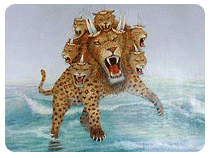
The point of this miracle is deeply theological. In this regard two points to note. First, the sea and what it represents in biblical terms as chaos over which God's sovereignty is exerted. (See, for example, Gen 1:1-10; Job 9:8; Ps 144:7; Dan7; Mk 5:13; Rom 6:3-4; Rev 13.) The sea is a place of chaos, demons, fear and possible death. And Jesus can walk on it and control it just as God does. (See also Matt 8:23-27.) Second, the great "I AM" that Jesus uses to identify himself. (Matt 14:27) The translation just has him say, "It is I." But we lose the force of the Greek which is an echo of the name of God from the Old Testament" I AM. (See Exod 3:14; Isa 51:12; see also John 6:35; 8:58; 10:11; 11:25; 15:1)

With this background the point of the miracle becomes clearer. By walking on the water, and claiming to himself the great I AM, Jesus is identified with the God of Israel, creator and saviour, the God who rules over the chaotic seas and brings life out of (Gen 1:20-21) and through the sea. (Exod 14:21-30). To get lost in the miracle as a suspension of the usual rules of science not only misses the point, is anachronistic, but also deflects us from the true meaning of the miracle!

And just in case we should miss the point, the gospel does a strange thing with this identification of Jesus with God. Yes, by walking on the waters of chaos Jesus shows himself to be imbued with the actual authority of God. But the gospel does not allow us to remain at the miracle as the point of recognising the true identity of Jesus. It is not enough. Indeed, it can lead to the wrong conclusion if we end up focusing on the proof of his divinity lying in breaking the rules (of nature). Jesus is divine, one with the creator and saviour of the world, and this will be displayed preeminently on the cross. The disciples struggled with this, as do most people staying away from church. [The miracle worker seems more comfortable, and perhaps more distant, indeed controllable: there when we need a miracle, the rest of the time back in heaven.] It is important to maintain the identity of Jesus on the cross with the Jesus of the miraculous walking on water because the God of creation and redemption will bring both to their fulfillment in the cross of Jesus.

Walking on Water (Kids' Talk)

Pentecost 13, August 10, 2008. Kids' Talk delivered at Holy Innocents. The reading was Matt 14:22-36, Jesus walking on the water.


If I pick up this heavy box, do you think I prove myself to be God? (Get some answers, then lift it. Make the box empty, but put on a face, just so you don't do your back in!)


I did it! So am i God? No. What would I have to do to prove I was God? (See what they say.) Move a mountain, change the colour of my car by clicking my fingers, walking on water, feeding 5000 people from one loaf of bread? (Get answers as you go.) The first disciples recognised Jesus as God because he walked on water.


What about dying on a cross? Cross on the one hand, and walking on water on the other. Which one. (Weigh it up in front of them. Both! Most people can see the first, but the second is just, even more true.

The Bible says the cross. God might be able to do pretty special tricks and they impress, but dying on a cross for us, now that shows Jesus really was God.


Saturday, 9 August 2008

Some Notes on the Three Major Arguments Against the Full Inclusion of Women in Ministry


Three major arguments are used against the full inclusion of women in the Christian community.

1. The place of women is one of subservience, sometimes argued as complementarity, but always involving a subordination of women to the authority of men.

· This is often argued from a (small) number of biblical texts, and usually inconsistently. The obvious problems with this interpretation of Scripture (e.g. the authoritative ministries of women in the New Testament church) are left unresolved.

· Ignores the obvious authority of women in the history of the church. (Think of the Queen and CofE.)

2. God is male, Jesus was a man.

· God is ‘male’ (no, God is beyond sex and gender)

· Jesus was a man (Compare with ‘became fully human’.)

· Priests are in persona Christi, and must therefore be men. (Actually, all the baptised are in persona Christi)

3. Reproductive role and the nurturing nature of women

· Even if true, not sure why this should exclude women

· Even if true, could be used to argue for the inclusion of women (a more rounded and complete priesthood) For example, the male and female teams mentioned in Romans 16:3-4, 7.

· Jesus was not the quintessential ‘alpha male’, so I’m not sure why anyone should think nurturing –whether in women or men – is a bad thing. (See also Jn 13:23-25, reclining on the breast of Jesus, conveniently missed in the English translations!)

· Scripture, and Jesus himself, did not restrict the role of women in ministry according to their theoretical reproductive capacity. E.g. Lk 11:27.

Thursday, 7 August 2008

Book Review: Rowan Williams, 'Tokens of Trust. An Introduction to Christian Belief'.


A guest-post by Joan Durdin.

The author, a theologian, philosopher, teacher, writer and priest expands on addresses that he delivered to a Holy Week congregation in 2005, and offers them to a wider audience. His teaching is prompted by his conviction that there is a crisis of trust in our society. Without trust we cannot fulfill God’s agenda for us, to live in peace with each other, free for our foremost activity of offering praise to God.

The book’s sub-title is ‘An Introduction to Christian Belief’. It is based on the church’s time honoured statement of belief, the Apostles’ Creed. The writer presents his teaching in six chapters, each exploring the implications of one segment of the Apostles Creed. The first chapter is entitled “Whom can we Trust?” and the answer is immediately provided in the words ‘I believe in God the Father almighty’. The issues raised include the lack of trust in today’s society – indeed, in the history of humankind, and the justification for putting our trust in God the Father - God thought we were worth dying for. A few examples from biblical times to the present, draw our attention to the lives of people whose trust in God, in the most daunting circumstances, never failed them.

In the second chapter, entitled ‘The Risk of Love’, the focus is on the phrase - ‘maker of heaven and earth’. This is where questions about the existence of God come up. Chapter 3, ‘A Man for All Seasons’ is developed from the words ‘and in Jesus Christ his only Son, our Lord’. The fourth, fifth and sixth chapters are respectively titled ‘The Peace Dividend’ (He suffered and was buried and the third day he rose again); ‘God in Company’ (I believe one catholic and apostolic Church); and ‘Love, Actually’ (I look for the resurrection of the dead). Each chapter offers a wealth of Christian doctrine and teaching.

Several features of the book have special appeal to me :

  • The structure is made clear in the list of chapter titles and sub-titles and helped me to ‘see the wood for the trees’.
  • From the depths of his theological understanding, the writer shares his insights on many issues of concern to the Christian, including the problem of evil, miracles, pain and suffering, the answer to prayer, sacrifice, the virgin birth, forgiveness.
  • He displays a sense of humour which lightens the reading and points to his natural ‘human-ness’ and humility
  • In each chapter the selection and framing of certain key statements provides, in a sense, a summary which helps the reader to recall the content.

The illustrations which appear throughout demand attention. As Archbishop Williams stated in the introduction, the paintings invite us into a much deeper world by the mysterious lightness of the strokes and the colours. They ask us to look at the world in a new way.

Among many books which have I have read on the subject of Christian belief, I find ‘Tokens of Trust’ particularly satisfying. It requires careful reading and reflection.

Wednesday, 6 August 2008

No Simple Contrast

... a simple contrast between activity and passivity will not do for creatures' relations with God because no matter how active one is as a creature, one is never anything other than the recipient of God's active grace - God remains active all over. Kathryn Tanner

Tuesday, 5 August 2008

Enjoying Life


Address delivered at the secondary campus assembly to induct the new school captains. The reading was Philippians 4:4-7.

I was walking around town yesterday and saw a lot of apparently unhappy people. They looked troubled. It made me wonder, where does happiness come from? Enjoyment, that is, joy? The cultural assumption is that we are happy, we can enjoy ourselves, when things are right on the outside of us: when we are with our friends, when we get to do what we really like, when there is no pressure, no responsibility; then we can enjoy ourselves. Presumably this means that when things are going badly, or we have responsibilities, or we are doing things we don’t particularly want to do, we can’t enjoy ourselves. Is that right?

I must really be unhappy then. I carry a good deal of responsibility in my life, as a priest in the parish, my duties in the wider church and community, in my home, spouse and children etc. And poor [... school captains...] They are taking on more responsibilities just as they approach their most difficult year academically. They will have pressures and responsibilities, many of which we will place on them, and they will have to do some things at least that they might not otherwise choose to do. On this reading they won’t be enjoying themselves much at all for the next 12 months. And aren’t [... outgoing school captains...] lucky to be stepping down. Now they can be happier!

I don’t think so. Let’s think about this for a moment. If our happiness and ability to enjoy ourselves is determined by the outside environment, much of which is out of our control, we are less than free. I prefer freedom.

Happiness, joy, enjoyment has its source within us, not outside us. Even though I carry responsibility and frequently feel under pressure and have to do some things as a priest that are difficult, I enjoy my life. When the pressure rises, or things aren’t working out how I would like them to, I decide to enjoy myself anyway. This does not mean that I ignore the problems or don’t feel the pressure. I’m not suggesting that we should deny any part of our lives. What I do is like flicking a switch inside me. I decide that I will enjoy myself no matter what the external circumstances.

Where or what is this switch to be flicked on the inside? We get the clue in our reading today from St Paul. “Rejoice in the Lord always “ he says; in other words, find your joy in God. The God who dwells with you. The God who said when you were made, ‘S/he is good.’ The God who thinks you are of inestimable value, the God who fiercely loves you and will never abandon you. Much of our worry revolves around anxieties concerning how others perceive us or will perceive us: am I good enough, will I perform well enough, will people like me or not, what is going to happen etc. We don’t want to let people down so we worry. All this gives up our freedom to the vagaries of others’ perception of us.

I strive to find my sense of self, my personhood, my worthiness in my relationship with God. I do not gauge my sense of self on the results of my performance. I enjoy myself, I carry my responsibilities lightly, and I let God do with what is achieved what God can. Don’t get me wrong, this is not an excuse for slackness. In fact, to find your true freedom within you in your relationship with the God who dwells within, this brings with it a joy that enables us to live our lives more fully, to engage with a new discipline and diligence in the tasks of life.

So, [... school captains ...], you have the great honour and task of being our school captains/vice captains for the next twelve months. You will carry new responsibilities, feel some new pressures, do some things that you might not choose to do otherwise. You will also do many things that are pleasant and bring great satisfaction. But in all of this enjoy yourselves. Feel the freedom that comes from flicking the switch that is a sense of personhood derived from the God who dwells within. Be the great leaders that you are called to be, and enjoy yourselves while you do it.

Monday, 4 August 2008

Self-Sacrifice


St John's Chapel Address Weeks 3 & 4, Term 2 2008.Part of the 'Jesus is Different Series'.
[The reading was John 15:12-17]

I left the story from last week with a screwdriver poking in my belly and satanic abuse being spat (literally) into my face from a drug crazed maniac. It got worse. Screwdriver man decided not to stab me. But the female parishioner beside me gave him some lip, he responded, she did likewise, and boom, his arm went up to stab her. Right next to me. And that is when I knew I loved my life more than hers. It was all in slow motion. I had time to just step in front of her and take the blow. But I didn't want to. (I should have said earlier that I loved my life more than their lives - she was pregnant.) Luckily, screwdriver man's partner in crime rugby tackled him at the crucial moment and pulled him off. Things fizzled then, we stepped back from the precipice, and twenty minutes later the police arrived and went off to find screwdriver man and arrest him.

Contrast this with what Jesus teaches, and lives. He says that we should be willing to sacrifice ourselves. Why? Well, for at least a couple of reasons. First, it is the nature of love to self-sacrifice when called upon. Jesus thinks that we should love one another, just as he did, and as God does. Second, evil is not overcome by standing idly by, nor is it overcome by punching back. Jesus recognised that evil is overcome only when those who oppose it are willing to bear the cost of opposing and standing up to it. In his case, that resulted in his death. This is a tough call. But I am sure Jesus is right, no matter how difficult it is to put into practice. Of course, few are asked to actually physically die. But all of us are invited everyday to love that little bit more, and that will mean self-sacrifice of some kind.

Sunday, 3 August 2008

Feeding the 5000 (Kids' Talk)


Kids' Talk, Pentecost 12, Aug 3 2008. Reading is Matt 14:13-21.

Have chalice with cruet of wine and paten with host sitting in front of you.
Start with the refrain: when you think of Jesus, think of God.

Then...

Do you know what it is like to feel hungry? ... How does it feel? ...

Tell story of feeding.(Break the host as you tell the bit about Jesus distributing the bread.) Points to emphasise:
  • crowd
  • Jesus' compassion for their hunger
  • not enough food to go around (miss by a mile)
  • Jesus makes it enough and feeds everybody
  • with tons left over!
What could this story mean? Possible answers:
  • Jesus didn't want the people to be hungry, and given the refrain above, God doesn't want people to be hungry
  • Jesus fed the people, God feeds us
  • when Jesus feeds there is always enough to go around
Point to chalice and paten: like at the eucharist, Jesus feeds us because God doesn't want us to be hungry, and there is always enough to go around, and even more people could come to be fed.

Feeding the 5000


[Sermon for Pentecost 12, August 1, 2008 @ Belair. The reading was Matthew 14:13-21.)

What did you notice in the reading? The miracle is pretty hard not to notice! I'm not one of those who in principle disbelieves in the possibility of miracles. That Jesus multiplied loaves and fishes seems possible to me. But it in this case is is easy to let the miraculous take us away from the point of the miracle.

Some things to notice about the story:
  • the compassion of Jesus leads him to heal and feed
  • the disciples thought there were just too many people to feed from their meagre resources
  • Jesus asks the disciples what they have. 'Just this little bit' is their reply.
  • the eucharistic overtones of the feeding (Jesus takes, looks to heaven, blesses, breaks, and gives; see Matt 26:26)
  • the huge amount left over
There was so little to share, but in the end so many more could have been fed! A recurring theme in the Bible:
  • the mustard seed (Matt 13:31-32)
  • the yeastin the loaf (Matt 13:33)
  • a cup of cold water will get the reward (Matt 10:42)
But pre-eminently, the cross of Jesus. The defeat of a peasant by the might of Rome, yet a defeat that saves not only those who directly sinned by crucifying and deserting him, but the whole world.

And a recurring theme in the history of Christianity:
  • St Francis of Assisi
  • Charles de Foucauld
  • Brother Roger of Taize
But they are famous examples. What about putting yourself in that list? What about putting this church in that list? Have you ever felt that, in comparison to the world's needs you are just five little loaves and two fish? Of course.

Now continue the story. Christ takes the loaves and fish, blesses, breaks, and distributes. And all are fed, and it turns out more could have been fed.

Does it feel like I am stretching the story a bit? Not really. Think about what we are about to do at the Eucharist. We will say that we are the body of Christ, then we will, at the altar, take bread, bless it, break it,and distribute it. We, the body of Christ will receive the body of Christ; we will eat it, it will become one with us. At the end of the service we will say, "Go in peace to love and serve the Lord. In the name of Christ. Amen." We are that bread, we are that body in the world.

Today it doesn't perhaps matter all that much whether you believe this miracle happened or not. What is of real interest is whether you think you could be that miracle, the church you are part of could be that miracle, taken, blessed, broken, distributed, with much left over.

Saturday, 2 August 2008

Jesus and Non-Retaliation


St John's Chapel Address Weeks 1 & 2, Term 2, 2008. Part of the 'Jesus is Different Series'.

[The reading was Matthew 5:38-48]

Ten years ago, after a Christmas service, a man high on drugs carrying a screwdriver and yelling satanic abuse, burst upon me and the congregation. He held a screwdriver in my belly while yelling his abuse a few inches from my face.

My response to this, after the incident, was to learn martial arts for seven years. Not an unreasonable response perhaps. The problem is that my response keeps the world as it is. The next time this happens, and I fight, the spiral of violence continues, and could even get tighter.

Contrast my response to the teaching and life of Jesus. He has a different vision which he was willing to live (and die) for. He says that we should not overcome evil and violence through evil and violence but through love. Turn the other cheel etc.) And love can be costly, but to maintain the spiral of violence costs us all even more, at least in the long run. (Think of the way weapons of more, developed for self-defence, get more and more terrifying.) This is a different view of being human, one that leads to life, and life not just for us but for all of us.

Friday, 1 August 2008

"You Are The Generation We Have Been Waiting For!"


Yesterday many of us had a good session with Tim Costello and Jim Wallis in the St John’s Chapel. Tim Costello is well known in Australia. Jim Wallis has been an extremely influential figure in the churches in USA, particularly in is work through Sojourners in bringing out the true justice orientation of the biblical faith. He is very good stuff. His early books and writing in Sojourners almost 30 years ago where very influential in my life. His main point was the need for us to continue to struggle to meet the world’s needs with God’s justice and compassion. He invoked the axiom we have all used at some point, both in reference to ourselves and now to younger generations: we can change the world! Foolishly, however, I asked a question during Q & A time. My question went something like this:

"It seems to me that while we can change some of the world, we don’t seem to be able to change the world. We win some battles but also the world seems to be the same in so many ways from generation to generation. The realization of this can come as a shock. Many people when they realize this become disenchanted, even cynical. How do we prevent this from happening? When disenchantment begins to set in do we hope people will be able to move from ‘we can change the world’ to hope in God, or should we perhaps modify our discourse to young people now, which would mean not being quite so optimistic about the extent of change. Utopia is not going to come through our action."

Which didn’t seem to go down that well. (I wish I hadn't used the word utopia; it seemed to exacerbate things.) Jim reiterated his point about working for those causes that are here with us now (a good point and quite right), and that things have changed. His new book uses as examples of the change: Desmond Tutu in his struggle against Apartheid and the anti-slavery movements of the nineteenth and twentieth centuries,among others. I think he might even have interpreted me as saying that nothing changes so why bother! But anyway, I wouldn't mind an answer to my question. When we say to young people ‘You are the generation we have been waiting for”, at some point in the future most of them will realize that, although great victories might have been achieved through their work for justice, injustice just moves on to a new crisis. This crisis too can be overcome, but injustice has already moved on again! I know so many people who have lost the passion for justice and faith because they could not move from “We can change the world” to hope in the God who will bring the change in God's way and time. (This was one of the points Jim made in his talk - hope in God as essential.) Hoping in God is not a renunciation of responsibility, but relieves us of the need to carry the messiah complex cherished by secular, enlightenment society. We hope in God, and act as ambassadors for the God of justice, working for signs of God's kingdom now, and discovering the kingdom where many overlook it.

So, my question again: Do we continue to tell young people they can change the world, or do we change (perhaps only subtly) what we say to them in the first place? But even subtle changes, while I suspect more honest, are just not as inspiring as the refrain, "You are the generation we have been waiting for!"

Wednesday, 30 July 2008

Respecting Our Common Humanity


It will be useful for me to post abbreviated versions of the various addresses, sermons and classes that I present as chaplain of St John's. Even if you won't find it interesting now, keep it in the back of your mind for when you might want some ideas for addresses to young people in Years 7-12. The following was the address I gave at the assembly at which I was commissioned by the the Venerable Peter Stuart, Archdeacon of Adelaide early in Term 2.

[The reading was Genesis 1:26-31.]

Our reading today tells us that we share a common humanity, and that this common humanity is made in the image of God.
We should always remember this great dignity attaching to being human together.

We also need to be respectful of that common humanity and its great dignity, as we live it and as we encounter it, in others. And I can think of three ways at least in which we can respect the great dignity of our humantiy here in this school:

  1. By acknowledging each other. This might seem like a strange thing to suggest, but to acknowledge one another acknowledges our common presence to each other. When we acknowledge the other person we are recognising the right as a human being to be given space in our world to be human with us. And to give this basic right of existence to other people is to affirm their worth, a worthiness with its source in God.

  2. The way we treat each other. The way we treat each other is the primary way we show respect to the common humanity we share. The problem is that this is precisely where we struggle as a race to be respectful. Jesus can help us here. This term in chapel we will be looking at some of the things Jesus says, and contrast this with what we ordinarily do. Jesus is a trustworthy guide of how to respect the dignity of each person we meet.

  3. The third way respect for our common humanity can be practiced applies particularly to my role here as chaplain and priest. I will endeavour to provide a reason for us to be here that is more than compulsion, and more than self-interest. We respect the God in whose image we are made when we go beyond these things to discover the meaning and purpose of life, and to use this reason and purpose to live, study, and enjoy ourselves. The meaning and purpose I speak of here is to be found in the life, teaching, death and resurrection of Jesus. So expect to hear a lot about him in the coming years!

NT Wright's Concerns About GAFCONish Claims


When I hear Peter Jensen say that ‘we are not self-selected; we are God-selected, because we are based on the word of God’; when I hear beloved and respected Jim Packer say that the ‘Jerusalem Declaration’ should be the basis of a new covenant to which all English bishops will be required to sign up; when I hear Vinay Samuel, one of the sharpest minds in the whole GAFCON movement, saying (unless he was misreported) that ‘we are not breaking away from the Anglican Communion – we ARE the Anglican Communion’; and when I see Bishop John Rodgers of AMiA saying that ‘we are the true and faithful Anglicans . . . the true representatives of the Anglican Communion’ – then it is time for someone, and it might as well be an old-fashioned Bible-believing evangelical like me, to stand up and say, with usual English understatement, ‘hold on, this seems to be somewhat over the top’. Just as the ‘covenant for the Church of England’ bore all the marks of sloppy thinking and hasty drafting, so the ‘Jerusalem Declaration’, though affirming more or less the doctrines that I myself have spent my whole adult life affirming and teaching, bears all the marks of similar haste. In addition to its embarrassingly obvious weaknesses, it has smuggled in, alongside the doctrinal affirmations, various open-ended formulae which basically mean ‘We will decide who’s in this new club and who’s out of it, and if we decide you’re out we claim the right to plant new churches in your territory, “authorize” them, and send in bishops to look after them’. This is not a ‘suspicious’ reading; it is more or less exactly what the text says. And I say to my fellow evangelicals in the Church of England: do not be taken in by this. This is not the answer. There are good answers to such problems as we face and this is not among them. (NT Wright)


For the full text of his comments see Stephen Bloor's post here.

Monday, 28 July 2008

Rowan Williams and Consensus


Here is a good summary of Rowan Williams' strategy for the Anglican Communion, 'contrasted' with the GAFCONish type slurs we hear of him.

And Stephen reads him right here.

Thursday, 24 July 2008

Talking About Sacraments (Part 2)

The church has found some sacraments particularly meaningful, and in the celebration of these particular sacraments we are opened up to the presence of God all around us, and within us. Seven of these sacraments are often listed: eucharist, baptism (and confirmation), anointing, ordination, marriage, and reconciliation (confession & absolution).

But why celebrate particular sacraments over and over again? If everything is sacrament, why not celebrate any or all sacraments? There are a few reasons. First, the ritual celebration of these particular sacraments is not meant to exclude the sacraments of everyday life. It is more that we need particular celebrations to remind us of our sacramental universe and lives. By celebrating these sacraments the church is encouraged to find God everywhere. If God can come to us in the humble form of eating and drinking bread and wine together, we are reminded to look for God in the smile of our neighbour.

Second, when we humans do not make particular celebration of what is always and everywhere around us, we soon forget. If we do not stop to find the beauty somewhere, we will not find it anywhere, even though it is all around us! If we do not celebrate and cherish our love by another, we will soon take it for granted or even forget it, even though we are always carried by that love!

Third, repetition brings fluency and skill in recognising and living the sacramental life. These particular sacraments become the doorway to sacramental living all the time. Moreover, intellectual familiarity with what we are doing repetitively allows us to get out of our heads and into our hearts. The problem with variety is that we never have time to get much further than intellectual analysis.

Of these particular sacraments, eucharist and baptism are the two most important, and this for at least two reasons. First, Jesus commanded us to practice them. (See Matt 28:16-20; 1Cor 11: 23-26) Second, they are the two crucial sacraments of initiation and sustenance in the Body of Christ, recalling for us in dramatic form the death and resurrection of Christ, and our participation in him.

Tuesday, 22 July 2008

Talking About Sacraments (Part 1)

John O’Donohue, in his book Anam Cara defines a sacrament as ‘a visible sign of invisible grace.’ He continues:

In that definition there is a fine acknowledgement of how the unseen world comes to expression in the visible world. This desire for expression lies deep at the heart of the invisible world. (pp. 72-73)

The threshold between God and the cosmos is paper thin. In traditional language we can say that we are surrounded by sacraments. The whole of the created order is sacramental. From constellations in the sky to the smallest seed, the created universe tells the glory of God. We live in a sacramental universe.

And it is not just ‘things’ that are sacraments. Touch is a sacrament. The caress of a lover carries with it more than a simple explanation of skin brushing skin. If it were not so, why did God become human, and could it have even been possible? It were not so how could we be ambassadors of Jesus Christ? How could we be the temple of the Holy Spirit?

Monday, 21 July 2008

African Bible Study

Here is a group Bible study method that requires no formal knowledge, but will deepen your life with God. it is truly confronting if done consistently over time. You could do it each week with a group of people using the Sunday readings. The important point is not to justify your answer or particularly explain it. The point is our transformation through engagin with the Word of God.

1. One person reads the passage slowly.

2. Each person identifies the word or phrase that catches their attention.

3. Each shares the word or phrase around the group. (NO DISCUSSION, TEACHING, JUSTIFICATION)

4. Another person reads the passage slowly .

5. Each person identifies where this passage touches their life today.

6. Each shares their answer: "This passage touches me ..." (NO DISCUSSION, TEACHING, JUSTIFICATION).

7. Passage is read a third time (another reader).

8. Each person names or writes "From what I've heard and shared, what do I believe God wants me to do or be? Is God inviting me to change in any way?"

9. Each person shares their answer: "God invites me to..." (NO DISCUSSION, TEACHING, JUSTIFICATION)

10. Each prayers for the person on their right, naming what was shared in the other steps.

Close with the Lord's Prayer and silence.

Saturday, 19 July 2008

Prayer: Experiencing the Relentless Love of God

What we try to do in prayer is to experience deeply and consistently the undeserved, relentless love of God for us, despite everything. (Katherine Marie Dyckman & L. Patrick Carroll)

Friday, 18 July 2008