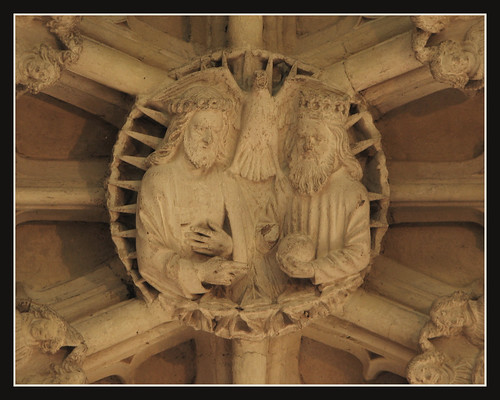
Creation is an action of God that sets up a relationship between God and what is not God. Eternally, there is just God – outside time because he doesn’t get better or worse, or change in any way. And time begins when God speaks to call into being a world that is different and so establishes a reality that depends on him. It depends on him moment by moment, carried along on the current of his activity. Behind and beneath everything we encounter is this action. (Rowan Williams)
Wednesday, 17 September 2008
Creation's Dependence on God
Tuesday, 16 September 2008
If Salvation is for Any...
If salvation is for any, it is for all…. The ‘return’ to the lost, the excluded, the failed or destroyed, is not an option for the saint, but the very heart of saintliness. And we might think not only of Jesus’s parable of the shepherd, but of the great theological myth of the Descent into Hell, in which God’s presence in the world in Jesus is seen as his journey into the furthest deserts of despair and alienation. It is the supreme image of his freedom, to go where he is denied and forgotten…. He comes to his new and risen life, his universal kingship, by searching out all the forgotten and failed members of the human family. (Rowan Williams)
Sunday, 14 September 2008
Study Notes For Rowan Williams, 'Tokens of Trust' Chapter 5
The book is getting easier. Three highlights to look out for are what he says about the meaning of peace, the nature of the church, the Eucharist, and the Bible.
- The meaning of peace not as an absence of conflict or tension, and this includes inner peace, but peace as a dynamic giving and receiving within relationships with others. And there is always some 'action' happening in relationship! 'Peace' as conceived by many is more like escape.
- The church echoes the Trinity as neither individualism nor communitarianism, but personal. (Think about the person of the Father: the more he is father, the more he relates, thus person brings 'individuality' and relationship into proportionate relationship.) In this regard Williams mentions the early church metaphor of 'Body of Christ', and points out that its Christian use goes beyond the functional interpretations of paganism. The church as the Body of Christ is about gift giving and receiving, with each unique member called to bring their unique contribution to the common life. This is not just a functional perspective, but recognises that the gift of God is personal, directed to us and shared via our uniquely personal presence and activity. Not just about functional giving, but the gift giving of ourselves, albeit through ministries.
- The Archbishop says a lot of good things about the Eucharist, particularly relating it to the work of the Spirit and baptism. The Eucharist is not magic, but the work of the Spirit in extending the presence of Jesus in this action of making eucharist. The sharing of the bread and wine through Christ (and addressed to the Father in thanksgiving), prefigures the end of all things, when all that is will glorify God through Christ in the power of the Spirit. The eucharist gives us a clue to the cosmoc nature of salvation (just in case the Incarnation isn't enough!).
- Jesus is the Word of God, not the Bible. The Bible is the primary witness to Christ and is not a text of magic answers to life's questions. It witnesses to a history and a life: God's history and life (Father and Son), and God's history and life with the cosmos in Christ.
Friday, 12 September 2008
Pure Forgiveness
It's About Ideas and Information
The key to ministry is not coordination and administration, but the sharing of information and ideas. (Easum and Bandy)
Thursday, 11 September 2008
Its about Continuity and Change
The only way to preserve values over time is to be involved continuously in renewal and change, thus finding ever fresh expressions for those values. When any organization decides it will seek to save its life by building walls against change, that organization is destined to lose its life and vitality. It is through such concepts as ‘continuity and change’ and ‘stability in motion’ that we find the path that leads to ever new organizational life. (Lovett H. Weems Jr)
Wednesday, 10 September 2008
It's About a Dream
There is no freeway to the future. No paved highway from here to tomorrow. There is only wilderness. Only uncertain terrain. There are no road maps. No signposts. So pioneering leaders only rely upon a compass and a dream. (James M. Kouzes & Barry Z. Posner)
Tuesday, 9 September 2008
It's About Vision
Vision is a gift from God. It is the reward of disciplined, faithful, and patient listening to God. Vision allows us to see beyond the visible, beyond barriers and obstacles to our mission. Vision ‘catches us up’, captivates and compels us to act. Vision is the gift of eyes of faith to see the invisible, to know the unknowable, to think the unthinkable, to experience the not yet. Vision allows us to see signs of the kingdom now in our midst. Vision gives us focus, energy, the willingness to risk. It is our vision that draws us forward. (Bishop Rueben P. Job)
Without a compelling vision there will be a vacuum in which almost nothing is happening, but in which almost every problem becomes exaggerated. (Lovett H. Weems Jr)
Monday, 8 September 2008
Study Notes For R. Williams, 'Tokens of Trust' Chapter 4
1. God’s desire for us and our world is an ‘economy of gift’ (82) whereby we live by a mutual generosity. But this is not the world we live in, and none of us seem to be able to break this cycle of ‘original sin’, which is merely the observation that we are all born into this imperfect world, and exhibit this imperfection in our lives. Thus we have weaved a tangle of selfishness “that goes back to the very roots of humanity.” (82)
2. Jesus is the break in the cycle that is needed.(83) The break must be genuinely human (or it won’t break the human cycle), but it must also be divine to effect the transformation required, for only God is so utterly free as to be able to give utterly selflessly. (This selfless giving is the very nature of God, Father, Son and Spirit.) This is why the doctrine of the two natures in Christ is so important; it verbalizes the experience of being saved by a human act, but one carried out by God in person.
3. Jesus, as Son in relationship with the Father, is this living out in history of the Trinitarian life of unrestricted and utterly consistent love. Utterly consistent remember because God is an utter fullness of love already and does not need us in this sense.) And in him this love is turned also toward us, so that the love we see and receive in Jesus is the total and unselfish giving of God. Through Christ, who is both God’s love turned to us and the Son in person in relationship to the Father, the very life of God is brought into history, personally. Think of Jesus as the intersection of God’s own life of love with the world.
4. But when love meets sin, the cross is the result. (84-85) Notice some of the New Testament metaphors for the death of Jesus (87-88) Williams picks up. None are literally true (which doesn’t mean they are meaningless), but all help us understand the depth and comprehensiveness of the salvation wrought in Christ. “The single central thing is the conviction that for us to be at peace Jesus’ life has to be given up. It isn’t that a vengeful and inflexible God demands satisfaction, more that the way the world is makes it unavoidable that the way to our freedom lies through the self-giving of Jesus, even to the point of death.” (88)
5. The descent into hell, pp. 88-89. Don’t get hung up on this, the point is that Christ’s salvation is universal and complete: nowhere is safe from it! The dereliction of the cross finds its nadir in the descent to the dead/hell, that place of utter godforsakenness. This follows the logic of the substitution of the cross to its (theo)logical conclusion.
6. Interesting argument for the reality of the bodily resurrection of Jesus, not just as a personal/psychological appearance (91-2). The resurrection is the triumph of God over evil and sin, but the theology of resurrection focuses on Jesus, not this triumph in abstract terms. This suggests that the disciples could not dispense with Jesus when talking of resurrection.
7. Through the giving of the Spirit to us (see John 20) we receive the new humanity that is possible through Jesus ‘the break’ in original sin. The cycle is broken in him, and transmitted to us. (92) This Spirit we receive is not just a Spirit of loving other people, but is the Spirit of the love of Father and Son, the love that is free and unrestricted self-giving. (The latter is possible because of the former.) This parallels Jesus’ relationship with the Father on the one hand, and on the other hand, his relationship to the world.
8. The victory of Christ and the giving of the Spirit now have led some to think that the end has already come. Wrong. And this includes all those who cease to act rightly because they believe the end is nigh. We are assured of the future victory, but as the future. (This is one reason why it is important to see the resurrection as the future come to meet us, rather than a past event like the cross. The victory is not locked in the past, ineffective against current evils.)
9. In speaking of the second coming, Williams remembers a saying of Luther who said that if he knew the world was ending tomorrow he would plant a tree today! This is because to do so is good in itself, and doing good is important no matter how short the time frame. (98) So caring for the environment, or doing justice, is the right thing to do and to do now, even though the resurrection will transform everything.
10. Notice the interesting interpretation of ‘Lead us not into temptation’ (99). The light of Christ’s love is not just all beer and skittles. There is the pain of transformation, transforming the persons we have made ourselves by following the channels of original sin. Williams says that ‘save us from the time of trial’ is asking to be spared this final transformation until we have had the time to do some more work now, so that the final judgment won’t be quite so painful. 11. Sharing in the communion of Holy Spirit doesn’t just mean receiving an external gift, but receiving the Spirit that transforms our very natures. (101) What we share – our human nature – is transformed into the likeness of Christ himself. (The Word of God, by becoming an obedient human person, perfects our nature, and this perfection is transferred to us.) This new nature echoes the Trinitarian life itself, a nature that is constituted by mutual giving and receiving. (102) Thus the cycle of original selfishness, broken in Christ, becomes universal
Its About Leadership
The time for leaders has come, the time for enablers has passed. (Kennion L. Callahan)
Sunday, 7 September 2008
Where Two or Three Are Gathered
Cathedral Service
I’m only here because I wandered in
Not knowing that a service would begin,
And had to slide into the nearest pew,
Pretending it was what I’d meant to do.
The tall candles cast their frail light
Upon the priest, the choir clad in white,
The carved and polished and embroidered scene.
The congregation numbers seventeen.
And awkwardly I follow as I’m led
To kneel or stand or sing or bow my head.
Though these specific rites are strange to me,
I know their larger meaning perfectly-
The heritage of twenty centuries
Is symbolised in rituals like these,
In special modes of beauty and of grace
Enacted in a certain kind of place.
This faith, although I lack it, is my own,
Inherent to the marrow of the bone.
To this even the unbelieving mind
Submits its unbelief to be defined.
Perhaps the meagre congregation shows
How all of that is drawing to a close,
And remnants only come here to entreat
These dying flickers of the obsolete.
Yet when did this religion ever rest
On weight of numbers as the final test?
Its founder said that it was all the same
When two or three were gathered in his name.
Peter Kocan
Saturday, 6 September 2008
Discipline and Forgiveness (The Structure of Matthew 18)
Matt 18:10-20.
Where two or three are gathered..." This is the verse we usually focus on in Matt 18; the presence of Jesus is not dependent on huge 'success'. True enough, and it gives a bit of a warm fuzzy, especially to dwindling congregations or persecuted churches. But let's not miss what else is also going on in this text. But to do this we need to look at all of Matt 18, which can be divided up into four basic parts. The first section talks of the need for humility(18:1-5) . Given the next section's focus on the need for leaders to care for those they lead, and the question about greatness at 18:1, it is probable that this section is a warning to the leaders of the church, offering a practical solution to the ever-present problem of arrogant leadership.
Section 2 is 18:8-14 warns these leaders about the judgment to follow if they disdain even the least of the Christian community. None should be lost. But alas, while this sounds like a recipe for harmonious communal relations, such is not the case. Section 3 (18:15-20) provides the church with a simple procedure by which recalcitrant members of the church can, to be anachronistic, be excommunicated. ("Let such a one be to you as a Gentile and a tax-collector"; although see 9:9-13). Try to work it out the text says, but if , then take witnesses to see if they can talk some sense into the person, and if the person persists, let them be judged in front of the entire church. God will uphold the decision (18:18 "... will be bound in heaven", a theological passive, that is, God will do it) of the disciples, "For where two or three are gathered in my name, I am there among them. (18:20)
But we can't stop there. Section 4 is that beautiful teaching of Jesus on forgiveness that is a direct response to the arrogant mega-vengeance of Lamech in Gen 4:15 & 22. (See Matt 18:21-22) , followed by the parable of the unforgiving servant. The teaching of Jesus is a response to the universal predicament of humankind, offering an abundance of forgiveness as an antidote to the hubris of disproportionate vengeance. (And this forgiveness that we practice toward others mimics God's forgiveness of us, Matt 18:23-35.)
A couple of things to notice about the structure of the chapter. First, the sections on potential relationship breakdown occupy half the chapter, while the need for forgiveness occupies the remaining half chapter. There is a suggestion here, I think, of the importance of forgiveness no matter what else is said about particular instances of church discipline.
Second, while forgiveness seems to be the primary and overriding imperative here, church discipline cannot be excluded. Arrogant leadership brings judgment (threatened eternal judgment, see 18:3, 8-9), and improper behaviour linked to an arrogant unwillingness to be corrected results in 'ex-communication' (with earthly consequences and heavenly implications, see 18:18-20)
By holding all these threads together without a simple resolution the passage reflects the complexity of real life. It just isn't enough, in the face of serious ecclesial failure, to speak only of forgiveness. Similarly, however, heavy-handed punishment is overriden by the dominical imperative to forgive.
Friday, 5 September 2008
Reading Scripture
So how do we read the Scriptures? The most important point is to read each part according to the whole. This is a tricky thing because we are reading Scripture and working it well before we understand the whole. This is one reason why dismissing Scriptural texts, especially ones representative of the important themes of Scripture can prevent the reader ever understanding the whole.
A few examples at this point. Take some of the well known stories of Genesis 1-11. They are not meant to be read literally; this is not the point of why they are where they are in the Bible. Genesis 1-11 is, if you like, setting the scene for what is to unfold in the remainder of the Bible. These stories represent the universal predicament of humankind and creation, the cul de sac from which we are to be liberated. Genesis 12, on the other hand, begins God's response to the universal predicament. The response is the calling of Abraham and Sarah, culminating (if I am permitted to telescope things a bit!) in Jesus. To become bogged down in the historicity of Adam and Eve or the ark is to miss the point of how these stories function in the Bible. (Reread Romans 5:18-21 with this in mind as it will make a huge amount of sense of what Paul is saying.) In this case we read these first chapters in the light of the total structure of Scripture.
John 14:28 is another example of the need to read from the perspective of the whole.
Jesus says "The Father is greater than I." The heretics love this because they use it to reinforce their alien understanding of the eternal relationship between the Father and Son. The Son is not eternally subordinate to the Father. If it were so that the Son was eternally subordinate, the whole gospel unravels, for God remains the shadowy figure behind Jesus and our salvation is not inclusion in the very life of God but a subordinate relationship. Read from the perspective of the whole (and in this case the whole as represented in the historic Creeds of the Church) this verse does not mean an eternal subordination. It refers to the manner in which the eternal self-effacement of the Son is translated in the life of the incarnate Christ.
But how do we work each portion from the perspective of the whole? It is essential to work each part of Scripture, no matter how small, on its own terms. But 'on its own terms' includes the wider context of the passage. So one must work a few verses in the context of the chapter, the book, the testament, the whole Bible, and the historic faith of the church derived from working these Scriptures before you and I were even around.
It is important for each of us, as we work Scripture, to bear in mind the whole that we are constructing. Does the Scripture we are working fit the whole? Before it is rejected, it is important to gain a sense of why it doesn't, and in rejecting it how much other Scripture we are leaving out. The less Scripture left out from our 'whole', the better. (And please, unless you are of the stature of Hans Urs von Balthasar or Karl Barth or the like, don't tell me you include all Scripture in your 'whole'. Indeed, even those two greats probably struggled with some of Scripture and how to fit it into the whole.) It is more likely that, instead of rejecting a piece of Scripture, it can be reworked in the light of the whole. A few examples of this latter procedure will follow in the near future.
God Almighty
"When we express trust in ‘God the Father almighty, maker of heaven and earth, and of all things visible and invisible’, we affirm that we have grounds for hoping that our lives, in all their fragmentedness, their conflict and their imperfection, can be held and drawn into cohesion – just as the diverse and alarming world itself is held in cohesion – so that God’s own self-consistent active love and beauty may be reflected within the universe." (Rowan Williams)
Thursday, 4 September 2008
Chalcedon, prosaically stated
Jesus turned towards the world is God's wisdom and power in action; but Jesus turned towards the Father is the embodiement of a sort of divine response to divine generosity, the Son turned towards the Father. The life of God is not only the outpouring gift, it's a life in which our own response of selfless gratitude and response is also foreshadowed for ever. Jesus is divine responding embodied in our nature and our world; he responds freely and totally to the gift of the Father, and that response is no less divine than the gift - a perfect response that is both human and more than human. (Rowan Williams)
Wednesday, 3 September 2008
God is Not the One Who Pushes the First Domino
Here is how one of the arguments for the existence of God goes. Here I am, but there is a cause as to how I got here, and a cause behind that, behind that, behind that.... until we get to God. (I had a line of dominos to push over, starting from the first domino to elucidate the point.)
And the question that comes to mind immediately? Who caused God.
Exactly. And that's why the proof doesn't work.
Except it is not the argument that Christianity developed. We don't think God is one cause among many, who just happens to be the first cause next to the first domino.
I'll come back to this.
Turning to the story today. God has heard the cry of the people, the cry of the oppressed, and God intends to free them from their slavery and lead them into a prosperous land flowing with milk and honey. Moses is a bit non-plussed by it all, and asks for God's name. And God says, "I AM".
Strange; it is incomplete. "I am a man, I am Warren Huffa, I am human, I am not a chair, etc; all these are sensible and complete. They define who I am, and do this partly by defining that I am not you, not that chair, etc. But "I AM"?
God just is. God is already complete. God doesn't need to define God's self any further, no need to define God's self over against something else. God just is.God doesn't need us to be complete. This stretches our theological imagination. Christianity thinks of God as absolutely full, with no need to define Godself in relationship to you or I, no need to compete with you or I.
Go back to the example of the dominoes. God is not therefore the one who starts the dominoes off. God is more like the reason why there are any dominoes at all. What pushes them over is as natural as the dominoes themselves. [This means that belief in God is not an alternative to science in explaining the functioning of the universe.]
When you next come to chapel I am going to use this in a subtle piece of theology, but a life transforming one.
In the Stillness
Lord, teach us the silence of humility, the silence of wisdom, the silence of love, the silence that speaks without words, the silence of faith.
Lord, teach us to silence our own hearts and minds: that we may listen to the movement of the Holy Spirit within us and sense the depths which are God. Amen.
Tuesday, 2 September 2008
The Log in Your Own Eye
Who likes being gossiped about? No one?
Now, who has gossiped about someone else? You get the point.
No one likes it being done to them, but we all do it. And if you haven't done it, you will. Don't feel bad though; welcome to the human race!
Jesus knew this about us. He likened it to missing the plank in your own eye while criticizing someone else for the matchstick in their eye. (I had a plank and a match held up at this point.) That is, we apply standards to others that we do not maintain ourselves, and are often oblivious to this blindness.
Why? Well, I suppose we feel better about ourselves when we do it. But it gives us a false sense of self and fractures community. There is a better way to strengthen our sense of self rather than criticizing others, and, at the same time, have the courage to face our own truth and do something about it. The key is finding our sense of self in God. This does not mean that we can't find our own sense of self, but just that we do not rely on ourselves alone, for then we will tend to reinforce our sense of self at the expense of others.To find our sense of self in God is to give ourselves a foundation that is solid in itself, not requiring us to pull others down to build ourselves up.
Monday, 1 September 2008
The Desires of the Flesh
St John's Assembly, Galatians 5:13-1, 22-23.
Some people say that we are the most sexually liberated and free generations of humans ever. And that we have successfully thrown off the chains of sexual oppression that held back former generations.
Well, historically, not exactly true in the way we think. Not true that former generations were necessarily sexually chained in all respects. And certainly not true that this generation is liberated in comparison. It seems to me there are new chains. Like peer pressure, to be cool means, for some, to be sexually active. It doesn't look anything like freedom from where I stand. Looks more like a new oppression to me. But I am just a priest... Resist the pressure, and you might find freedom. That will take courage, and character, and I am starting to learn that courage and character are here in abundance.
Christianity has been criticized for being one of those forces historically that said sex was bad, that anything that was enjoyable was bad. Some truth in that, I am sad to say. But not exactly true. I missed that bit in my Christian formation. I found what Christianity has always said, and it is this: whatever we do, however we exercise our freedom, if what we do is done selfishly, or if the result of our freedom is the pain of another, then it's wrong; if it is done out of love, consideration for the other, then it is right. True freedom does not lie in doing whatever we like. True freedom lies somewhere else.
St Paul in today's reading from the Bible says that true freedom is to be found in the Spirit of God. He contrasts the fruit of the Spirit with the consequences of selfishness. Selfishness brings with it enmity, jealousy, anger, envy and the like. Of course it does, because selfishness (no matter how free it seems) is about me, not us. The Spirit of God, in contrast, brings with it love, joy, peace, patience, kindness, generosity, faithfulness, gentleness and self-control. Nothing enslaves this Spirit and its fruit, and this Spirit, the Spirit of Jesus, leads to true freedom.
Let us pray.
Jesus, in your life and teaching you showed us the way to true freedom, a freedom that cannot be bound by selfishness, but instead leads to life in abundance for all. We pray for hearts that are free, free to love, free to be joyful, free to be generous, and free to be peaceful.
Give us the courage to choose to be truly free. Amen.
Sunday, 31 August 2008
A Prayer for the Heart
We shall rescue the entombed heart. We shall bring it to the surface, to the light and the air. We shall nurse it and listen respectfully to its story. The heart’s story of pain and suffocation, of darkness and yearning. We shall help our feelings to live in the sun. Together again we shall find relief and joy. Amen. (Michael Leunig)