Monday, 26 July 2010
John Dickson's, Jesus A Short Life
Monday, 19 July 2010
Yes, But ...
Last week I quoted from Diana L. Hayes. it was a good quote (see here), quoting in turn, and in approval, St Augustine about our need for God. In the same small article - written like a manifesto for a new spirituality - she says that churches, synagogues and any of the other traditional forms of institutional religion are not answering the deepest yearnings of people anymore. "Perhaps this is so because these institutions have become so involved in naming and thereby controlling the Spirit that they no longer have it within their midst... They have lost that which they sought and claimed to own and have become 'whitened sepulchers' devoid of life, of knowledge, of hope, of the spirit." (p. 54) Seems a bit extreme, but it is written as rhetoric, so a bit of exaggeration is mandatory. Would the traditional religion she mentions be like that practiced by St Augustine himself? Presumably. Yes, of course, churches and church people can think that God is theirs, thereby making God into an idol. It is a common human failing, even when the god owned is the more common idol of wealth, power, family, longevity, security, etc. And I think it was Jesus who used the" whitened sepulchers bit", and he was most definitely traditional. (Unless, of course, you think nothing good can come from Israel, and therefore agree with the "Jesus went to India ..." antisemitism.) It seems quite a common practice for contemporary 'spirituality' to take from traditional religion its great insights and truths, cut the truths away from all the practices, beliefs and history that produced those truths, and then claim that, somehow, you know the truth better and can get there from some other route. Call me a skeptic, but it just doesn't hold water. Bonhoeffer, with his hint about a religionless Christianity, is used in a similar way. But Bonhoeffer was traditional. And the great figures who stood for justice and peace, favourites of the non-traditional movements, were traditional Christians. Think of Romero, or Dorothy Day. And then there is the deep spirituality of the mystics like Teresa of Avila, John of the Cross, and Brother Laurence, not to mention Francis of Assisi, and so many others that are beloved of new age religion, but flap around like fish out of water in it. The traditional faith and its traditional practices produced the mentioned greats. A strict, traditional sacramental and prayer life, with traditional ethics, theology and Scripture reading grounded the great mystics. Yes, the traditional church fails to be anywhere near perfect, but it has always thrown up the greats like Augustine and Teresa, as well as the ordinary, traditional Christians who do so much good in the world despite their failings, and who will always, it seems, be a disappointment to the new age.Sunday, 18 July 2010
Desire for God
The certainty of the fundamentalist must be sacrificed and radical doubt must be allowed to question us all. Our experience with the death of certainty is also the death of desire—the egotistical desire to be right, to be safe, to be better than others. Such death is our sharing in the cross. The rebirth of desire that follows is the transformed desire that springs from a pure heart in the vision of God. This “desire for God” is not like any other desire we have known. Yet “happy is the person whose desire for God has become like a lover’s passion for his beloved,” St John Climacus declared. It does not exhaust itself or lead us to exploit others in order to fulfill it. It is both desire and freedom from desire as it was experienced before. [. . . . ]
Friday, 16 July 2010
Restless Hearts (Quote)
'Our hearts are restless until they rest in thee, O Lord.' Surely, St. Augustine spoke the truth. For he too knew that lust and greed could consume one's very existence, filling one's life with supposedly all that one could wish for but somehow still leaving an echoing, gnawing emptiness within the core of one's being. This emptiness is our hunger for God, for someone or something greater than ourselves, who transcends our everyday world and carries us beyond that world, enabling us to have hope. (Diana L. Hayes)
Tuesday, 13 July 2010
Meditation (Quote)
Meditation is . . . about stillness. It is like the stillness of a pool of water. The distractions that we have when we begin to meditate are only ripples and currents and eddies that disturb the water. But as you begin to meditate, and stillness comes over you, the depth of the water becomes clearer and clearer in the stillness. The experience of meditation, the experience to which each of us is summoned and of which all of us are capable, is to discover that depth within us which is like a deep pool of water, water of an infinite depth. (John Main)
Monday, 5 July 2010
It's About God Not Us
Wednesday, 30 June 2010
Monday, 28 June 2010
Avoiding the Call of Jesus
"What is thus stated in the form of a general rejection of all particularity in favor of a vision of universal validity is, when more deeply seen, more particular and more negative; namely, a specific pattern of avoidance of the particular claims of Christian loyalty in its continuing risk and uncertainty."
Tuesday, 22 June 2010
Sinners
The two fundamental affirmations of Christianity are that God is good, and that we are sinners. The two go together. It is tempting, however, to split them. Most people seem to quite like the first; even those who don't believe in God! It is the second that causes all the trouble. Some people don't know how to make it an affirmation; they only hear it as destructive and over time can't stop it demolishing their carefully constructed sense of self. Others embrace the appellation of 'sinner' because it fits their low sense of self. Just another way to flagellate themselves.We can hide from the harshness of the designation 'sinner' by looking at 'sin' and 'sinner' as forensic terms, with the simple meaning that we fail. 'Sinner' becomes a bare fact, rather than saying something about our identity as human beings. As a purely forensic term it remains external to who we are. However, a more nuanced and deeper exploration of our failure makes us realise that everything we do is tainted: we are sinners, not just occasionally falling into sin. And this is when it start to gets harder and people are tempted to recoil from 'sinner' altogether. This rejection of 'sinner' is completely understandable if our sense of self is dependent on us creating our sense of worth, through a kind of moral standing. (I'm a good person, I'm worthwhile, etc.) The 'self-made man' remains in control, separate and ultimately alone. But must at all costs avoid anything that can tear down the self-creation. (Good people can occasionally sin, but they remain essentially good, i.e. I am good.))
The alternative is offered by the gospel. God loves us. God comes to us when we are sinners to show not only that we don't have to create ourselves, but also that we can gain our true identity in that relationship of love. Or to put it another way, when we are at our weakest God comes to us in an act of utter grace to show that we don't need to earn God's love. In Christ God's love is given freely and lavishly. And although grasping onto our self-creation will only hinder the full realisation of that love and our true identity in it, our self-creation can't prevent the generous showering of love that God gives to us. It can make us lovers of God and others. (Luke 7:47)
And we can go further than this. God's gracious act in Christ shows us that our self-creation remains irrelevant to receiving God's love. Grace is not a stepping stone to a spot where we can take over ourselves, eventually creating a self that doesn't need God entirely and utterly. We don't at some point take over from God's grace and do it ourselves and thereby eventually earn a grudging acceptance from God. Our identity is always to be found in God's gracious action in Christ.
Moralists are suspicious of the bold statement that our moral standing is irrelevant to receiving God's love. They are worried that grace then becomes cheap. St Paul's critics thought the same. Whatever you do with the call to holiness it should never be at the expense of our utter dependence on God's love irrespective of any self-created personhood or moral standing. On the other hand, St Paul did not preach cheap grace, and for all those who accept the pure gratuity of God's love an annual reading of Bonhoeffer on costly grace is a necessity. (Dietrich Bonhoeffer, The Cost of Discipleship, pp. 35-47.) Grace is not to be universalised as a principle that is everywhere present and automatically available apart from God's free act in Christ. This is the error of liberal Christianity: moving from God's love in Christ freely given and without reserve to a necessary principle universally available, conceived almost as a right. Cheap grace in other words.
Monday, 21 June 2010
Would Jesus Go to Church?
Once a month we hold an event at Holy Innocents named QT (Question Time). The event is exactly that: speakers, questions from the audience, great live music, wine from Belair Fine Wines, and delicious snacks from Foods From the Edge. Last night the question was whether God/Jesus/you/me/anybody would/should come to church? I was the speaker for the affirmative, and not just the affirmative, but that if Jesus were going to go to church (rather than synagogue) he would go to a traditional church. I made three broad points:
First, many people find church such a disappointment. We love to point the finger or regale a good conspiracy story about the church, the Vatican, bishops, priest, monks and nuns, or the generally hypocritical group of human beings known as church-going Christians. Well, I think the church is a disappointment. We are sinners. (See here for more on this point.) But remember, Jesus quite liked sinners. When the church forgets it is a company of sinners, Jesus would disapprove. But sinners who seem to be getting it wrong and know it? He'd hang around with us. What is the alternative anyway? Are those who say they don't come to church because the people who go to church aren't perfect saying that they would come if we were perfect? (Like them?) If you are one of those then I am glad we aren't perfect because you'd be a bigger pain in the arse than we are already.Furthermore, a number of years ago I suddenly realised that my disappointment in the church's failure was really just a projection of my own disappointment in my own failure. The realisation came through a hard lesson, but the lesson is simply that I'm not the messiah, the church is not the messiah, and Jesus is the messiah. Get over it people.
My second point was that many people protest against the institutionalization of Jesus and his gospel in the church. When we separate out my first point above from this protest there isn't much left except a bit of contemporary institution-bashing. The truth is that without the institution there would be no memory of Jesus left after all this time. No means for the eyewitness accounts to be carried faithfully through the generations. It would have all been lost. A dangerous memory needs an institution. The problem is not the institution as such. The problem is when the institution prevents people from seeing the gospel. The mismatch between institution and gospel is the problem. (Although remember the point about failure I made above.)

My third and final point picked up what I think is perhaps the most common complaint about church: church is boring. Indeed the local baptist church advertises with the catchy, "Do you find church boring?" The idea is that they aren't I think. Well, there are greater sins for a church than being boring. Superficiality is the greater danger, I think. Indeed, following James Alison, I think the liturgy has hit the mark when it feels a little anti-climactic. Alison contrasts what he styles 'Nuremberg' worship (Nuremberg was a preferred site of the Nazis for their mass rallies/liturgies) with 'un-Nuremberg' worship. Nuremberg worship, through building up a sense of victimization, righteous anger and the formal identification of the 'sinners' leads to the great climax of the appearance of the messiah who will save the people. Alison contrasts this with the climax of Christian worship (particularly traditional Eucharist) with the appearance of the true messiah who is 'just there', having already achieved all there is to achieve. No mass hysteria, no invitation to the congregation to feel victimised, rather the congregation knows itself to be forgiven by the victim. No need to whip the crowd into a frenzy. An anti-climax really. This fits nicely with the thesis of James K. A. Smith in his Desiring the Kingdom, where he points out that worship is all about reorienting our desire to God. The reorientation is for our benefit, redirecting our love away from the idols of our times. And worship that shifts our gaze from the shopping plaza, the AFL/Olympics/World Cup theatrics, internet games, etc., will necessarily appear boring. Otherwise it becomes the religious version of bread and circuses. Boring is good. Jesus would approve, and come to church because it is boring. It's meant to be. (At times at least.)
Wednesday, 9 June 2010
Sex 'Industry'
Tuesday, 8 June 2010
Life is a Gift (Quote)
Monday, 7 June 2010
Bless Me Father (Joke)
I have been with a loose girl'.
The priest asks, 'Is that you, little Joey Pagano ?'
'Yes, Father, it is.'
'And who was the girl you were with?'
'I can't tell you, Father. I don't want to ruin her reputation'.
"Well, Joey, I'm sure to find out her name sooner or later
so you may as well tell me now. Was it Tina Minetti?'
'I cannot say..'
'Was it Teresa Mazzarelli?'
'I'll never tell.'
'Was it Nina Capelli?'
'I'm sorry, but I cannot name her.'
'Was it Cathy Piriano?'
'My lips are sealed.'
'Was it Rosa DiAngelo, then?'
'Please, Father, I cannot tell you.'
The priest sighs in frustration.
'You're very tight lipped, and I admire that.
But you've sinned and have to atone.
You cannot be an altar boy now for 4 months.
Now you go and behave yourself.'
Joey walks back to his pew,
and his friend Franco slides over and whispers,
'What'd you get?'
'Four months vacation and five good leads.'
Friday, 4 June 2010
Evil and Suffering
There is no neat explanation for the apparent contradiction of a God of love and a world of suffering and evil. And it wouldn't make much difference anyway.The Bible tries a couple of times to present a cause, but it is not the comprehensive answer some look for that magically solves the contradiction. Instead the Bible is more interested in the future metamorphosis of the present rather than explaining the past cause of our present suffering. Christianity affirms that God is creator of all that is and will bring it to its final conclusion. All shall be well. Eventually. It is the gap between our present experience and that future that makes us cry out in lament and fury now. The lament expresses not just our grief,disappointment, rage and confusion, but also expresses our desire for the kingdom to come now. "If the kingdom were here now, this wouldn't have happened. Marana tha, Come Lord Jesus!" It is this desire for the kingdom which is important to remember in intercessory prayer. We ask legitimate questions about the point of intercessory prayer, but intercessory prayer is an expression of our desire for the kingdom to come now in some place or in someone's life.
Wednesday, 2 June 2010
Hard To Spread Gospel?
Tuesday, 1 June 2010
Pius XII and the Nazis
"Pius XII was Pope (1938–58) during one of the most difficult times of the papacy during the Second World War while Rome was under the heel of Mussolini and later occupied by Germany. The contemporary assessment of his Pontificate during the Second World War was rather positive. In his Christmas radio message of 1942 the Pope was very clear and the Nazis understood very well what he wanted to say. The New York Times, which is not known as a church–oriented newspaper, had already in 1941 published an editorial where it spoke of the Pope as the only voice in the silence and in the dark with the courage to raise his voice. After the deportation of more than 1000 Jews from Rome (only 15 survived) in October 1943 he ordered a general Church asylum in all convents and ecclesiastical houses, including the Vatican and Castel Gandolfo. According to authoritative estimates, about 4500 Jews were hidden.
After the death of the Pope the then minister for foreign affairs and then Prime Minister of the State of Israel Golda Meir thanked the Pope with warm words for what he had done in dark times for the Jewish people. In a similar way, the then Chief Rabbi of Jerusalem Herzog also praised the Pope for what he did. These are only some witnesses of high–ranking and well–informed persons who were well aware of what had happened, and who can be called witnesses of the time.
With Hochhut’s fictional play The Deputy (1963) the perception changed radically. Since then the reproach of silence about the extermination of the Jews has become widely spread. Hochhut was not an historian and today there is evidence that he was dependent on communist sources.2 One of the first to defend Pius XII was Joseph Lichten, a Polish Jewish diplomat who later, as director of the International Affairs Department of the Anti–Defamation League of B’nai B’rith, played a distinguished role in interfaith–dialogue. The serious recent historical research is differentiated. There are still today Jews who defend Pius XII, and on the other side there are Catholic authors who are critical about his attitude. So there is no clear frontline between Jews and Catholics,5 though the majority of Jews, especially in Israel, are still critical. Whether this is partly due to a lack of information about more recent historical research work, I would like to leave open."
Monday, 31 May 2010
Worship Without Expectations
Contrary to this, I don't think we really know what God wants for us, and how much goodness God wishes to shower upon us, and the sheer weight of goodness we miss because we have tunnel vision: we only receive the goodness that our expectations allow. Breaking our addiction to ourselves by not coming to worship with expectations of what God should do and how God should achieve it can be painful. People confuse this spiritual correction going on within us as boredom, or poor preaching, or bad liturgy, etc.
Another example of this is when people stay at a church because they are receiving what they want. If you think about it, it is just the other side of the coin of people leaving because they don't get what they want. Coming to church without expectations of how and what God should do broadens our experience of God, and our hopefulness. Sitting in church when you don't particularly feel God's presence is good practice for those times when God seems particularly absent. Feeling like God is absent at church will also give us a new sense of how shocking the crucifixion of Jesus must have been for the first disciples, not to mention a new sympathy for Jesus hanging on the cross is desolation. We are in good company! And if you are sitting in church and you wonder where God is in all of this, well focus on the Eucharist: it proclaims the death and resurrection of the Lord until he comes. Talk about presence in absence. And the next time we find ourselves nailed to the cross, there will be some formed practice to fall back on.
Friday, 28 May 2010
The Gospel of Thomas and the Historical Reliability of the Gospels IV
- of its anti-Jewish flavour
- with sayings that appear to be disconnected from a legitimate context
- and reflects a more pagan individualism than a Jewish-Christian sense of bodily community
Jesus was a Jew, most of the first disciples were Jews, and they weren't idiots so it is difficult to understand how such an anti-Jewish, ahistorical (contextless) set of sayings should be considered early in composition. While different contexts in the canonical Gospels for the same saying of Jesus requires an explanation, the first one that comes to mind is not that the disciples blatantly decided to cut Jesus, his life, sayings and actions free from the Jewish context of which he was part and make him an opponent of the Jews. Seems a bit far-fetched. Moreover, why would the disciples think that they should blatantly cut the words and actions of Jesus away from the actual situation in which his words and actions arose? Better to assume they didn't, especially given the evidence in the canonical Gospels that context seemed to be important in the telling of the story of Jesus.And then add this to the Jesus of the Gospel of Thomas appearing like some pagan sage with his monistic teaching for individual souls, and it is hard to believe that Thomas is early. This doesn't mean it is of no use, just that it is more useful in telling us something about the second century situation out of which it arose rather than a more direct route to Jesus.Reminds me of the Jesus Seminar's love for the sage Jesus who, according to them, only makes epigrammatic, pithy statements that are countercultural and surprising. Handy assumption if you want to cut away most of the canonical Gospels and make Jesus an ahistorical freak floating around the first century but never engaging in the language forms and disputes of the day. (For example, Jesus seminar types seem to hate the idea that Jesus taught and prophesied in apocalyptic, so, given apocalyptic was the usual thought form of the day, they then assume Jesus wouldn't have used it! See here for an extended criticism of the Jesus Seminar's methods from NT Wright.)
Thursday, 27 May 2010
At the Heart of Worship, Truth
Stop me if you have never been in a situation where - in hindsight at least—you have not felt that you missed an opportunity to say something helpful and supportive to someone who needed support. If you could turn back the clock, you would have spoken gently and carefully, and maybe provided someone some room to move ahead, But you did not ….. Or maybe you stopped someone else from offering support …….
Wednesday, 26 May 2010
Worship is About God and We Are the Beneficiaries!
Tuesday, 25 May 2010
Worship is About God
Moreover, such a practice (of remaining where we perceive God to be absent) is a spiritual practice that will serve us well when we face those intense times and places of God's absence, like sickness and death. Working with our need to tell God where and how God should be present is a spiritual practice that can lead to spiritual maturity. This 'working with our need to tell God' will include questioning God ("Where are you?" "Why have you deserted me?"), but that is part of the faith experience. But if we rant at God from a position of waiting for God, then such questioning is productive and does not need to lead to atheism.
Monday, 24 May 2010
The Historical Reliability of the Gospels III
The old canard that drives a wedge between the Jesus of history and the Christ of faith, and that places the Gospels firmly in the latter category, still seems to me a methodological error. Faith in Christ does not mean that Christians can't write history without fabricating it. The Gospels have a great deal more credibility than the sceptics (both believing and non-believing) allow. Richard Bauckham in his Eyewitnesses, and NT Wright's trilogy on the historical Jesus and the resurrection are persuasive in advocating a less sceptical view of the Gospels, and demonstrate the Gospels' historical value.
Indeed, it is because of the history of Jesus (not despite it) that there is any faith at all; history has always been central in Christianity. However, the Gospels weren't written merely as history, for the history they narrate invites us to do more than look into the past. Jesus, his history and history-like resurrection appearances, beckons for more. A faith response is that more. But this faith, which is more than corroborated historical claims, always includes in some way historical or history-like claims. This doesn't mean that we can't be critical of historical claims made in the Gospels. Of course we can, but to drive a wedge between history and faith is methodological prejudice. There is no need to assume the Gospel writers were indulging their appetite for fantasy when they wrote the Gospels. One has to show this to be the case, as can be shown with the spurious non-canonical Gospels.
Saturday, 22 May 2010
The Historical Reliability of the Gospels II
Hunsinger agrees that more can be shown than this, but it is not necessary to do so. Historical probability (which is what we are always dealing with in historical research) is a certain kind of knowledge, but the New Testament accounts of Jesus invite a knowing that is not limited to historical probability. So, for example, he makes the observation that the key claim of the resurrection of Jesus is beyond historical proof, and that Christianity is asking for a response beyond what can be "proven" by historical probability.
Friday, 21 May 2010
The Historical Reliability of the Gospels I
Thursday, 20 May 2010
Peace (Quote)
"Peace is not stasis; it is not the absence of violence: where there is isolation, separation and indifference between peoples, conflict can break out at any time. Nor is it simply civility and respect for the law, in which the walls of separation remain firm.
Peace, rather, is the counter-dynamic to competition, rivalry and the clash of strengths. Peace can only come when the chain of violence is broken and the weaker members of society are fully welcomed, loved and respected."
Jean Vanier
Wednesday, 19 May 2010
Pastoral Care and Unbaptised Secular Psychology
There was a trend (that is still being played out) in the 70s and 80s toward the clergy re/training in the human sciences like psychology and social work, etc. For some it was a natural move given their liberal theological position that struggled to give faith, theology and even God any firm foundations other than as a cipher for justice and care for others. For some it also provided a little insurance against ecclesiastical caprice! This confusion between the human sciences and Christian theology and practice was evident in the training I received in pastoral care back in the mid-80s. A large part of our practice and reflection consisted of learning secular techniques of counselling and then constructing a theological justification for the use of these techniques. However, it was all a little too uncritical. (One of the ironies in this is that those who advocated the mostly uncritical use of the human sciences were often those most critical of the church's alleged uncritical baptism of political power in the time of Constantine and since.)Now, the human sciences are an extremely valuable and pragmatic grab-bag of theory and practice that serve us all well. Good therapy, when you need it, is a great gift. However, to collapse Christian pastoral care into this grab-bag of psychology and medicine is a mistake. Pastoral care is more than psychology conducted in a Christian context or by Christians supplemented with prayer and Bible reading. (Although it can be this too.) When this collapse occurs the goals of Christian pastoral care and Enlightenment
medicine and psychology become almost indistinguishable. For example, the tendency of the human sciences (and medicine) is to consider pain and suffering something to be avoided and eradicated. If it cannot be eradicated then the task is to help the client/patient cope with the pain. Well and good at one level, but we
wouldn't want that to determine our response in toto. A specifically Christian response might be to spend some time on the person's relationship with God in the midst of the pain and suffering, and ask, "What practices might help this person remain faithful to God in the midst of this pain, and to know the continuing care of God in their life?" How might we help people cope with their experience of a providential God, their eschatological hope in the kingdom to come, and their current experience of confusion and alienation? The experience of pain and suffering can be a laboratory where we learn our need and renew our love for God in a more real manner. But that is a tough thing for a pastor to try these days because the aims of the secular human sciences and medicine have a virtual monopoly on the practice and goals of pastoral care.Tuesday, 18 May 2010
The Christian Response to Suffering

"Suffering is presumed to have little of no meaning or purpose beyond the constant quest to eradicate it."(1)
There are lots of ways to respond, as a Christian, to suffering. To seek healing comes to mind, as does the eradication of the pain that is causing the suffering, or sitting in the dust with the those who suffer, prayer, lament, anointing, confession and absolution, and that's just for starters. The problem is that all these practices and their accompanying theologies share too much space in our heads with the Enlightenment's optimism and trust in humanity's ability to control 'nature' generally and overcome pain and suffering specifically. These days we have to fight pretty hard not to succumb to the now generally accepted principle that pain and suffering are to be avoided at all costs. (See quote above) In this view a return to health is understood in terms of the absence of pain and suffering for the autonomous individual. Once healed the autonomous individual can return to their individual life having the suffering and its cause eradicated from their life. In this view, we would have no need, at least in respect of that particular pain and its cause. There is, of course, something desirable and good in the eradication of pain and suffering. But as the sole way of looking at our human condition, or even the dominant way, it is mistaken because it misunderstands the human person and presents an utterly fraudulent hope. We are not autonomous individuals with healing returning us to a needless state, thank you very much. And second, we cannot live lives devoid of pain and suffering, and even if this particular instance of it can be eradicated, just wait, one day it won't be eradicated. One only has to look around us to see that the hope of avoiding pain is a vain one. (I'll be blogging later this week about the asceticism of life, or the asceticism that we should be teaching our children is an absolutely essential and unavoidable part of life.)
Jesus commands us to
embrace the cross. Let's not make a straw figure of the crucified Christ as though he is commanding us to hate ourselves. Self-hate is not the only alternative to the unrequited hope of avoiding suffering. The call to carry the cross and follow Jesus is a call to actively suffer at times (witness, justice, etc), and not to fear the suffering that might come from bearing the pain of grief rather than burying it alive, and not to fear facing the truth of our psychopathologies and the pain such self-honesty will bring. But more than this, a specifically Christian response to suffering will also include those practices that help us remain faithful in the midst of suffering, and that help us continue to believe in the God who seems often absent. This last, so often overlooked, is an entirely appropriate response to suffering from those who claim to follow the forsaken, crucified Jesus. Jesus' cry of dereliction from the cross is, after all, a prayer, and is a prayer of faith, not disbelief. The lament, prominent in the Psalms and elsewhere in Scripture, is exactly one of those practices that can keep us faithful, but more on that later.1. John Swinton, "Patience and Lament: Living Faithfully in the Presence of Suffering", in Francesca Arran Murphy and Philip Ziegler, The Providence of God. p. 276.
Monday, 17 May 2010
Hildegard of Bingen
Saturday, 15 May 2010
The Concert

I've just watched the movie The Concert. It's a good movie, although for most of it you wonder if you could have waited for it to come out on DVD. It seems a bit on the low budget side, with characters more than a little cardboard cut-out like, and a potentially moving story that never seems to quite pull itself together despite plenty of opportunities to do so. Then comes the final 20 minutes or so. And all is redeemed. But that anticipates too much; first the story.
Filipov was the maestro of the Bolshoi Orchestra, until he and the orchestra were fired under the communists as enemies of the people. 30 years later he is the janitor at the Bolshoi, and Filipov intercepts an invitation from the Chatelet in Paris for the Bolshoi to play. He secretly takes the fax and puts together a motley crew from the past to play. Until the very end we are lead to think that Filipov is the father of the famous violinist soloist who will play with the orchestra in Paris. Filipov strangely misses the opportunity to tell her that he is her father and in the process she cancels the concert. But in the end she plays, the concert goes ahead, and they are brilliant together. And we discover that Filipov, rather than being the hero who stood up for his Jewish musicians all those years ago and lost his job for his moral clarity, in fact brought them to the attention of the authorities because he loved the power of the music they made together. His favourite violinist was not just arrested but dies in the gulag with her husband. But not before their baby girl is handed over to Filipov to spirit away to France. And yes, the solo violinist of the concert is that little baby now a great violinist herself. All is revealed, and the threads are brought together. The film itself seems to lose its cheap graininess and becomes beautifully clear and colourful. And the Tchaikovsky Violin Concerto is played beautifully as all is revealed. The disharmony of the previous 30 years, the failings of Filipov, the injustice, all of it is picked up beautifully and poignantly in the music as it is played, and woven into a harmony that is sheer beauty.
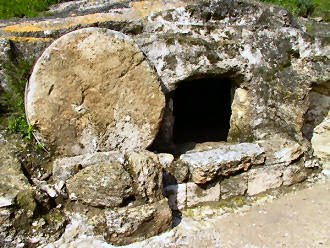
The shame, injustice, disappointment and death of the past 30 years is not scrubbed clean in the end. Rather it is woven into something grander through the actions of the protagonists as they have a chance to redeem the past. it might seem a bit simplistic but how very trinitarian it all was! The protagonists immersed in a history of failure, without a happy ending in sight most of the movie, in fact a sense of a second grade movie for most of its duration, comes to a surprising ending that sheds light on all that has gone before. The resurrection of Jesus (and all that it implies in terms of the kingdom of redemption) is that surprising ending. Redemption is possible, without justifying the failure and its suffering, yet weaving the disharmony into a beautiful concerto. Faith sees it, although dimly at times. Yet when the story reaches its climax its graininess will be transformed and woven into the beauty of the story of the crucified-risen Christ.
Tuesday, 6 April 2010
Rowan Williams on Augustine (Quote)

Undoing some cheap and easy criticisms of Augustine from Rowan Williams. I cut this from Ship of Fools...
What everyone remembers, of course, is the things you got wrong – or the things we're quite sure you got wrong.How you painted yourself into a corner over predestination, God deciding before all time who was to go to heaven and who not. And women; we get very indignant that you had difficulty believing that women were really in God's image as much as men. We forget that this is what you did believe, and how difficult it was for you to square this with what everyone else in your age thought.
And we blame you for messing up Christian attitudes to sex, because for you it was an area of humiliation and tragedy – forgetting, again, that you truly thought sex between husband and wife had something of heaven in it.
We look for a scapegoat to explain why Western Christianity and Western civilization are so much of a mess. You wrote such a lot and so powerfully that I'm afraid you're a very good candidate for the position. But I think you would have turned around and challenged us: why the passion for a scapegoat? What are you refusing to look at in yourself?
In the City of God you explained the mechanisms: we're not sure in ourselves what we really love and value; we invest all our expectations in people and solutions inside this world, and they let us down cruelly. We feel restless and insubstantial because we don't know how and what to love. So we give ourselves a false solidity by pushing the darkness, the doubt and evil out there, projecting it onto some other person, some other group.
We get our solid identity from denying our own poverty and incompleteness. When I was teaching students about the City of God, I felt I really began to understand the Cold War.
So we can't learn to love unless we let go of the longing for solid, fixed identity. We start to grow up not when we become independent, but when we recognize that we shall always need the words and actions of others to give us life – and when we face that fact without resentment or shame.
Behind it all is the recognition that the only reason there is anything at all is the pure act of generosity that creates the world – it doesn't have to be there, God doesn't have to make it, but he wants his joy shared. When we know that, we know ourselves – not by introspection, because I shall always lie to myself about my motives, but by looking to the love that made me and remakes me.
Not a scapegoat, then, but someone who's taught me what I hope is the right kind of scepticism about myself and the world of power around me – and the right kind of trust in my maker.
Monday, 15 March 2010
Addicted to Anxiety (Quote)
Thursday, 11 March 2010
Jesus and the Practice of Reconciliation
A guest post from the Revd Ron Keynes
I had the experience of preparing a young married woman for Confirmation,. She was married to a man who was somewhat bitterly atheist insisting that the classes be held at their home so that he could have the opportunity of decrying all the Christian baloney that he expected to be presented to the candidates. It made life hard for the several other adults in that group, though it was something of a steep learning curve for them. As each gathering dealt with various issues, he began to have his say, and then there was a chance for our views to be presented. I remember quite vividly the situation when it came to discussing the Story of the Fall, and the underlining of the fact that even Hebrew faith was dealing with what tends to be called the human dilemma, that this young man started to listen. When it came to the Cross and reconciliation, the husband began to see that, not only did the Faith present a response to an issue to fundamentally human, but also had a significant answer, that the bellicose responses began to assuage.
It was not long after that, that the same man stopped me in the street one Saturday morning, and asked if it were possible for him to change sides! You can imagine the delight of the wife to find that her husband would be confirmed alongside of her; you can imagine my own delight more than 30 years later, to be told that both those two had continued on their Christian pilgrimage! It was not ‘religion’ that convinced that young man, but the relevance of the reconciliation process.
After a lifetime of preaching, teaching and Bible Study – and exploring the wonderings of other people, it has been an interesting business when one finds that other people, much older and wiser, had been seeing things the way that had been occurring to me also. I remember, in College, having been stunned to read a book by Bishop Stephen Neil, then a Bishop in the Indian Church, underlining the strong point of contact between Christian Faith and Muslim, Hindu and Buddhist people was just this business of reconciliation. I had been concerned about the apparent oddity that the Christianity of the time and place where I grew up was more concerned with ‘personal holiness’ and seemed to produce little other than a refined form of selfishness.
If there is one huge and overwhelming issue that dogs the whole history of this planet, (and seems to be moving towards a drastic and destructive goal,) it is that human dilemma that seems to parallel ‘Murphy’s Law.’ Hatreds between individuals, groups and cultures – yes and even religions – manage to produce constant crops of destructive outbursts and wars, exacerbating the terrible conditions under which millions of people live. Greed and selfishness have people and people set at conflict with each other, with no regard given to the opposition. They are there to be destroyed. And the millennia of human history attest to the constant breaking out of such terror.
(There will be those who will cheer at these words, certain in their own minds that the great cause of this trouble lies at the feet of religion. That rather stupid and cheap shot may have some currency when it has to be said that there are those people on the lunatic fringe who provide enough examples establish the case in a way. However, the reality lies in the fact that those who indulge in such ugliness have distorted whatever Faith it is they profess, and in doing so have rendered their subject unrecognizable. There never has been any guarantee that humans will profess properly the Faith they ‘own,’ and distortions are far too common and damaging.)
Should there be some answer to this tragic state of affairs, then one would have thought that the person who invented the solution would make the traditional millions. The greater tragedy is that Someone has, whilst having no interest at all in the possible profit. But too many of His followers can only see that Jesus has saved them from Hell when in reality that Lord of ours offers answers to a far more immediate threat anyhow.
Read the Bible (dare I say it) sensibly and you will see that it is precisely this issue that is the focus from start to finish. From Genesis 3 and its diagnosis of the human ill, to Revelation which offers a goal to the people of the late First Century, who had the challenge of failing to see Jesus as Lord, because all the blandishments of Rome and commerce was blinding them to rather lesser goals. Genesis 3 is actually pointing up the fact that the real problem with us humans is, to put it in the Biblical terminology that we all want to be God and rule the rest of you. Those ancient authors were far from silly, and were certainly not naive. Actually, it is stunning to see that people of such a remote and unsophisticated (?) period of history had the insight to see the real issues.
Both the Old Testament prophets, (Isaiah in particular) realized and articulated the need for Someone to show the way, in real life and in real time. Isaiah 53 – one of the Servant Songs – doesn’t get the picture entirely right, but it is a clear and remarkable insight into resolution of the problem. And Jesus lived it, in life and on the Cross, showing the costly but effective path to reconciliation: and that much of that cost would have to be borne by the reconciler, not the offender. Here, of course, lies one of the real reasons why the ‘Jesus’ approach to reconciliation has tended to be disregarded. Humans are far less willing to follow in a direction that would seem to be rather demeaning to a proud person. But that is rather the point: pride is one of the great barriers to reconciliation, because ‘I prefer to blame the party of the other part,’ and that blocks the process.
Neither time nor space permits a complete look at this, but it is important to realize that the Cross of Christ is not just there to provide me with forgiveness. It is there as the process, par excellence, that restores the peace, provides justice and enables people to get along together regardless of what lies behind them.
Monday, 8 March 2010
Theology Begins When ... (Quote)
Theology begins with an unwillingness to believe that the reality of human beings and human society can be fully explained solely in material terms. Its agenda and subject matter is the exploration of how an openness to a different or fuller explanation of those realities is best articulated and an exploration of how the consequences of such openness bear upon individuals and society, their beliefs, the axioms and principles of social conduct and responsibility. Theology in the specific sense of God-talk is a particular subset of that exploration — the theistic premise regarded as the most appropriate starting point to construct a positive alternative to the purely materialistic explanation of what is — though the openness in many cases will include an openness to the possibility that the theistic premise is itself wrong or misleading’. (Jimmy Dunn)
I pulled this quote from Jason's blog again. He cut this from an interview with Dunn. For links to other great figures in theology check out the full post.
Wednesday, 3 March 2010
The Hollowness Within (Quote)
That hollowness we sometimes feel is not a sign of something gone wrong. It is the holy of holies inside of us, the uncluttered throne room of the Lord our God. Nothing on earth can fill it, but that does not stop us from trying. Whenever we start feeling too empty inside, we stick our pacifiers into our mouths and suck for all we are worth. They do not nourish us, but at least they plug the hole. Barbara Brown Taylor